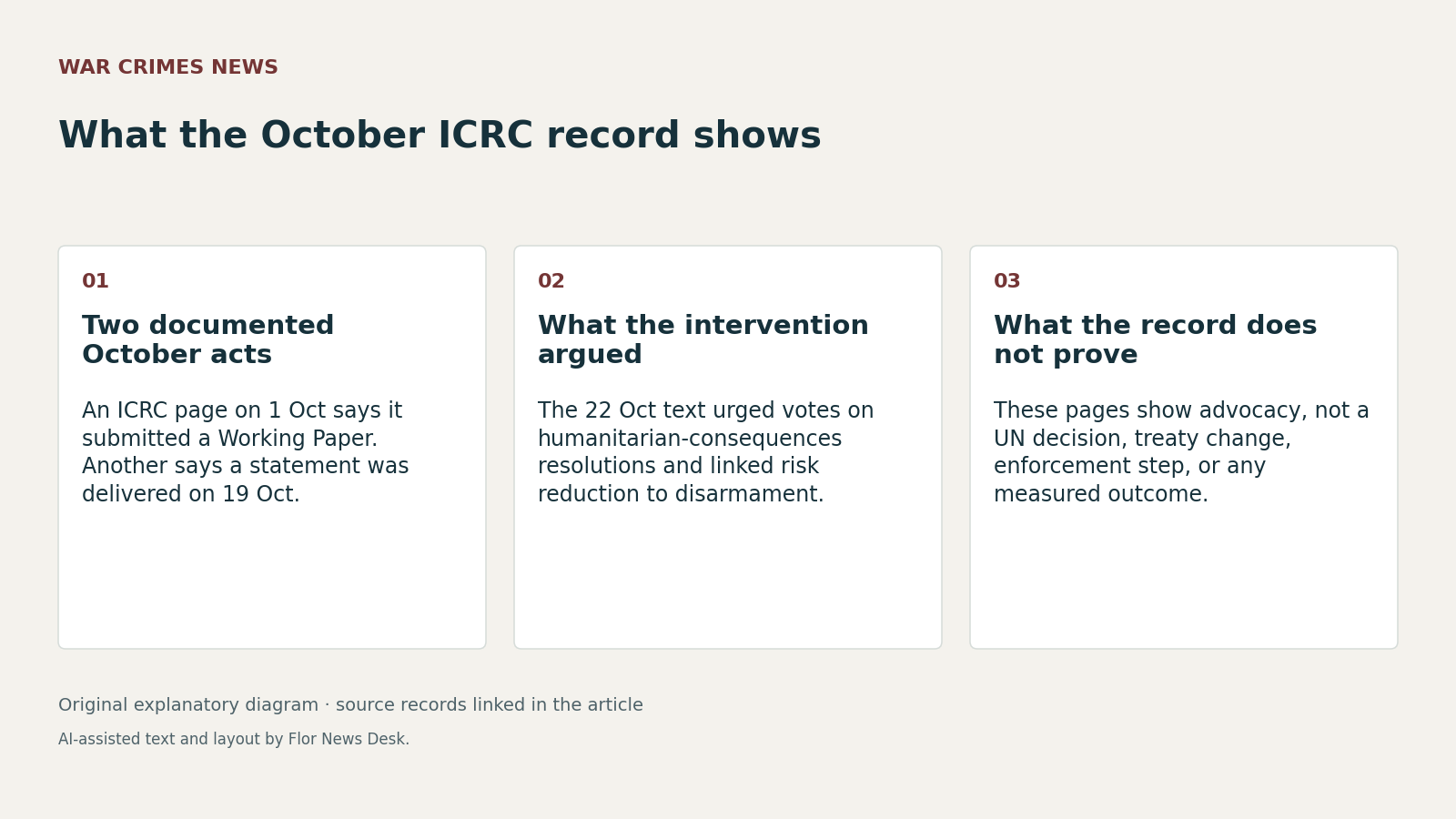
On 1 October 2026, the International Committee of the Red Cross said it had submitted a Working Paper to the UN General Assembly’s First Committee on Disarmament and International Security at its 81st session. On 22 October 2026, it published an abridged text that it said had been delivered on 19 October 2026 during the Committee’s thematic discussion on nuclear weapons. Taken together, those records establish a documented expansion of the ICRC’s public engagement in that forum. They do not, on their own, establish any new legal obligation, UN decision or accountability mechanism. Working Paper page Nuclear-weapons statement
The narrow but important point is institutional. The 1 October page says the Working Paper set out the ICRC’s views and recommendations on the main disarmament issues before the Committee and that the organization wanted humanitarian disarmament and civilian protection kept central to the Committee’s work. A separate ICRC statement published on 14 October said the organization had already submitted that paper and identified nuclear weapons and autonomous weapon systems as two especially pressing concerns. That shows continuity between the paper and later oral advocacy, even though the available record summarized here does not provide the full Working Paper text. Working Paper page 14 October statement
The more distinct October step was the ICRC’s direct intervention in the nuclear-weapons cluster. According to the 22 October page, the ICRC said it had decided to address that cluster for the first time. In the abridged text, it argued that the humanitarian consequences of any nuclear-weapon use should shape both immediate risk-reduction efforts and longer-term disarmament, urged states to back First Committee resolutions on humanitarian consequences, and reiterated that the ICRC and the wider International Red Cross Red Crescent Movement support the Treaty on the Prohibition of Nuclear Weapons. That matters because it places the ICRC’s humanitarian-law framing inside a live UN debate among states, rather than only in broader public advocacy. Nuclear-weapons statement
The same statement also connected the ICRC’s intervention to two other institutional tracks: a UN General Assembly-established Independent Scientific Panel on the Effects of Nuclear War, and a World Health Assembly decision to update World Health Organization reporting on the health and environmental effects of nuclear weapons. On the face of the record, those references strengthen the ICRC’s argument by linking humanitarian law concerns to scientific and public-health processes. But they do not convert the ICRC intervention into a judicial finding or a treaty interpretation binding on states. Nuclear-weapons statement
The limits of the evidence matter as much as the intervention itself. The 1 October page is an ICRC summary page, not the Working Paper text, and the briefed record says it does not show a separate submission date, any action by the First Committee, any state response, or any legal effect. The 22 October text is expressly an abridged ICRC statement, not a neutral full transcript. The 14 October statement also included forward-looking timing about a nuclear-weapons discussion the following week; only the later 22 October page supplies the asserted delivery date of 19 October. For accountability reporting, that means the October documents prove participation and advocacy by the ICRC, but not acceptance, implementation or enforcement by anyone else. Working Paper page Nuclear-weapons statement 14 October statement
That distinction is the story. The October record shows the ICRC choosing a more explicit place in UN nuclear-weapons debate and tying that move to humanitarian consequences and civilian protection. What it does not show is any completed change in law, any agreed state outcome, or any new route to individual or state accountability. Readers should treat these pages as evidence of a sharpened institutional pitch, not of a settled legal result. Working Paper page Nuclear-weapons statement