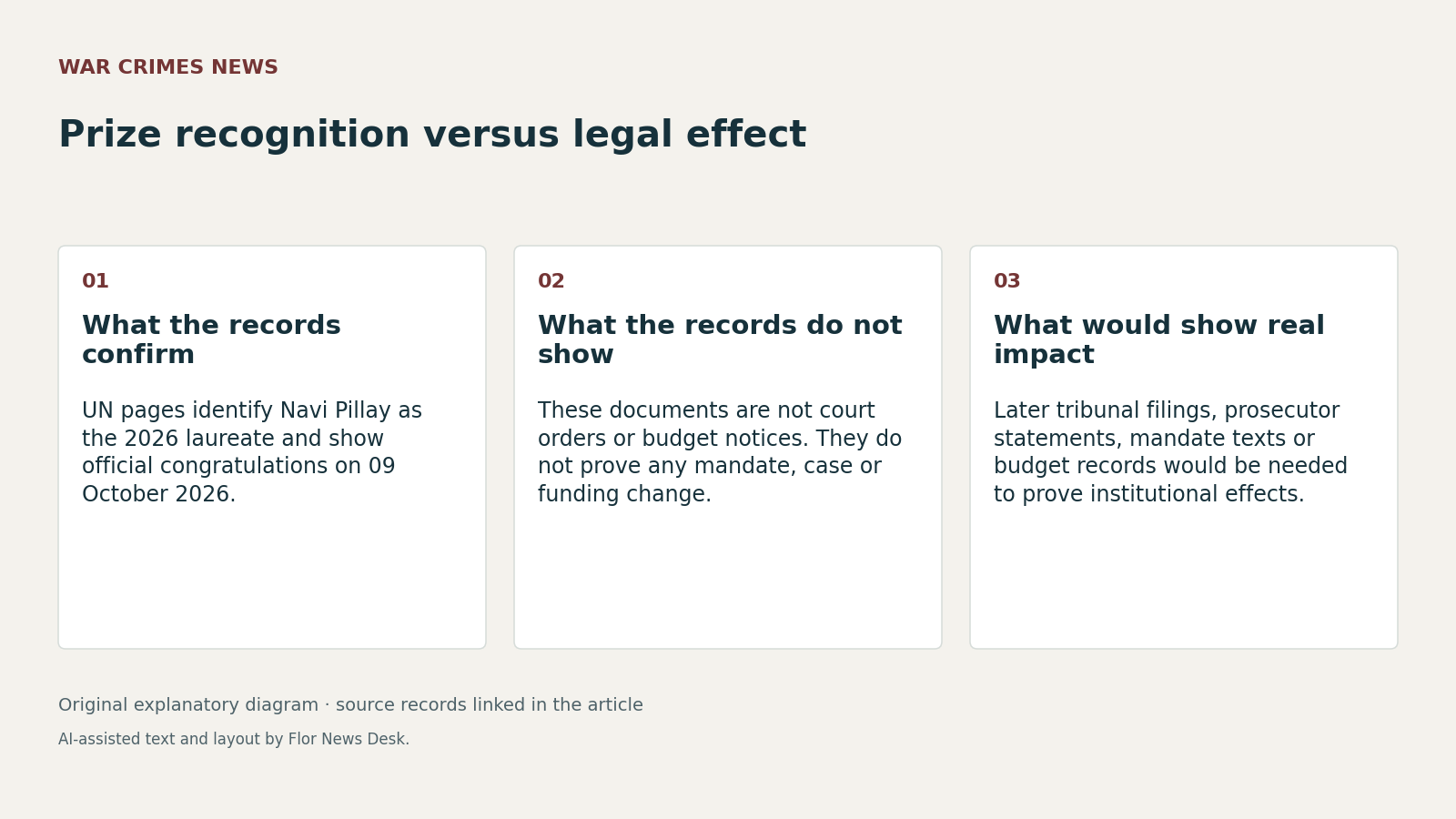
Navanethem “Navi” Pillay’s 2026 Nobel Peace Prize is already visible in UN public records, but the documentary effect is narrower than the symbolism. As of 13 October 2026, the source set establishes that UN channels presented Pillay as the year’s laureate and that senior UN offices publicly congratulated her. It does not establish any new judicial order, prosecutorial act, mandate revision or funding decision in the international justice system.UN profile UN in South Africa release UN Web TV schedule
The most direct record in this set is a UN page identifying Pillay as the 2026 Nobel Peace Prize recipient and attributing the award rationale to the Norwegian Nobel Committee.UN profile The same page presents the institutional biography the UN wants readers to connect to the prize: service at the International Criminal Tribunal for Rwanda, including as president; a judgeship at the International Criminal Court from 2003 to 2008; and a term as UN High Commissioner for Human Rights from 2008 to 2014.UN profile It also says she chaired the UN Independent International Commission of Inquiry on the Occupied Palestinian Territory, including East Jerusalem, and Israel from 2021 to 2025.UN profile But that page shows no publication date, and it is not the Norwegian Nobel Committee’s own announcement. For readers tracking accountability institutions, that means the page is strong evidence of UN recognition, not the primary award instrument.
A second document, a United Nations in South Africa release dated 09 October 2026, confirms that one UN country office treated the prize as a major institutional event the same day.UN in South Africa release The release describes the award as recognition for Pillay’s work on human rights, international law, justice and accountability, and says the office joined the Secretary-General in congratulating her.UN in South Africa release That is evidence of coordinated public endorsement. It is not evidence that any court, prosecutor or investigative mechanism changed course because of the prize.
The third record adds timing, not legal consequence. The UN Web TV schedule for 2026-10-09 lists a media stakeout by High Commissioner Volker Türk on Pillay receiving that year’s Nobel Peace Prize, a Security Council stakeout by Secretary-General António Guterres congratulating the winner, and the UN daily press briefing with Nobel and ICC topics on the agenda.UN Web TV schedule Because this is a schedule page rather than a transcript, it establishes that those appearances were publicly listed in New York time. It does not, by itself, establish the full substance of each remark or any follow-on decision.UN Web TV schedule
That distinction matters. From these records alone, the immediate measurable effect is communicative: UN institutions used the award to spotlight Pillay’s career and to restate support for rule-of-law values.UN profile UN in South Africa release Analysis can go one step further without overstating the evidence: when multiple UN channels elevate the same figure on the same date, they help set an accountability agenda for diplomats, advocates and journalists. But the present record does not show that the prize altered jurisdiction, reopened a case, extended a mandate, unlocked money or bound any prosecutor.UN profile UN in South Africa release UN Web TV schedule
The next reporting step is therefore straightforward. To test whether the Nobel award has institutional consequences, reporters would need later primary records of a different kind: the Nobel Committee’s own citation text, tribunal or court press pages, prosecutor statements, mandate documents, or budget notices. None of those outcomes is established in the cited UN pages. For now, the verified story is significant but limited: a laureate associated with major accountability institutions received one of the world’s most visible honours, and the UN moved quickly to frame that recognition in its own public record.UN profile UN in South Africa release UN Web TV schedule