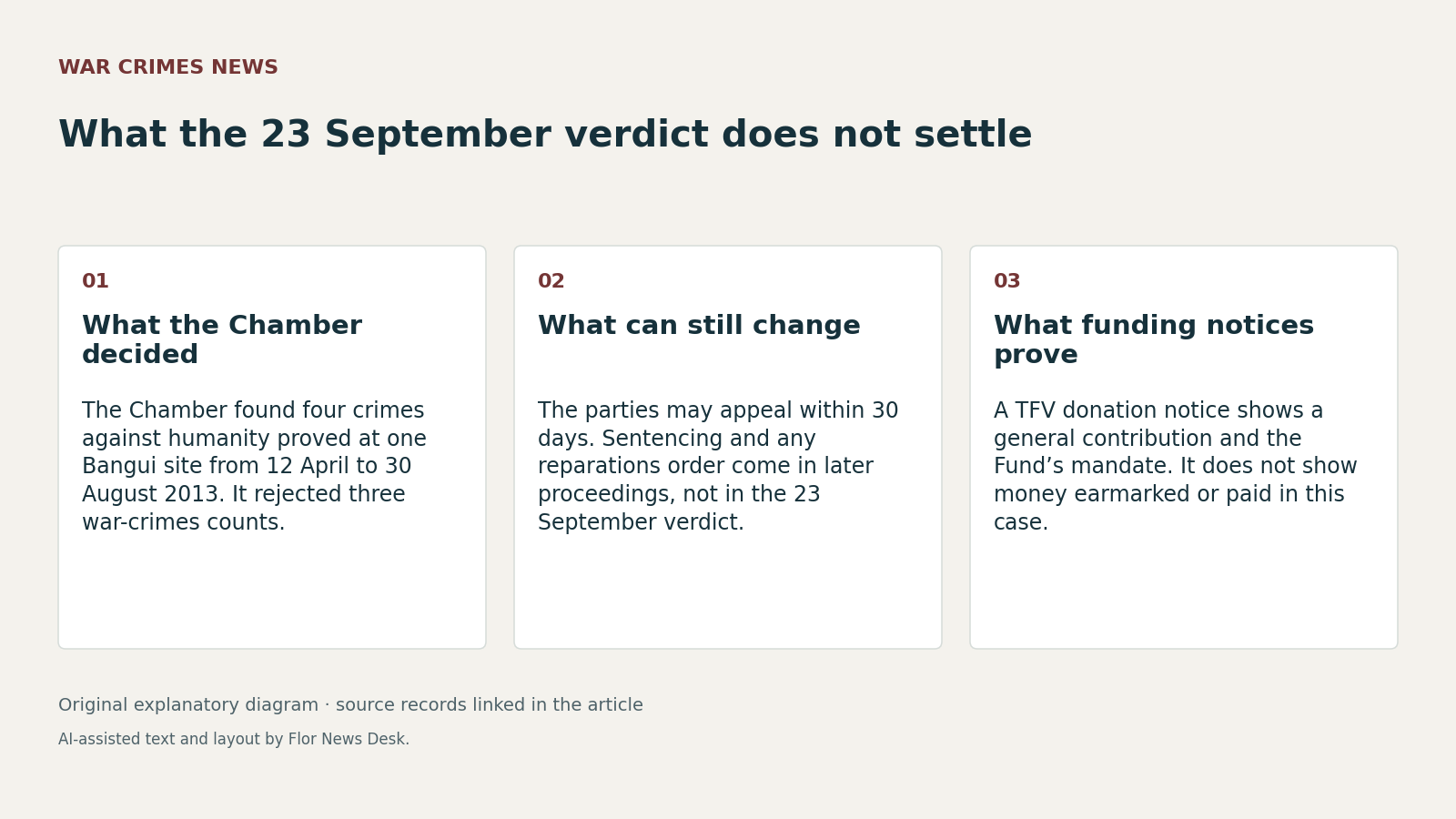
On 23 September 2026, ICC Trial Chamber VI found Mahamat Said Abdel Kani guilty beyond reasonable doubt of four crimes against humanity: imprisonment or other severe deprivation of physical liberty, torture, persecution, and other inhumane acts. The court’s summary says those crimes were committed at the Office Central de Répression du Banditisme in Bangui between 12 April and 30 August 2013, and that Said was convicted as a direct co-perpetrator linked to his role as the Seleka commander there (ICC news release; ICC case page). The Chamber did not find him guilty beyond reasonable doubt of the war crimes of torture, cruel treatment, and outrages upon personal dignity (ICC news release; ICC case page).
That means the verdict is both substantial and limited. It establishes criminal responsibility for a defined set of crimes, at a defined place, over a defined period. It does not, on the reviewed record, amount to a general judicial finding about every allegation tied to the Séléka in the Central African Republic. The ICC case page also shows how narrow the court file remained despite its duration: a sealed arrest warrant on 7 January 2019, surrender on 24 January 2021, confirmation proceedings in October 2021, and trial opening on 26 September 2022 before the judgment on 23 September 2026 (ICC case page).
The Office of the Prosecutor’s statement adds context, but it should not replace the Chamber’s own formulation. The Prosecutor said Said was the first senior Séléka member tried before the ICC and described civilians perceived as supporters of President François Bozizé being targeted on discriminatory grounds, including religion, ethnicity, gender, political background, profession, and domicile (OTP statement). It also described the case as covering crimes committed between May and August 2013, while the court’s own summary and case page specify 12 April to 30 August 2013 (OTP statement; ICC news release). Without the full judgment in the source set, that discrepancy should be preserved, not harmonised.
The immediate legal consequence is not a completed case, but a new procedural phase. The court says both sides may appeal within 30 days of the verdict, sentencing will be decided later, and a reparations process will begin for victims of the crimes of conviction (ICC news release; ICC case page). In the source records reviewed on 27 September 2026, there is no identified appeal filing, sentencing date, or reparations order. The court’s news release says the trial involved 130 hearings, 3,863 admitted items of evidence, and 32 participating victims, while the Prosecutor separately described relying on 81 witnesses and more than 2,500 items of evidence (ICC news release; OTP statement). Those figures describe different parts of the record, not a settled outcome on sentence or remedy.
The reparations question is especially easy to overstate. A 18 September 2026 Trust Fund for Victims notice says New Zealand made an unrestricted voluntary contribution of EUR 123,180, that the Fund’s mandate covers both ICC-ordered reparations and assistance programmes, and that its annual funding target is at least EUR 10 million (TFV notice). But that notice does not connect the contribution to Said, to the Central African Republic, or to any future order in this case. It records announced funding to the Fund, not money allocated or paid to victims here.
That leaves an important boundary around what can be said after 23 September. The verdict fixes a legal record against one defendant for four crimes against humanity at one site in Bangui. The reviewed records do not establish whether appeals will be filed, what sentence will follow, what reparations form the judges may order, or what resources and cooperation will actually be available to carry those measures out. Those are now the documents worth watching, not assumptions drawn from the conviction alone.