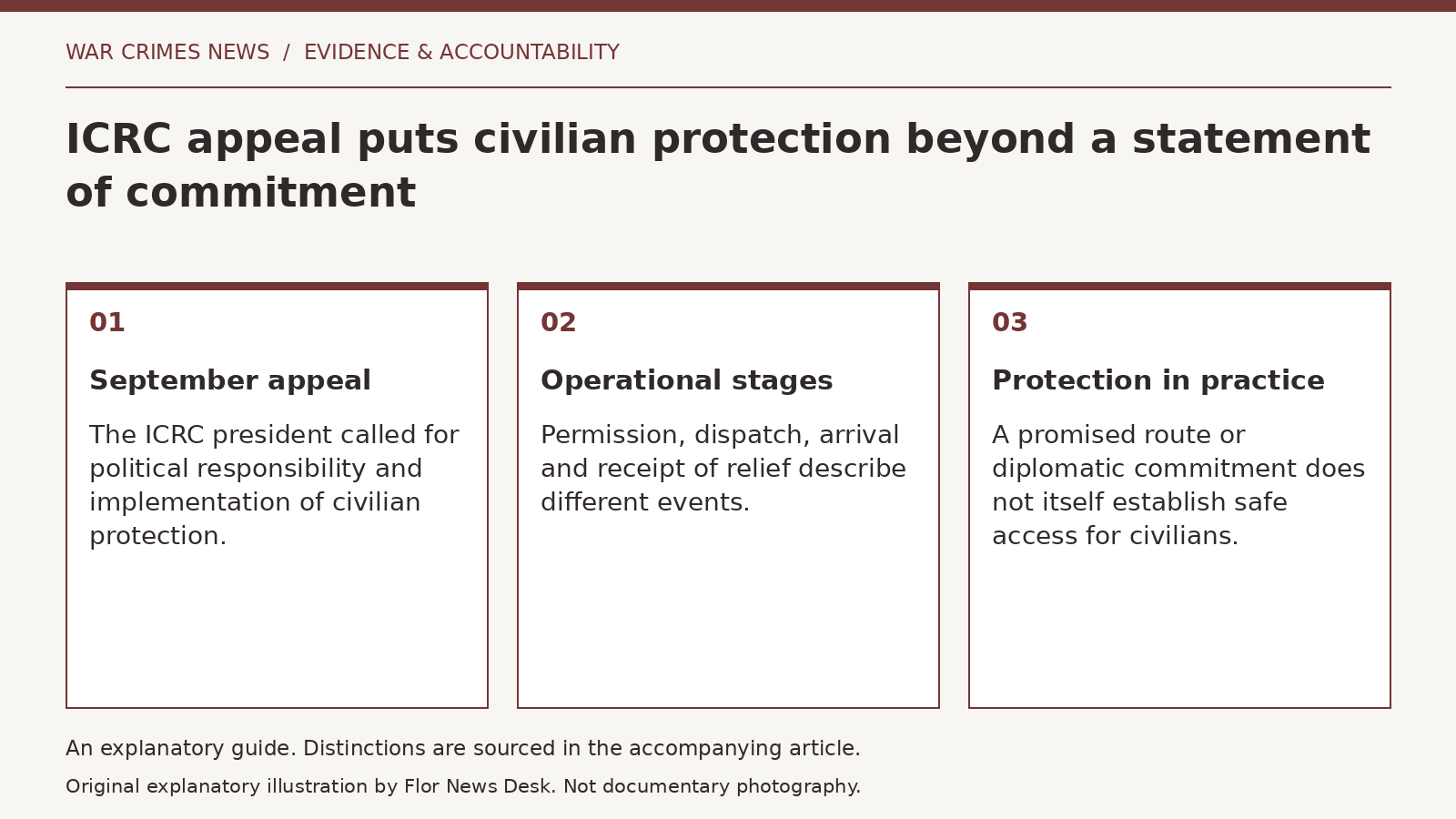
ICRC president Mirjana Spoljaric called for political responsibility for the protection of civilians in a September 21, 2026 statement associated with the UN General Assembly. Her published remarks argue for commitments to humanitarian law to be translated into conduct. That is the institution’s stated appeal, not a finding that a new diplomatic agreement has already changed conditions on the ground.
The distinction is between an announced intention and an observed result. A commitment can provide a standard against which later conduct is examined. It cannot serve as its own evidence that the intended protection occurred.
Follow the relief effort through its stages
Imagine a fictional relief operation in which permission is announced for supplies to move. The announcement establishes a decision at one stage. Departure records, arrival records and evidence that civilians received the supplies would address later stages. None should be silently inferred from the first announcement.
A count of dispatched vehicles would also answer a different question from the amount reaching an intended population. This example does not allege diversion or obstruction in an actual operation. It explains why a measure must be matched to the event it describes.
The ICRC’s explanation of civilian protection during sieges states that starving civilians as a method of warfare is prohibited and describes obligations applying to both besieging and besieged parties. It also explains protection for civilians leaving an area and duties concerning those who remain. These general rules are not an adjudication of a particular siege.
Access and safety need evidence
In the fictional operation, a route being announced would not establish that every civilian could safely use it. Conditions at the relevant time and the experiences of people affected would require separate examination. A public label such as corridor cannot substitute for that evidence.
The September speech and the earlier legal explainer perform different roles: one advances an institutional appeal, while the other describes the ICRC’s account of applicable protection. Neither supplies a complete operational record for a named conflict.
Reporting the appeal accurately therefore means preserving its prospective purpose. The question for later reporting is what changed in actual conduct and access, for whom and when. Declaring that civilians were protected solely because protection was promised would replace that inquiry with an unsupported conclusion.