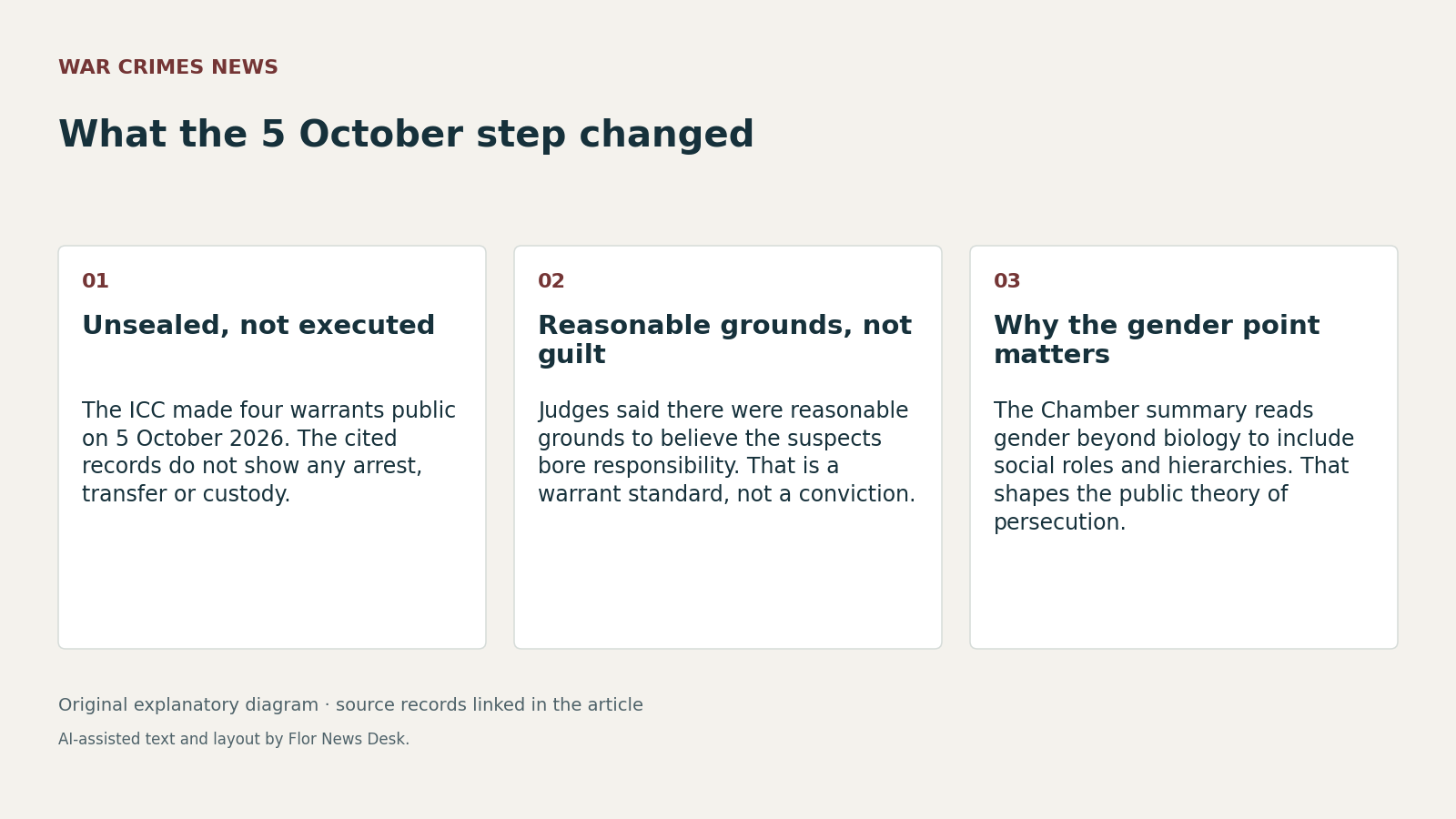
On 5 October 2026, ICC Pre-Trial Chamber II unsealed four arrest warrants in the Afghanistan situation, making public orders originally issued on 8 July 2025 and 9 September 2025 against Haibatullah Akhundzada, Abdul Hakim Haqqani, Habibullah Agha and Neda Mohammad Nadim. The Chamber said there were reasonable grounds to believe the four were criminally responsible for ordering, inducing or soliciting persecution as a crime against humanity on gender and political grounds in Afghanistan from the Taliban takeover on 15 August 2021 until at least 20 January 2025. That establishes a judicial warrant stage, not an arrest or a finding of guilt. ICC chamber release
What changed on 5 October 2026 was partly legal visibility, not the existence of the first two warrants. The Court says the Akhundzada and Haqqani warrants had already been made public on 8 July 2025, when the Office of the Prosecutor said judges granted applications filed on 23 January 2025. The new public record is that four warrants, including the later September 2025 orders, are now unsealed together. ICC chamber release OTP 8 July 2025 statement
The most consequential point for future Rome Statute argument may be the Chamber's stated reading of gender. According to the court summary, the statutory term reaches beyond a purely biological view of sex and includes socially constructed roles and hierarchies associated with sex. Read alongside the prosecutor's 23 January 2025 description of alleged Taliban persecution against girls and women, people seen as not conforming to Taliban expectations on gender identity or expression, and people seen as supportive of girls and women, the public record shows judges accepted a broader persecution theory at the warrant stage. The cited documents do not show any contested hearing or merits judgment on that interpretation. ICC chamber release Prosecutor applications statement
The warrants also sit inside a larger Afghanistan investigation than the October 2026 announcement alone suggests. The ICC victim-information page says the Appeals Chamber authorised an investigation on 5 March 2020, Pre-Trial Chamber II authorised its resumption on 31 October 2022, and the Appeals Chamber on 4 April 2023 aligned the scope with crimes in Afghanistan since 1 May 2003 and some linked crimes in other States Parties since 1 July 2002. The prosecutor's 8 July 2025 statement said its Afghanistan Unified Team had been investigating alleged Taliban crimes against Afghan civilians and that the investigation remained focused on alleged crimes by individual members of the Taliban and Islamic State – Khorasan Province. Victim information page OTP 8 July 2025 statement
The evidence picture in public remains thin. The January 2025 prosecutor statement said the applications relied on expert and witness testimony, official decrees, forensic reports, statements by suspects and other Taliban representatives, and audio-visual material, but none of those underlying items is in the cited public record. Timing also needs care: the January 2025 statement described conduct as ongoing as of its own publication date, while the later chamber summary and ICC victim page refer to crimes believed committed until at least 20 January 2025. Those passages do not establish what happened after that date. Prosecutor applications statement ICC chamber release Victim information page
That leaves enforcement, not interpretation, as the clearest unresolved issue in the sources. On 8 July 2025 the prosecutor's office said it would work with the Registry and states toward execution of the warrants, but the statement did not show any result. The ICC victim-information page says the Court has no police or executive force and depends on cooperation from States Parties and, where invited, non-States Parties. As of the 5 October 2026 unsealing, the cited record establishes public warrants and the Chamber's legal reasoning, but not arrest, surrender, transfer or any domestic measure taken to help carry them out. OTP 8 July 2025 statement Victim information page ICC chamber release