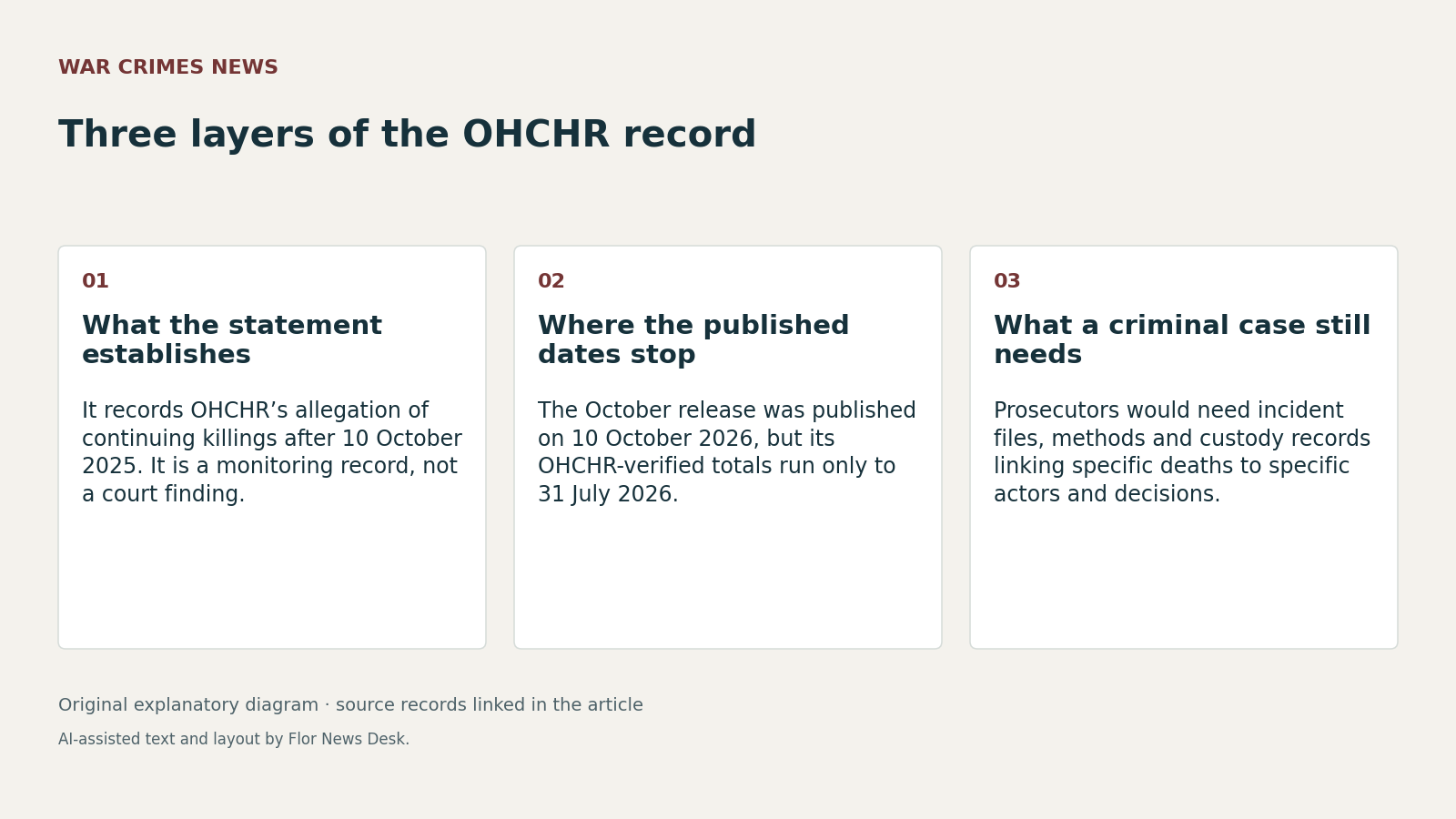

On 10 October 2026, the UN Human Rights Office in the Occupied Palestinian Territory published a statement marking one year since the 10 October 2025 ceasefire announcement and said Palestinians in Gaza were still being killed in reported Israeli attacks. It further said the pattern raised concerns about continued crimes under international law, including war crimes. That is a significant institutional record because it places a dated UN warning after the ceasefire announcement. It is not, by itself, a judicial finding or a finished criminal brief. 10 October 2026 OHCHR statement
The statement matters partly because it separates two different kinds of numbers. It attributes to the Palestinian Ministry of Health a figure of more than 1,400 Palestinians killed in Gaza since the 10 October 2025 ceasefire announcement, while also saying OHCHR had verified 1,076 conflict-related deaths between that announcement and 31 July 2026, including 268 children, 126 women and 682 men. It also says OHCHR had verified 331 Palestinians killed near the so-called yellow line by 31 July 2026. Those distinctions are important: an attributed ministry total is not the same as an OHCHR-verified count, and the OHCHR verification in this release stops more than two months before its publication date. 10 October 2026 OHCHR statement
The closest earlier OHCHR benchmark in the source record is its 10 April 2026 press release, issued six months after the same ceasefire announcement. That release said Palestinians across Gaza remained unsafe, attributed 738 deaths since 10 October 2025 to the Palestinian Ministry of Health, and said at least 32 people had been killed by Israeli forces since early April 2026. Read together, the April and October releases show OHCHR describing continuing danger over time, not a single episode. But they still do not establish whether the pattern intensified, narrowed or changed after 31 July 2026, because the October release does not publish OHCHR-verified figures for August, September or the first 10 days of October. 10 April 2026 OHCHR press release 10 October 2026 OHCHR statement
For accountability purposes, the gap between a monitoring statement and a prosecutable case remains large. A criminal case would still need incident-level proof about who fired, what was targeted, what precautions were taken, and how investigators can authenticate physical and digital evidence. Neither public release sets out full methodology, underlying evidentiary files or chain-of-custody detail. That does not make the statements unimportant. It means their strongest value is as an institutional record of what OHCHR says it had documented by specific dates, not as proof already ready for conviction. 10 October 2026 OHCHR statement 10 April 2026 OHCHR press release
The October release gives examples of patterns that could matter in later legal analysis. It says OHCHR had verified 64 children killed in reported Israeli attacks in which only children were killed, and another 30 women and 10 children killed in reported attacks in which all fatalities were women or women and children with no men among the dead. The April release separately said Israeli forces continued to kill Palestinians for their proximity to the so-called yellow line. Those patterns can help frame questions about distinction, precautions and repeated risk zones. They do not, on their own, answer case-specific questions about intent, military objective or the reliability of each underlying incident file. 10 October 2026 OHCHR statement 10 April 2026 OHCHR press release
The practical implication is narrow but important. As of 10 October 2026, the public UN record cited here supports saying that OHCHR was still alleging ongoing killings in Gaza a year after the ceasefire announcement. It does not support saying that OHCHR had publicly shown every incident needed for criminal responsibility, or that its October publication date proves verified outcomes through October. For future accountability, the decisive next step is not another broad warning but access to the incident records behind it.