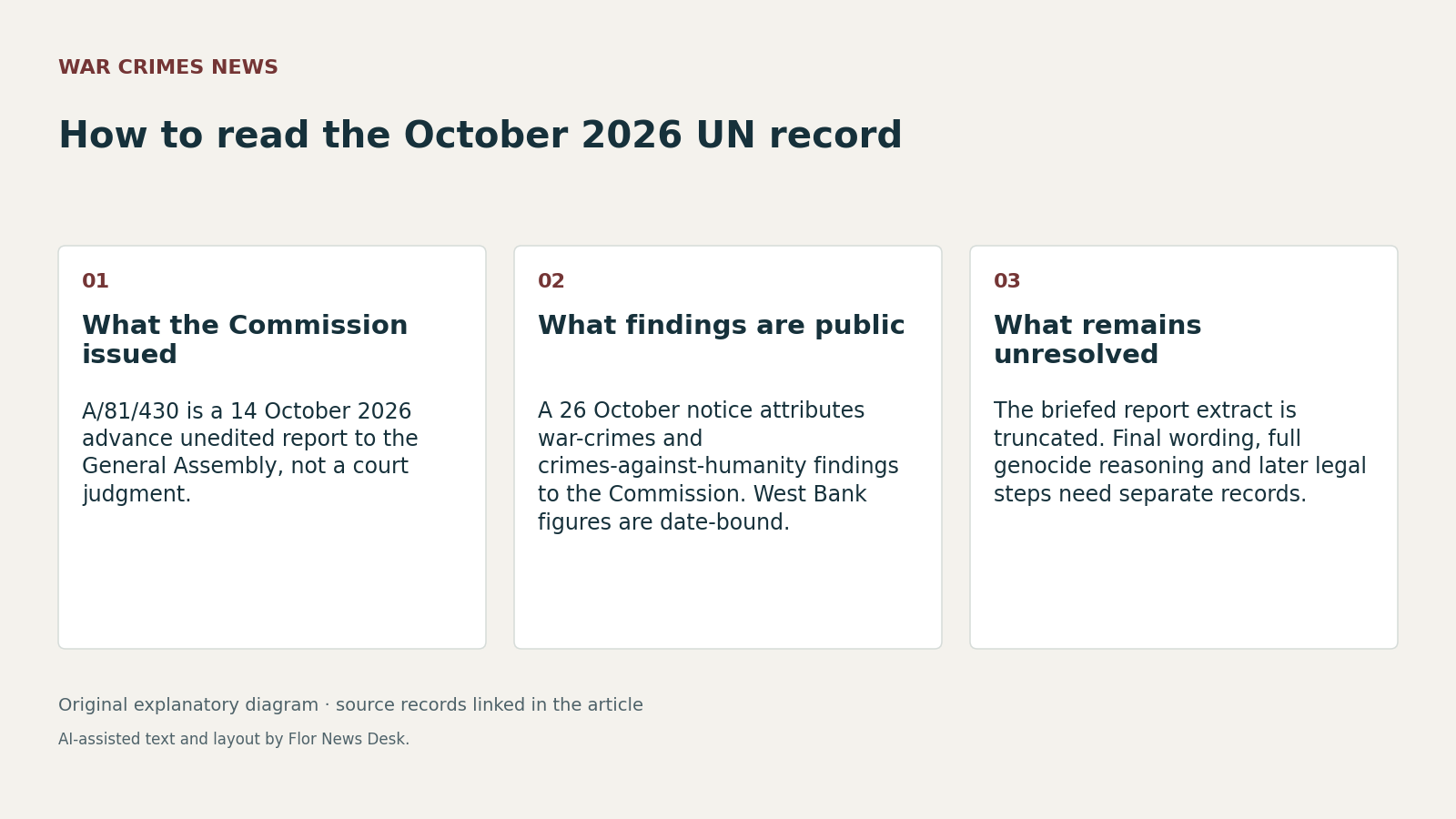

On 26 October 2026, a UN press notice said the Independent International Commission of Inquiry on the Occupied Palestinian Territory, including East Jerusalem, and Israel had found that Israeli state conduct in the Occupied Palestinian Territory amounted to war crimes and to the crimes against humanity of extermination, persecution, torture, rape and other forms of sexual violence UNISPAL press notice, 26 October 2026. The underlying document identified in the brief is report A/81/430, dated 14 October 2026 and labelled an advance unedited version transmitted to the General Assembly A/81/430 advance unedited report. That distinction matters: the available record is a UN-mandated investigative report and a press summary, not a judgment by the International Court of Justice or a criminal verdict by the International Criminal Court.
The report’s stated scope is narrower than a headline alone suggests. In the briefed extract, the Commission describes this as its fifth report to the General Assembly and says it mainly examines killings and bodily and mental harm by members of the security forces of the State of Israel and of the State of Palestine since October 2023 A/81/430 advance unedited report. It also says it used the same methodology and standard of proof as in its previous investigations, issued a call for submissions on 30 September 2025, and sent two requests for information each to Israel and to the State of Palestine; Palestine responded and Israel did not A/81/430 advance unedited report. That response gap does not prove or disprove the findings by itself, but it is part of the evidentiary setting readers should keep in view.
The most concrete material in the brief concerns date-bounded West Bank figures. The report says that between 7 October 2023 and 30 September 2026, Israeli forces killed 1,080 Palestinians and injured 10,940 in the West Bank, including East Jerusalem A/81/430 advance unedited report. The press notice adds a longer comparison: six Palestinians were killed by airstrikes there between 2008 and 6 October 2023, compared with 254 between 7 October 2023 and 30 September 2026 UNISPAL press notice, 26 October 2026. It also says military operations since January 2025 caused the largest displacement of Palestinians in the West Bank since 1967, with 34,176 still displaced as of August 2026 UNISPAL press notice, 26 October 2026.
The same 26 October notice also says the Commission found that the Palestinian Authority targeted Palestinians voicing dissent and failed to carry out effective and impartial investigations into killings UNISPAL press notice, 26 October 2026. That is important because it shows the report, as summarised publicly, is not framed only around Israeli conduct; it also assesses conduct attributed to Palestinian authorities.
Where the record stops is just as important. The press notice’s title refers to “continuing genocide in Gaza,” but the briefed extract of A/81/430 is expressly advance unedited and is truncated mid-analysis UNISPAL press notice, 26 October 2026 A/81/430 advance unedited report. On the material supplied here, readers can safely say that the Commission has issued serious institutional findings and date-specific factual counts. They cannot, from these records alone, reconstruct the report’s full legal reasoning on genocide, treat the report as a court determination, or infer what later prosecutorial or judicial action will follow.
As of 30 October 2026, the accountable reading is therefore a limited one: the Commission has put a formal, though not final-edited, record before the General Assembly. Its findings are consequential. Their legal and practical afterlife still depends on other institutions and on fuller source material than the briefed extract provides.