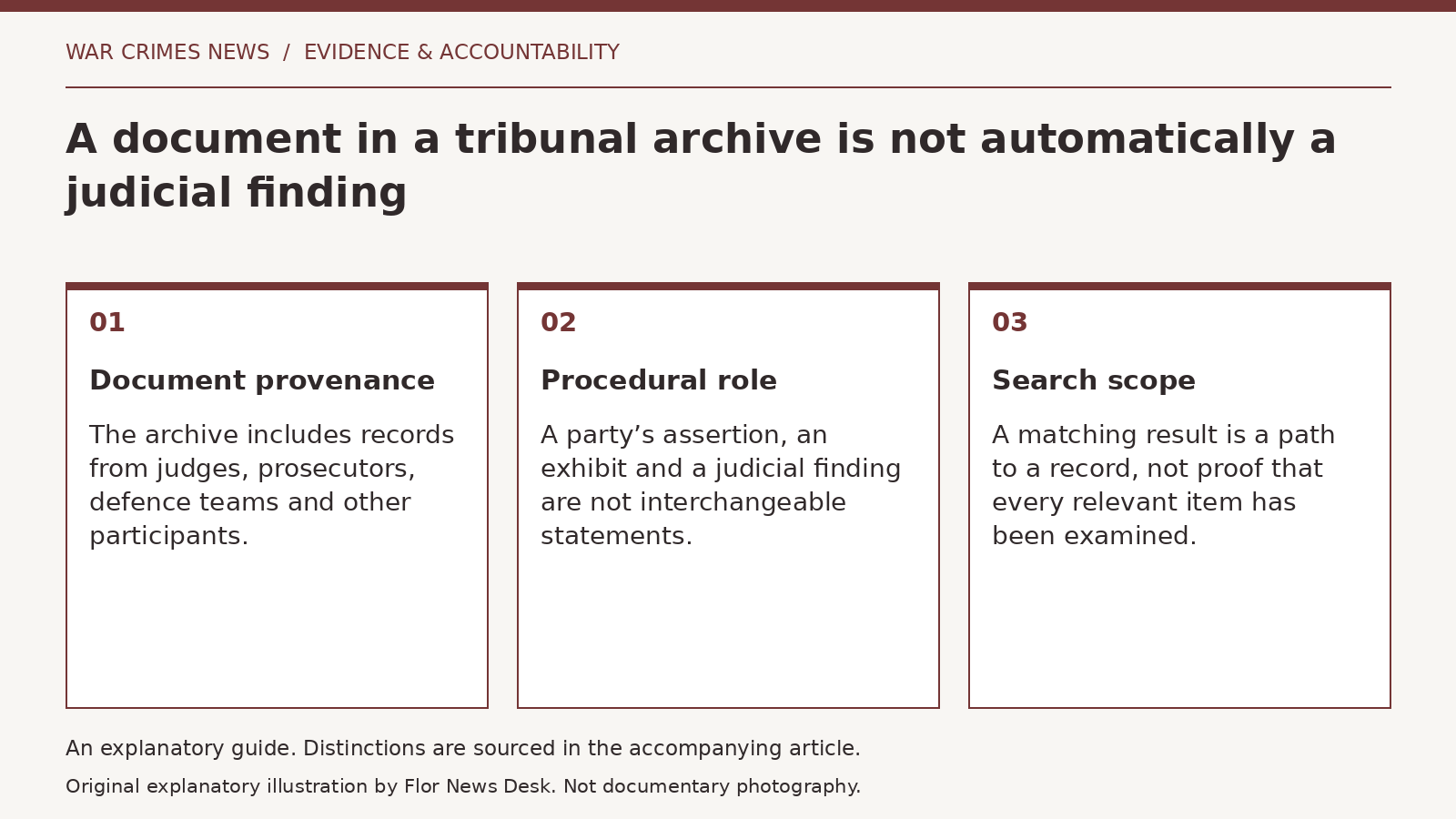
The archives maintained by the International Residual Mechanism for Criminal Tribunals contain material from the Rwanda and former Yugoslavia tribunals and the mechanism itself. Its archive explanation describes judicial records generated by chambers, prosecutors, defence teams, the registry and other participants, alongside exhibits and audiovisual material.
Their presence within one official archive does not make all their statements findings of a court. A party’s submission presents that party’s position. A judgment records a judicial decision. An exhibit and a transcript perform other evidentiary roles. Accurate reporting needs to preserve those distinctions.
Identify the document before quoting it
Imagine a fictional case in which a prosecution filing asserts a date and a defence filing disputes it. Finding both in an official repository would establish that both positions were recorded. It would not resolve the disagreement. A decision addressing the issue would need to be identified and read separately.
The same principle applies to a quotation inside a document. A judge can summarize an argument without adopting it. Removing the surrounding passage could turn a description of a submission into an apparent endorsement. The identity of the speaker and the procedural setting therefore belong with the words being reported.
The mechanism’s Unified Court Records portal provides an entry point to public judicial records and displays sign-in and registration options. This report examines the public portal and archive description only; it does not claim an authenticated search or a complete examination of records behind those controls.
Search results are a route, not a conclusion
A hypothetical search for one phrase could miss documents using another term. A list of matching records would describe what that search returned, not necessarily every relevant item. Without a defined search scope, an absence of a match cannot establish that no relevant record exists.
Likewise, a public archive and an institution’s complete holdings are different scopes. The archive description should not be read as a promise that every protected or restricted item is available to anyone.
The practical reporting standard is to identify the author, document type, date and procedural role before drawing a conclusion from a record. An official repository establishes provenance and a path to material. The content and status of the particular document determine what it can support.