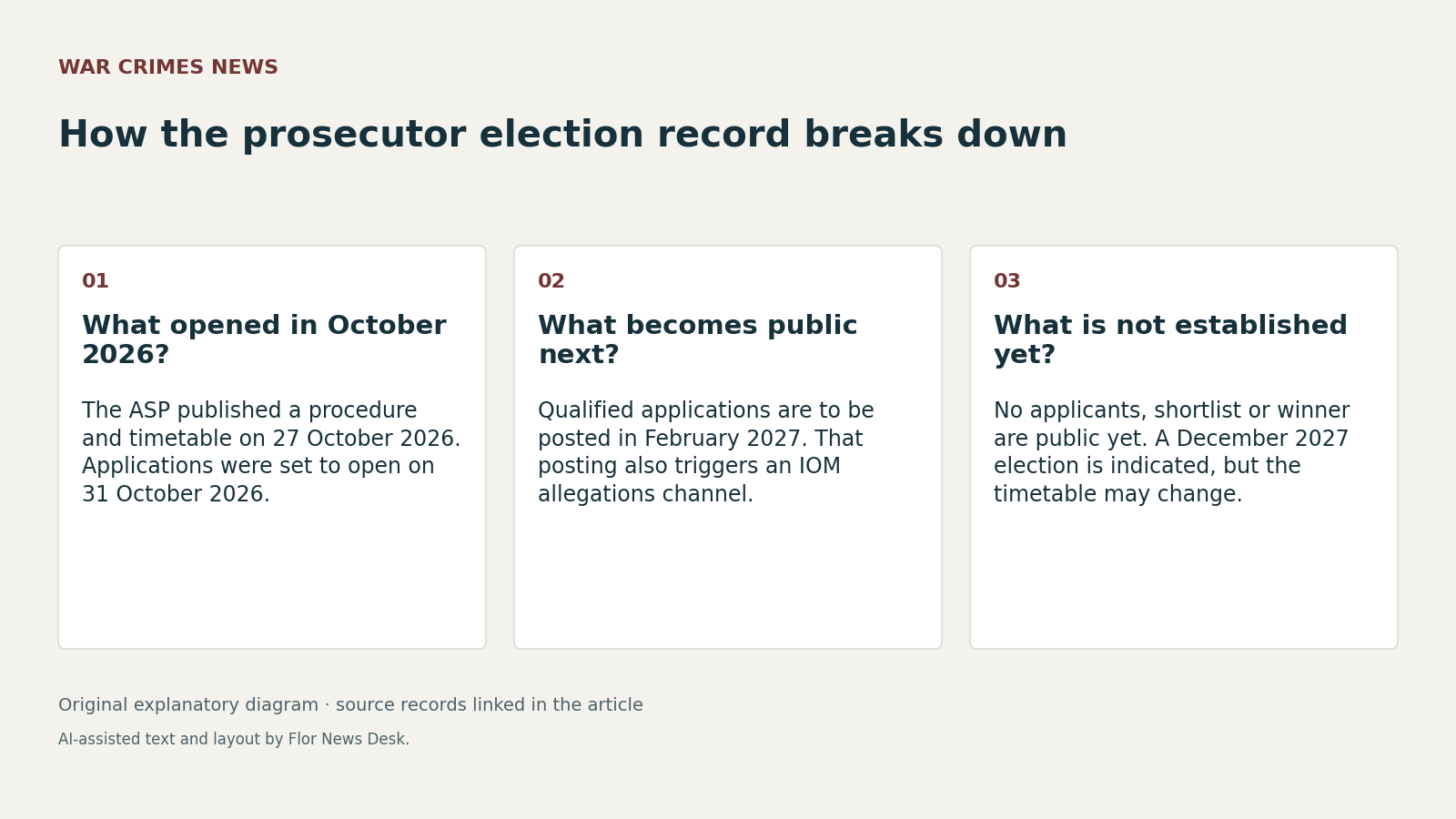

The Assembly of States Parties has now put dates and review steps around the choice of the International Criminal Court’s fourth Prosecutor, but the October 2026 record is still about process rather than contenders. The Assembly said on 27 October 2026 that its Bureau had launched the election procedure, with applications scheduled to open on 31 October 2026 and close on 31 January 2027 ICC press release. A separate Assembly election page, also dated 27 October 2026, says the Bureau launched the procedure on 26 October 2026, so the public record already contains a one-day dating difference that later reporting should preserve rather than smooth over Election page. As of the current date, 29 October 2026, that window had not yet opened.
That timing matters because, for now, there are no public applicants to assess. The records say people may apply directly, and States Parties or groups of States Parties may also submit applications on an individual’s behalf, with submissions going to the Secretariat of the Assembly of States Parties ICC press release Election page. In practical terms, the Bureau has defined who can enter the process, not who will. That is a significant distinction for readers trying to measure transparency: the October documents widen the entry routes, but they do not yet reveal the field.
The next important step is not the election itself but publication of candidate materials. According to both Assembly records, qualified applications are to be posted publicly in February 2027 ICC press release Election page. That planned posting is the first moment when outside observers should expect a documentary basis for comparing applicants rather than relying on diplomatic signaling. It also creates a fixed reporting checkpoint: if applications are not posted then, the October announcement alone would not establish whether the delay reflected disqualification, timetable changes or some other reason.
The published framework also separates advisory assessment from integrity screening. The Assembly says candidates will be assessed by the Advisory Committee on Nominations of Judges, acting as an advisory committee for this prosecutor election, while the Independent Oversight Mechanism will run a due-diligence process ICC press release Election page. The election page adds that it links to the adopted procedure, vacancy announcement and due-diligence procedure, including a reference to resolution ICC-ASP/22/Res.3, but the material available here does not independently establish any further detail from those linked texts Election page. The safe inference is narrow: one body is positioned to assess candidacies, another to test misconduct-related information.
That distinction becomes sharper in the planned allegations channel. The Assembly says a confidential Independent Oversight Mechanism channel for allegations of alleged misconduct against applicants will open after the public posting of applications in February 2027 ICC press release Election page. The existence of that future channel does not show that any allegation exists now, and it does not establish how any future allegation would be assessed or disclosed beyond the due-diligence role already announced.
The Bureau’s timetable points to an election in December 2027, but both the sequence and the outcome remain open ICC press release. The Assembly’s 2026 press-release index confirms the 27 October publication date for this launch and shows it appearing alongside other governance-sensitive Assembly items, including sanctions, Rome Statute withdrawals, disciplinary proceedings involving Prosecutor Karim Khan and judge-election due-diligence notices ASP 2026 press-release index. That context may explain why the Bureau emphasized procedure and due diligence, but the index does not prove those other files changed this election’s rules or schedule. What the current record establishes is narrower: a timetable, a public-posting commitment and a review structure, with no candidate list, no shortlist, no vote and no demonstrated effect on the Court’s ongoing cases.