
The key development is narrow but significant: on 18 September 2026, the Office of the United Nations High Commissioner for Human Rights published a thematic report that, it says, is based on findings by its Human Rights Monitoring Mission in Ukraine and covers 24 February 2022 through 31 July 2026. OHCHR says the mission documented 1,004 cases of sexual violence in detention and non-detention contexts.OHCHR thematic report The OHCHR reports index separately lists that publication on 18 September 2026 as a thematic report analysing data, trends and patterns.OHCHR reports index
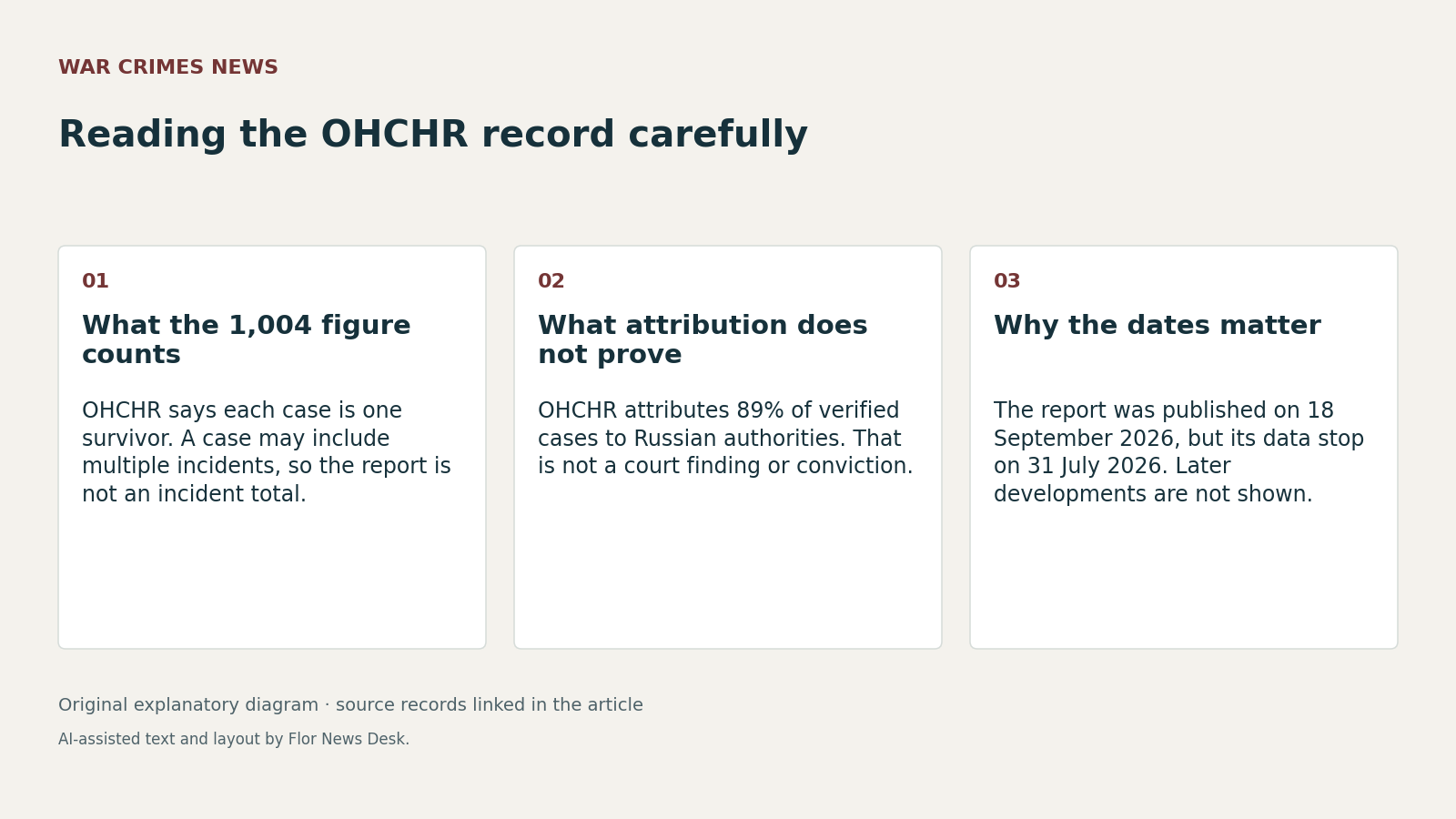
That total needs careful reading. OHCHR says the 1,004 cases include 984 cases during the report’s period and 20 cases that occurred before 2022 but had not previously been reported by OHCHR.OHCHR thematic report So the headline number is not identical to a count of conduct occurring only after 24 February 2022. OHCHR also says each case represents one survivor and may include multiple incidents, meaning the report does not provide a total incident count.OHCHR thematic report As analysis, that makes the figure a documented survivor-case count, not a tally of every act alleged in the conflict.
The report’s own caveats matter at least as much as its headline number. OHCHR says its findings are representative rather than comprehensive, and that sexual violence is underreported in Ukraine, as in other contexts.OHCHR thematic report Readers should therefore resist two opposite errors: treating 1,004 as a full measure of prevalence, or dismissing it because it is not comprehensive. The record establishes that OHCHR says it documented that many survivor-cases under its methodology. It does not establish an upper bound, a conflict-wide rate, or a final historical total.
The attribution data require the same discipline. OHCHR says 89 per cent of the verified cases are attributed to Russian Federation authorities and 11 per cent to Ukrainian authorities.OHCHR thematic report That is an institutional assessment by a UN monitoring mission. It is not, on this public record, a criminal charge, a judicial finding, or a conviction against any named person. The distinction is central in accountability reporting: attribution in a monitoring report can identify patterns and alleged responsible structures, but legal liability still depends on later investigative and judicial steps not established by these retrieved pages.
The dates also limit what can properly be claimed. The publication date is 18 September 2026, but the report’s data cut-off is 31 July 2026.OHCHR thematic report That means the document does not show whether additional cases were documented after July, whether any public prosecutorial action followed after July, or whether any institution later challenged or confirmed OHCHR’s assessments. The reports index helps confirm the existence and date of the publication, but it does not add evidentiary detail beyond identifying the report as a thematic analysis.OHCHR reports index
For accountability coverage, the practical value of this record is precision about what now exists in public: a dated OHCHR thematic report, based on HRMMU findings, with a defined time span, a survivor-case count, an attribution breakdown and explicit methodological limits.OHCHR thematic report What it leaves open is equally important. The retrieved record does not establish prosecution outcomes, reparations decisions or court-tested responsibility. Those are the next milestones to watch, but they are not proved by this publication itself.