
On 14 October 2026, the International Committee of the Red Cross used the UN General Assembly’s First Committee to argue that work under the Convention on Certain Conventional Weapons had advanced far enough to start negotiations on a new instrument for autonomous weapon systems ICRC First Committee statement. The point was procedural as much as moral. The ICRC was not announcing a new rule; it was saying that the CCW process had already produced enough common ground, including a consensus final report from the Group of Governmental Experts the previous month, to justify moving from discussion to negotiation ICRC First Committee statement.
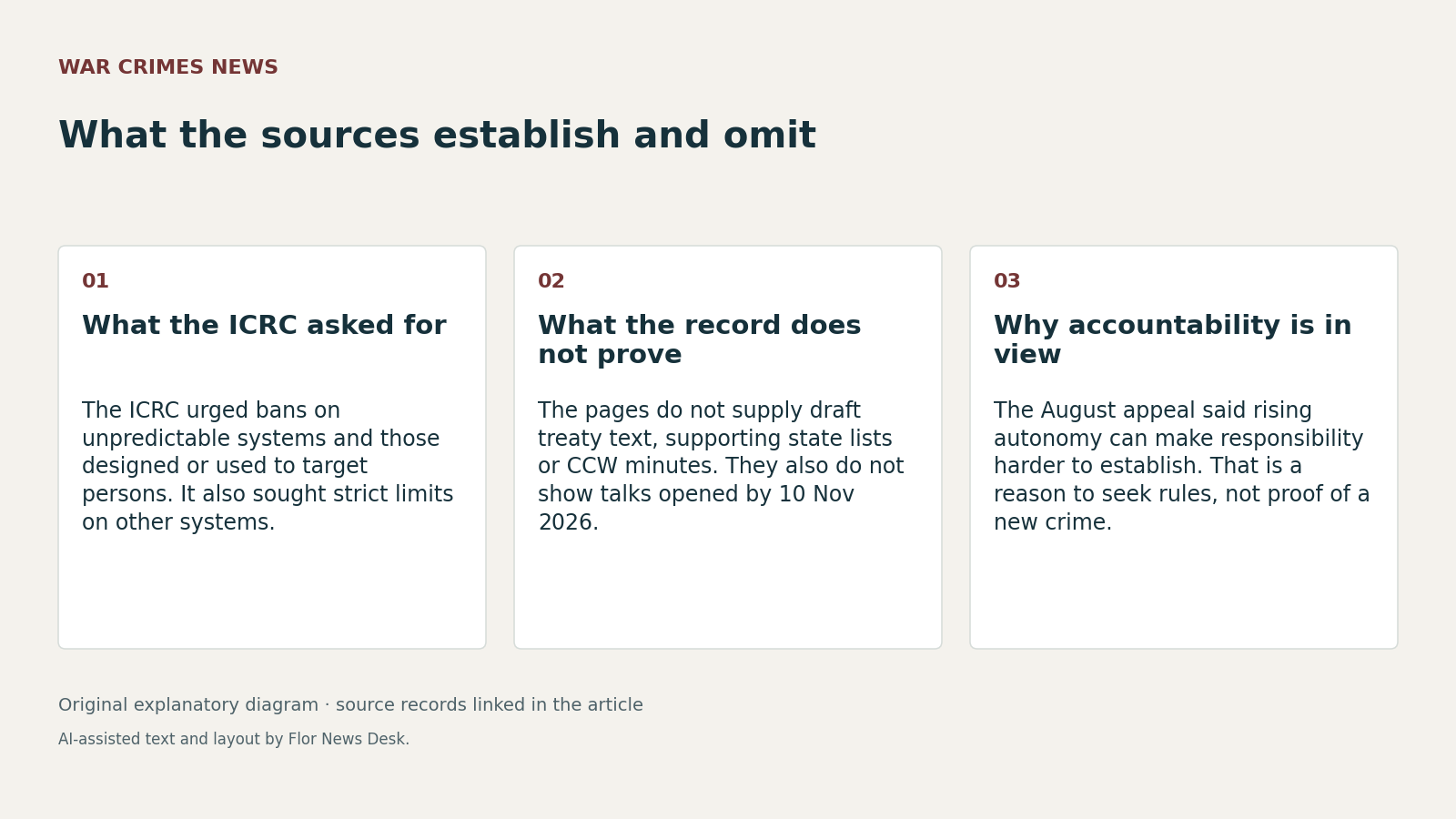
The October statement is also unusually specific about the legal categories the ICRC wants. It called for prohibitions on autonomous weapons the institution described as unpredictable and on systems designed or used to target persons, plus strict international legal limits on other autonomous weapons systems ICRC First Committee statement. Read narrowly, that is a three-part framework: some systems should be banned because their effects are not reliably controllable; some should be banned because of whom they are aimed at; the rest would still need tighter rules. What the record here does not provide is the draft protocol text that would define those categories in law ICRC First Committee statement.
The 25 August 2026 joint appeal by UN Secretary-General António Guterres and ICRC President Mirjana Spoljaric gives the accountability rationale for that push joint appeal. It said growing autonomy in weapons can reduce human control over the use of force and make responsibility for errors and breaches harder to establish joint appeal. For an accountability readership, that matters less as a prediction about any one weapon than as a description of the proof problem the institutions are trying to prevent. The appeal is still advocacy, not a finding that existing law has failed or that a new crime already exists joint appeal.
The largest gap in the available record is state consent. The October page says more than 70 states had explicitly called for launching negotiations and that states with differing positions had agreed on elements of an instrument ICRC First Committee statement. But the page does not attach the supporting-state list, a working paper, meeting minutes or draft language ICRC First Committee statement. That matters because agreement that regulation is needed is not the same as agreement on forum, mandate or text. As of 10 November 2026, the sources supplied here also do not establish whether the November 2026 CCW Review Conference actually opened negotiations; the August and October references to that conference were forward-looking when published joint appeal ICRC First Committee statement.
A separate ICRC record published on 4 November 2026 shows a different, broader track. It says consultations involving more than 160 states produced non-binding practical guidance on strengthening respect for international humanitarian law, including steps on new technologies such as continuous review and cross-verification of information on potential targets and regulation of personal digital devices in operational settings Global IHL Dialogue note. That suggests some states are willing to discuss operational safeguards outside treaty negotiations. It does not show support for an autonomous-weapons protocol, because the note is not CCW-specific and does not identify which states backed any negotiation step Global IHL Dialogue note.
So the October intervention sharpens the diplomatic ask without resolving the legal and political missing pieces. The clearest documentary change would be a CCW decision record, state intervention list, working paper or draft protocol that turns the ICRC’s categories into negotiated terms. Until records like those appear, the most accurate reading is narrower: the ICRC and the UN secretary-general have publicly pressed for binding rules, and the ICRC says groundwork exists, but the source set here does not yet prove that formal CCW negotiations or new binding law are in place joint appeal ICRC First Committee statement.