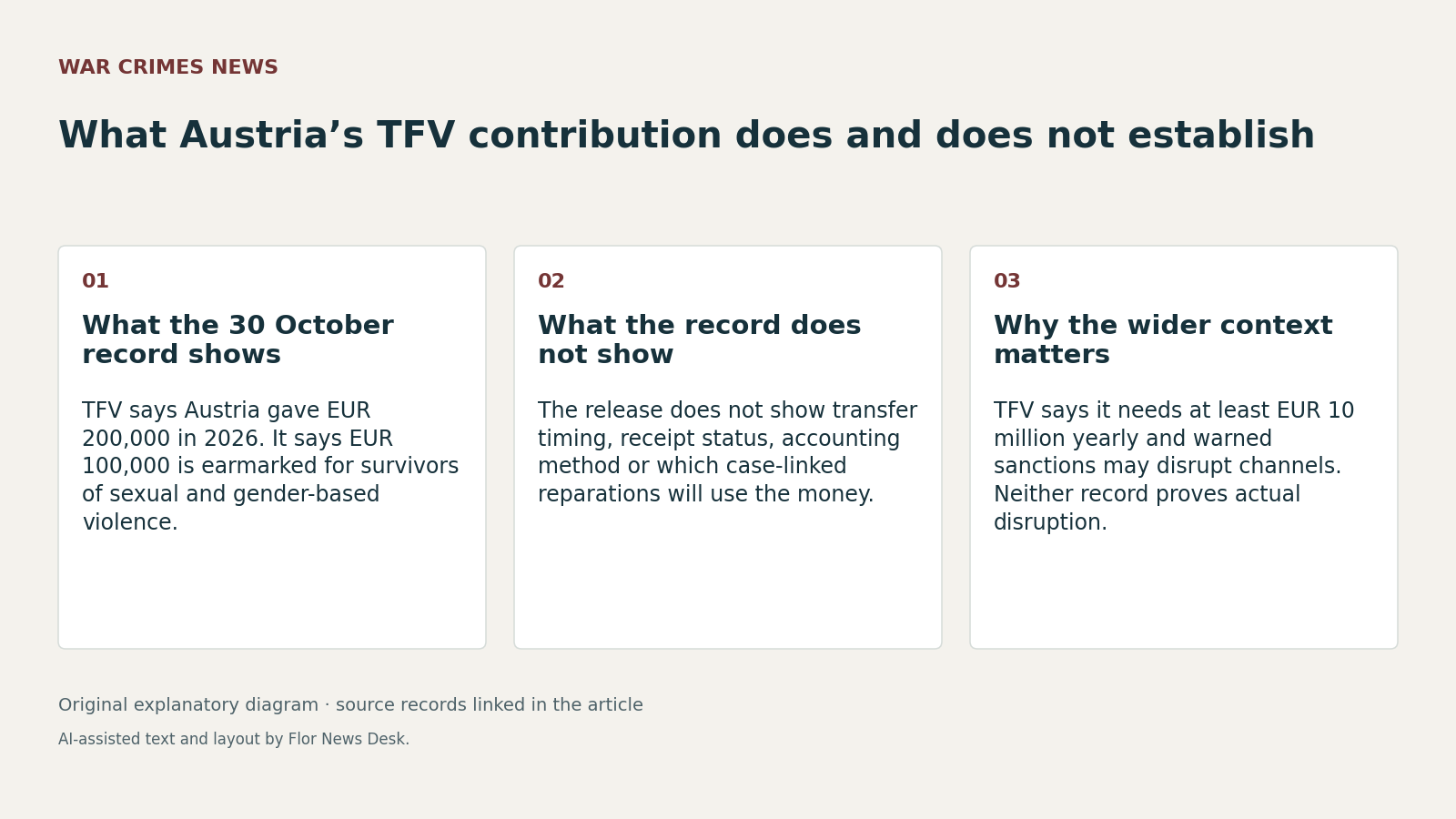

On 30 October 2026, the ICC’s Trust Fund for Victims said Austria made a voluntary contribution of EUR 200,000 in 2026, and that EUR 100,000 of it is earmarked for survivors of sexual and gender-based violence. The same release said the other EUR 100,000 will support ICC-ordered reparations and other programmes for victims’ benefit, and that Austria has made annual voluntary contributions since 2007. Those are concrete, dated facts about a donor, an amount and a stated purpose, not just a general appeal for support. 30 October 2026 TFV release
What the release does not do is almost as important. It is not an audited financial statement, and it does not show when the money was transferred, when it was received, how it will be accounted for, or which specific reparations awards or assistance projects will use it. The release’s background text says the fund has been appealing for contributions particularly for reparations in the Ntaganda and Ongwen cases, but that does not establish that Austria’s contribution will be directed there. On the present record, readers can verify a reported contribution and earmark, not a traced path from donor announcement to beneficiary payment. 30 October 2026 TFV release
The same document also gives the right benchmark for scale. The Trust Fund for Victims said its annual programme funding target is a minimum of EUR 10 million, and that contributions qualify as Official Development Assistance. Set against that target, Austria’s reported EUR 200,000 equals 2 percent of one minimum programme year, while the EUR 100,000 earmark for survivors of sexual and gender-based violence equals 1 percent. That arithmetic does not diminish the donation; it clarifies what it can and cannot prove. A specific contribution is evidence of donor support, but not evidence that the fund’s broader financing pressure has been resolved. 30 October 2026 TFV release
Recent TFV records suggest Austria’s announcement sits within a continuing fundraising effort, but they do not supply a full ledger. The TFV items index lists a Malta item dated 1 October 2026, summarised as an unrestricted EUR 20,000 contribution, and a New Zealand item dated 18 September 2026, summarised as a EUR 123,180 contribution. That supports a narrower point: public donor announcements continued in late 2026. It does not establish that the index is complete, that all listed sums were already in the fund’s accounts on those dates, or what the cumulative total for 2026 was. TFV items index
A second October record adds context, but not causation. On 9 October 2026, the Trust Fund for Victims said United States sanctions imposed on the ICC that day may disrupt financial channels, services and partnerships used to deliver its reparative mandate, while also saying it remained committed to mobilising resources and continuing programmes. Read together, the 9 October statement and the 30 October Austria release show that the fund was publicly warning about possible operational strain at the same time it was still announcing contributions. They do not prove that sanctions affected Austria’s transfer, changed Austria’s decision, or caused any verified interruption in programme delivery. 9 October 2026 TFV sanctions statement
The useful accountability distinction, then, is between a documented contribution announcement and a documented programme outcome. The first is in the public record. The second is not yet shown by these materials. To move from donor news to reparations reporting, later records would need to show receipt, accounting treatment, any case-level allocation, and whether earmarked funds for survivors of sexual and gender-based violence were actually disbursed.