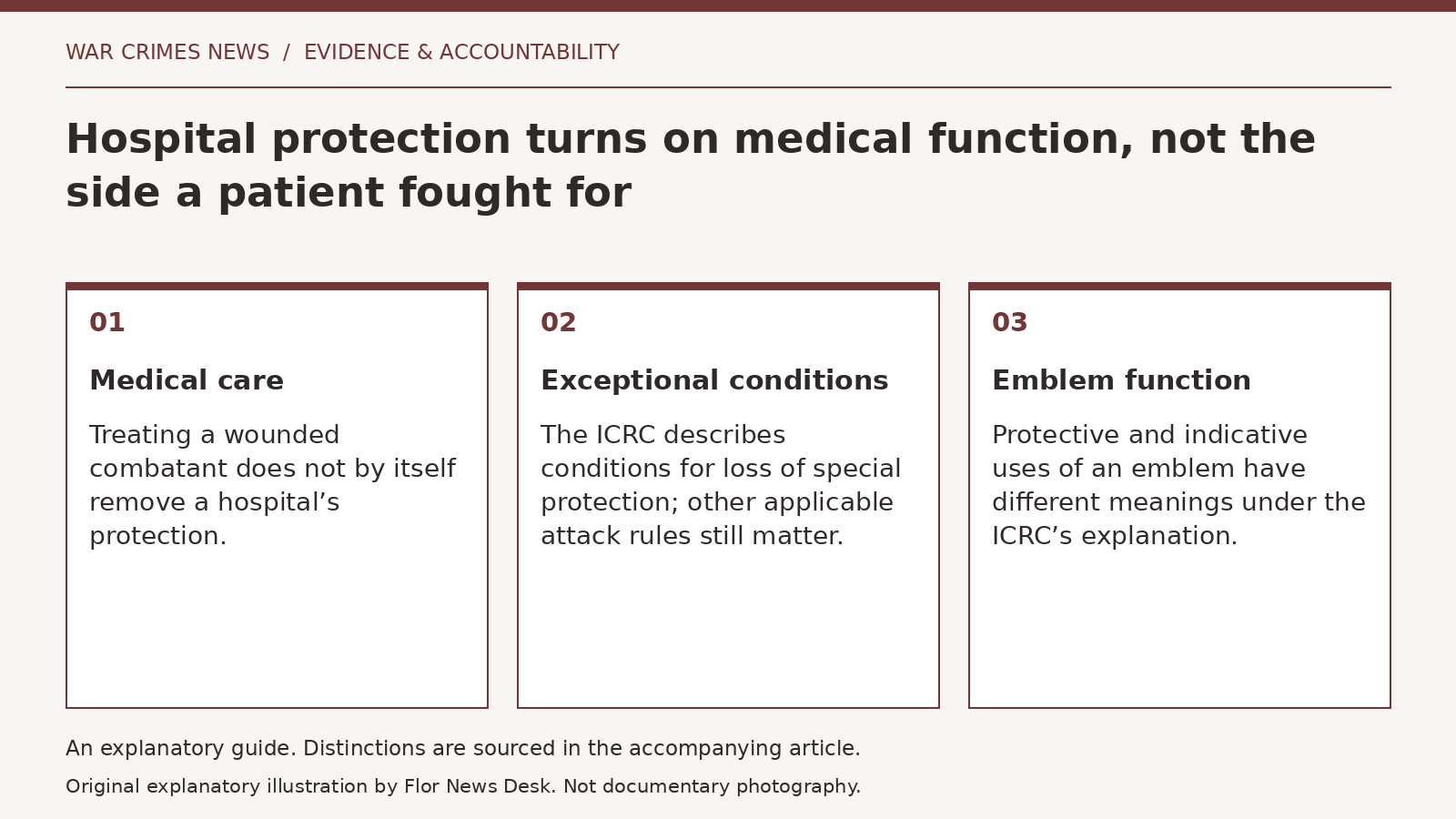
Treating wounded combatants does not by itself remove a hospital’s protection, the ICRC explains in its account of humanitarian-law rules for hospitals. The relevant distinction is between providing medical care and acts harmful to the enemy outside the humanitarian function.
The explanation, published in November 2023, describes loss of special protection as exceptional and subject to conditions, including warning requirements. Even where protection has ceased, applicable rules on proportionality and precautions still matter. This is general legal context, not a determination about a named hospital or a particular attack.
A patient and a facility are different subjects
Imagine a fictional report establishing that an injured member of an armed group received treatment. That fact would concern the patient’s identity and the provision of care. It would not, without additional evidence, establish that the building was being used for a separate military purpose.
The same distinction limits what can be inferred from a photograph. An image showing someone present at a location would not necessarily establish every activity occurring there or the status of the person at the relevant time. Context and the claim being examined must remain attached to the evidence.
The ICRC’s emblem explanation distinguishes protective use from indicative use. In the protective role, the emblem is a visible sign of protection under the law; indicative use identifies a component of the Red Cross and Red Crescent Movement. The functions should not be collapsed into a general logo test.
Separate description from determination
In a hypothetical investigation, one record might describe a medical function, another a warning and another the circumstances of an attack. Each would address different questions. A statement about one record could not substitute for examining the others.
This article does not reproduce an official emblem as publisher branding or offer a judgement on an actual incident. It explains why the patient’s affiliation, the facility’s use and the sign displayed are distinct observations.
A careful account should therefore avoid treating the presence of a wounded combatant as an automatic legal conclusion. The ICRC’s explanation requires attention to medical function and the relevant conditions. A case-specific allegation or finding needs its own verified record, not only a label attached to a patient or a building.