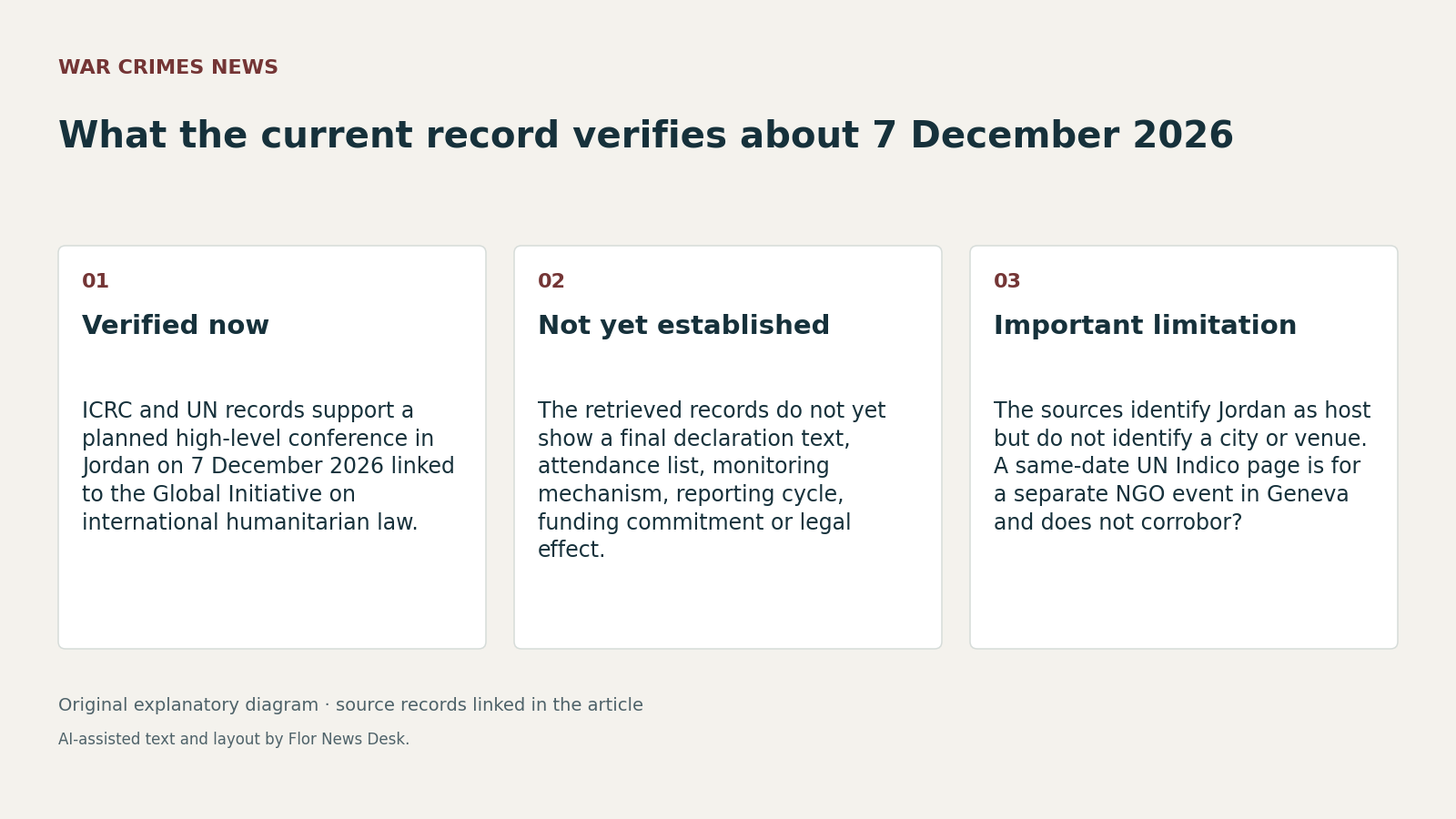

The public record currently supports a narrow conclusion. The Hashemite Kingdom of Jordan is planned to host a high-level conference on 7 December 2026 linked to the Global Initiative to galvanize political commitment to international humanitarian law, according to an ICRC joint statement dated 23 September 2026 and a UN WebTV page for a 20 May 2026 media stakeout before the Security Council’s annual protection-of-civilians debate. Those records do not, by themselves, establish any adopted outcome, enforcement mechanism or legal effect. ICRC joint statement UN WebTV stakeout page
The two sources align on the basic event facts. In the transcript on the UN WebTV page, Jordan’s representative says the initiative was launched in September 2024 by Brazil, China, France, Jordan, Kazakhstan and South Africa together with the International Committee of the Red Cross, and announces that Jordan will host a “culminating High-Level Conference on Humanity in War” on 7 December 2026. The ICRC’s 23 September 2026 statement names the same six founding states and says Jordan will host the “High-Level Conference to Uphold Humanity in War” on the same date. On scheduling and host state, that is enough to describe the event as planned. UN WebTV stakeout page ICRC joint statement
What those records do not establish matters more for accountability readers. The ICRC statement says that, after consultations, “a concise and inclusive political declaration will be issued by states at the conference.” It does not provide draft text, explain whether any document would carry legal force, or set out a monitoring mechanism, reporting cycle, compliance consequence or budget. That means the source record currently shows a proposed political output, not proof of a new binding instrument or a new enforcement process. ICRC joint statement
A related ICRC page, published on 24 September 2026 for remarks delivered on 23 September in New York, adds political advocacy but not procedural certainty. In that speech, ICRC president Mirjana Spoljaric urges states to join the initiative and “attend the international conference convened by His Majesty King Abdullah II of Jordan on December 7 at the highest possible level.” The same remarks state that deliberate attacks against humanitarian workers violate international humanitarian law and “constitute war crimes.” Those are the ICRC president’s published remarks, not a conference agenda, attendance list or adopted outcome. ICRC president remarks
The available numbers suggest growth in participation, but not yet the weight of any final conference result. The UN WebTV transcript says 111 states had officially joined the initiative as of 20 May 2026. The ICRC statement says 118 states had formally joined by 23 September 2026 and that 27 states co-led seven thematic workstreams. One limit should be stated plainly: the UN WebTV page contains inconsistent counts in some metadata fields, so the safer figure is the one stated in the quoted transcript itself. UN WebTV stakeout page ICRC joint statement
One correction is important. The sources here establish Jordan as the host state, but they do not identify a city within Jordan. They also do not supply a venue notice, agenda, registration page or attendance record. And a UN Indico page for 7 December 2026 concerns a separate NGO event at the Palais des Nations in Geneva. It does not corroborate the Jordan conference beyond sharing the same date. UN Indico page
As of 29 September 2026, the accountability test is still ahead. The most useful things to watch in directly retrievable post-conference records are who attends and at what level, whether any declaration is actually adopted and published, and whether any annex, timetable, reporting arrangement or funding commitment appears. Until then, the record supports describing 7 December as a scheduled diplomatic effort to mobilize compliance with existing law, not a demonstrated enforcement breakthrough.