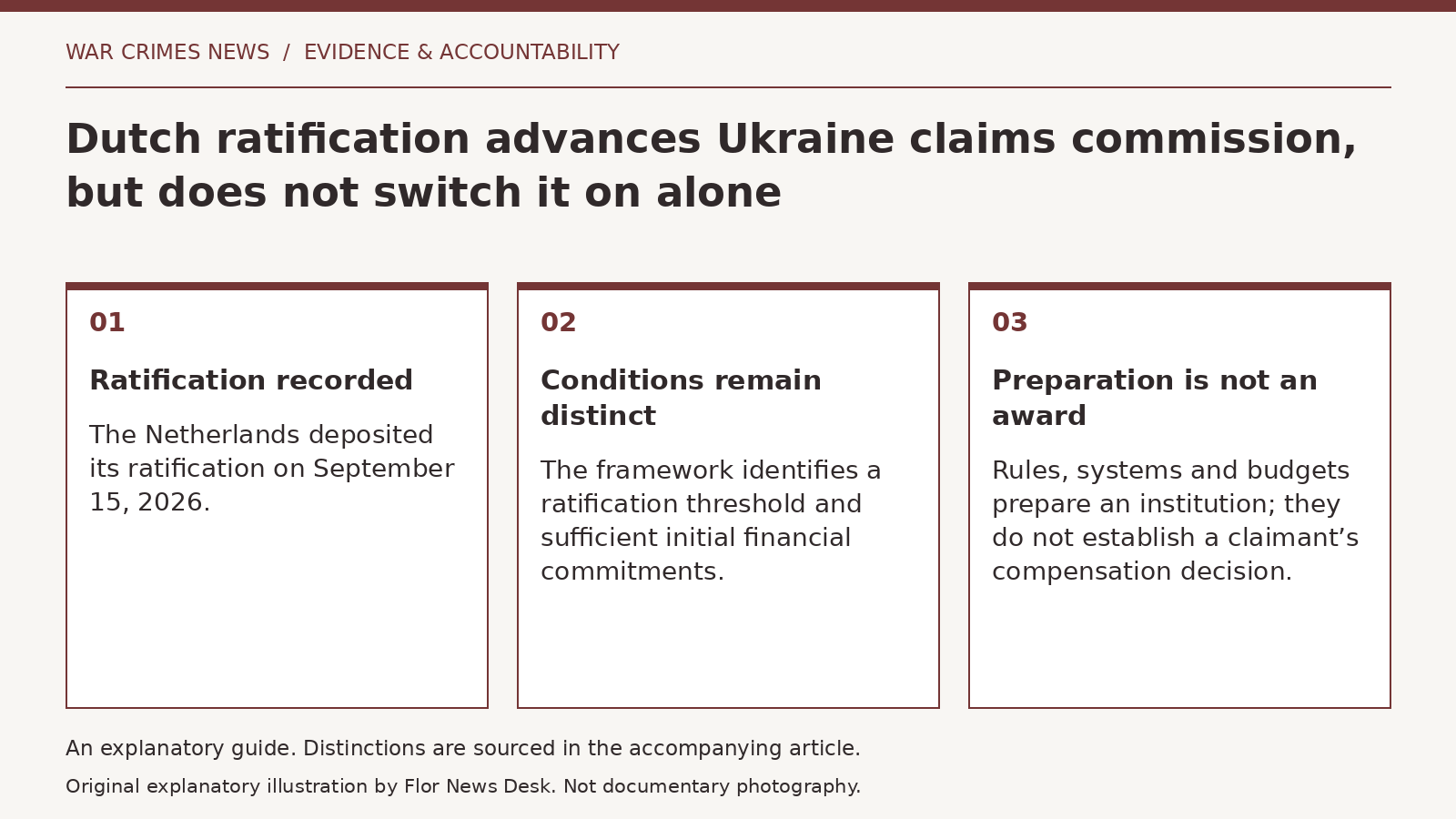
The Netherlands ratified the convention establishing an International Claims Commission for Ukraine on September 15, 2026. The Council of Europe announcement marks a treaty step by the prospective host country. It does not announce that the commission has already begun deciding claims or paying compensation.
The convention opened for signature in December 2025. The institution’s published framework requires ratification by 25 states or regional integration organizations, together with sufficient financial commitments for the initial work. The September 15 account reports nine states and the European Union having ratified at that date; those dated figures are not presented here as a new September 23 count.
Legal establishment and practical preparation
The council’s commission overview describes an independent administrative body that will assess recorded claims and determine compensation amounts. It also identifies a preparatory committee working on proposals, procedures and a provisional budget. Preparatory activity and an operational claims decision therefore occupy different stages.
A hypothetical administrative process makes the distinction clear. Drafting a form can happen before an institution receives authority to decide a case. Approving a budget can address resources without establishing that a particular claimant has received a decision. Neither step should be relabelled as completed adjudication.
The same reasoning applies to a host-country announcement. Naming a location identifies where an institution is intended to operate. It does not establish the number of cases resolved, the readiness of every system or the date on which a specific applicant might receive an outcome.
Follow the instrument, not the headline alone
A signature, a ratification and entry into force are different events in the record described by the council. Combining them into a single total of completed implementation would obscure what each actually establishes.
The two cited pages are institutional accounts of the council’s own process, not an independent performance review. They provide no basis for promising a particular payment or declaring the entire compensation mechanism complete. The precise development is narrower: Dutch ratification advances the treaty process, while the published conditions and preparations still define what must happen before the commission’s intended work can be described as an observed result.