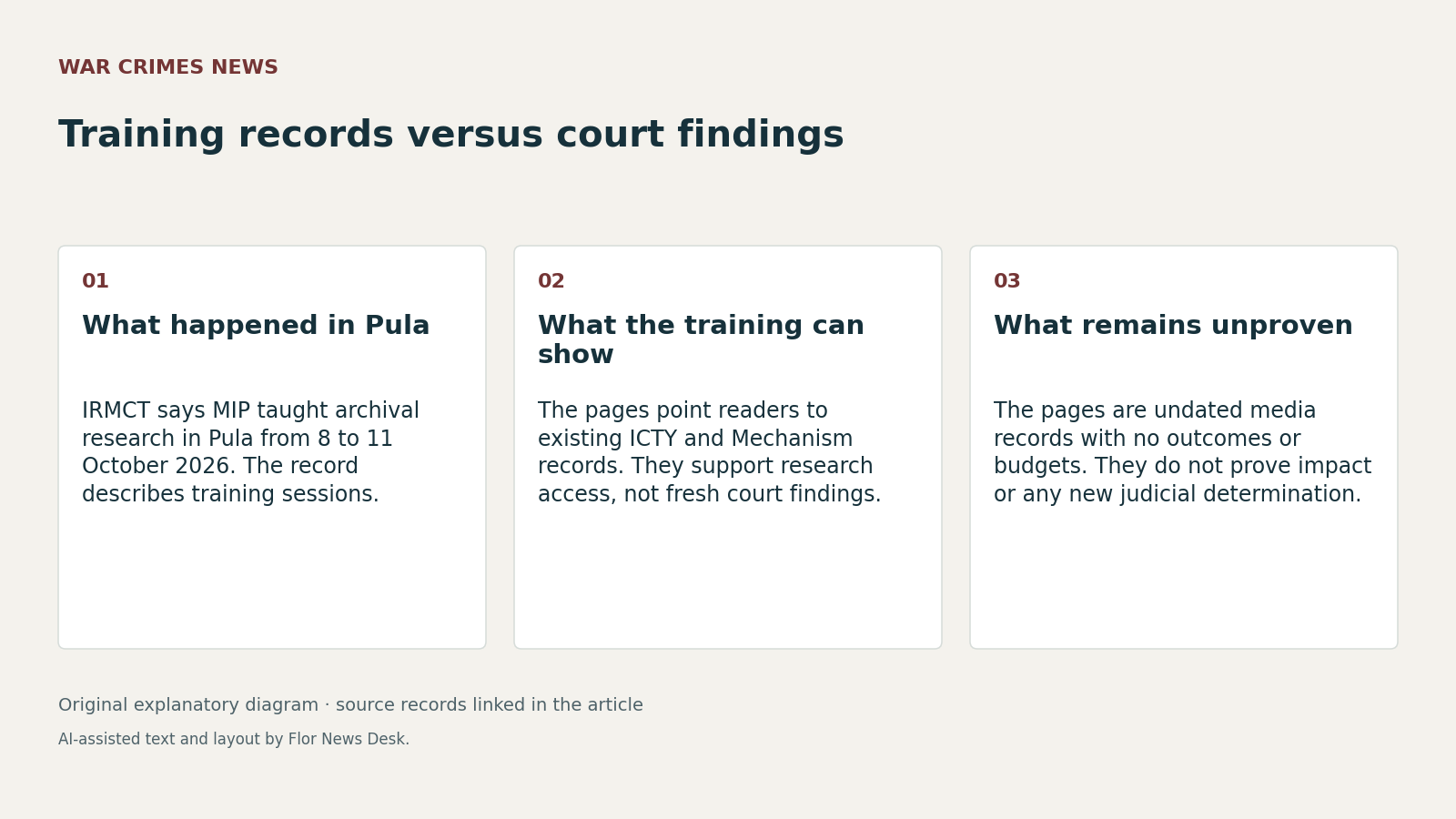
The International Residual Mechanism for Criminal Tribunals says its Mechanism Information Programme for Affected Communities spent 8 to 11 October 2026 in Pula, Croatia, teaching students and young professionals how to work with ICTY and Mechanism records. On its face, that is an access-and-methods development, not a new accountability result: the cited IRMCT record describes training on existing case material, not any fresh judicial determination. Pula academy record
According to that undated IRMCT media page, SENSE – Centre for Transitional Justice organised the Transitional Justice Academy for participants from Bosnia and Herzegovina, Croatia, and Serbia, and MIP researcher Nemanja Stjepanović led sessions on war crimes trials before the International Criminal Tribunal for the former Yugoslavia and the Mechanism, as well as the ICTY/Mechanism archives. The same page says practical sessions showed participants how to conduct archival research and use documentary material to examine judicially established facts about crimes committed during the conflicts in the former Yugoslavia. Pula academy record
That wording matters. A session on how to examine judicially established facts points researchers toward what prior courts have already found; it does not itself create another finding. The distinction is basic but often blurred in public debate around tribunal archives. An outreach event can improve a reporter’s or student’s ability to locate and read records. It cannot, by itself, change the legal status of those records or add to what a chamber has already established. That inference follows from the page’s own limits: it describes lectures and practical research instruction, not a new ruling. Pula academy record
A second 2026 IRMCT page points in the same direction. For 21 and 22 April 2026 in Sarajevo, the IRMCT says MIP staff joined the Sixth School of Transitional Justice, where MIP Coordinator Rada Pejić-Sremac and Stjepanović presented on the legacy of the ICTY and the International Residual Mechanism for Criminal Tribunals and led a workshop on using the Mechanism’s Unified Court Records to research cases and sources. The page adds that the event brought together 24 students and was organised by Pravnik with support attributed to the European Union and the United Nations Development Programme. Read beside the Pula record, that shows a repeated institutional role: training people to navigate and interpret existing material. Sarajevo school record
The funding language also needs precision. The Pula page states that MIP is funded by the European Union. That supports an attribution about the programme itself, not a broader claim that the EU funded every host event or delivered a new tranche of money on those dates. By contrast, the Sarajevo page separately says that school was supported by the European Union and UNDP. Those are related but distinct propositions, and the public records here do not quantify the funding or document disbursements. Pula academy record Sarajevo school record
The source record remains narrow. Both cited pages were retrieved on 25 October 2026, and neither shows a visible publication date in the retrieved text. Both are IRMCT media pages rather than formal judicial documents. They do establish dated outreach activity and the topics the IRMCT says were taught. They do not establish participant outcomes, changes in archive policy, or any new judicial finding. For accountability reporting, that is still useful: it shows how the Mechanism is framing access to its archives, while leaving the legal weight of the underlying cases where it already belonged, in the court record itself. Pula academy record Sarajevo school record