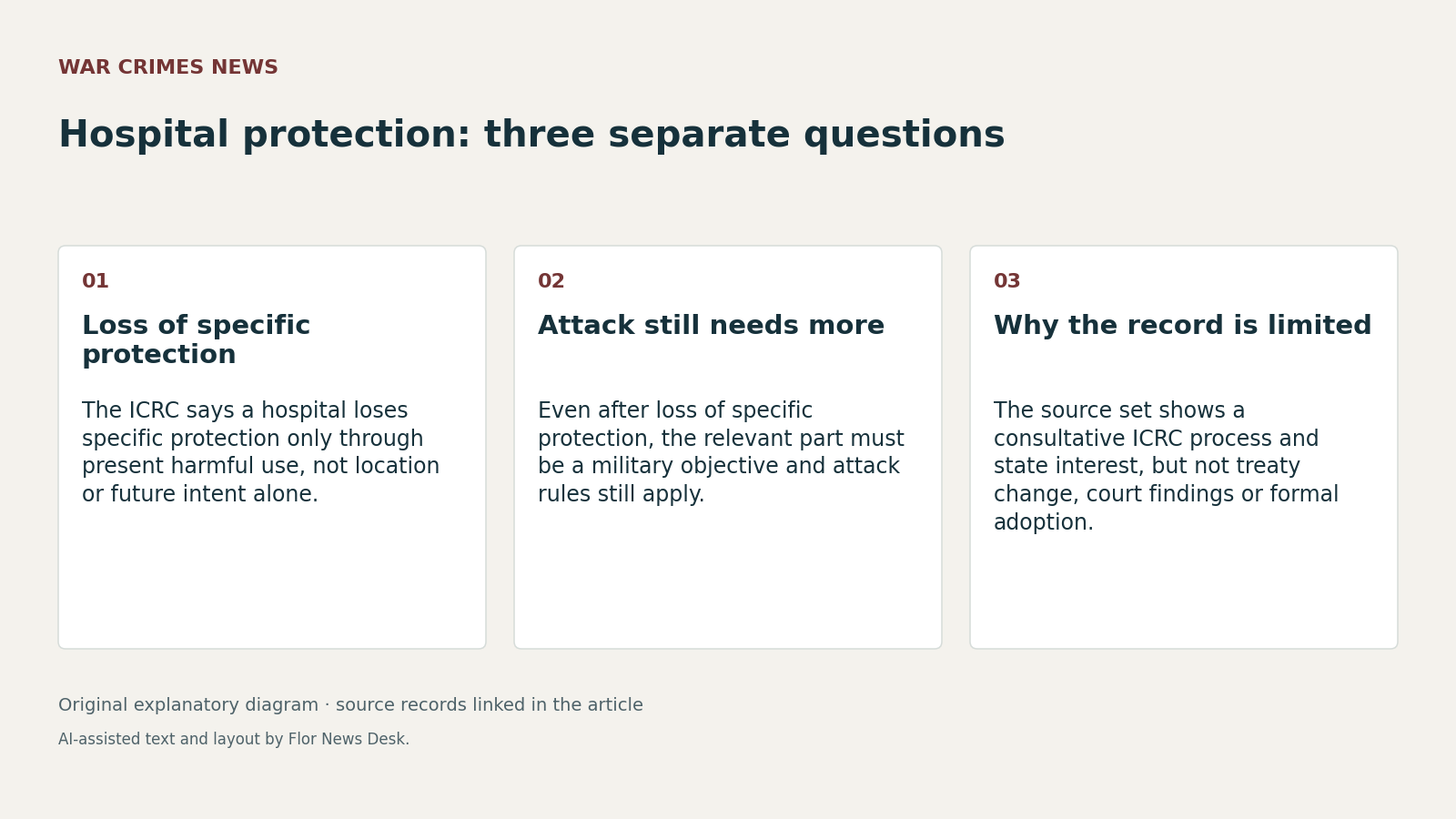

On 12 November 2026, the ICRC used its Humanitarian Law & Policy Blog to present the hospitals workstream outcome of the Global Initiative to Galvanize Political Commitment to International Humanitarian Law as a clarification of one narrow question: when can a hospital lose its specific protection under the law of armed conflict? The post says the answer is only when the facility is being used, at that time, to commit acts harmful to the enemy; location, nature and intended future use do not by themselves satisfy that criterion. The same post says the exercise was meant to clarify and help implement existing law, not create new law or secure formal endorsement.ICRC blog post, 12 November 2026
That distinction matters partly because of the document’s provenance. According to the ICRC post, Nigeria, Pakistan, Spain and Uruguay led the workstream with the ICRC after five consultations involving more than 100 states over 18 months and two expert workshops.ICRC blog post, 12 November 2026 But the retrieved ICRC compilation entry is dated 30 September 2026 and, in the excerpt available here, supplies only publication metadata for seven workstream documents, including the hospitals paper. It does not itself reproduce the hospital text or show that states formally adopted it.ICRC compilation entry
The most useful consequence for accountability reporting is what this clarification does not collapse. The ICRC post says that even if a medical facility loses specific protection, the relevant part of the facility must still qualify as a military objective, and any attack remains governed by distinction, proportionality and precautions.ICRC blog post, 12 November 2026 So, on the ICRC’s account, loss of a hospital’s special status would not itself establish that a strike was lawful.
That sequencing narrows one recurring shortcut in public argument. As analysis from the ICRC’s stated premises, evidence that a hospital stood in a contested area, was allegedly intended for a strategic role, or might be used differently in future would not alone answer the first question. An investigator or prosecutor would still need time-specific evidence of harmful present use, then separate evidence and legal analysis on military-objective status and on how the attack was carried out.ICRC blog post, 12 November 2026
The timing is also political rather than judicial. A UN Web TV page for a 20 May 2026 Security Council stakeout says Jordan, speaking on behalf of other states, described the initiative as launched in September 2024 by Brazil, China, France, Jordan, Kazakhstan and South Africa with the ICRC, said 111 states had officially joined, and announced a High-Level Conference on Humanity in War for 7 December 2026.UN Web TV summary, 20 May 2026 In the Sixth Committee on 16 October 2026, Portugal said it strongly supports the initiative and follows its workstreams, while Ireland said it had joined in March 2025 and was looking ahead to the December conference.Sixth Committee transcript, 16 October 2026 Those records show political uptake, but not legal adoption of the hospital text.
Another limit is the patchiness of the public UN record retrieved here. The Third Committee transcript for 2 October 2026 does not, in the fetched excerpt, mention the initiative or the hospitals workstream at all.Third Committee transcript, 2 October 2026 Both UN transcript pages say they are automatic speech-recognition products rather than official UN records, so they help identify positions but do not settle exact wording or institutional conclusions.Third Committee transcript, 2 October 2026 Sixth Committee transcript, 16 October 2026
For War Crimes News readers, the practical value is narrower than a treaty change and broader than a routine policy post. This ICRC-backed outcome gives future litigants, investigators and diplomats a public formulation that rejects arguments based only on purpose, geography or anticipation. But as of 15 November 2026, the source set does not establish state consensus on that formulation, implementation at the 7 December 2026 conference, or any judicial finding applying it. Those questions need separate, current records before they can be reported as outcomes.ICRC blog post, 12 November 2026 ICRC compilation entry