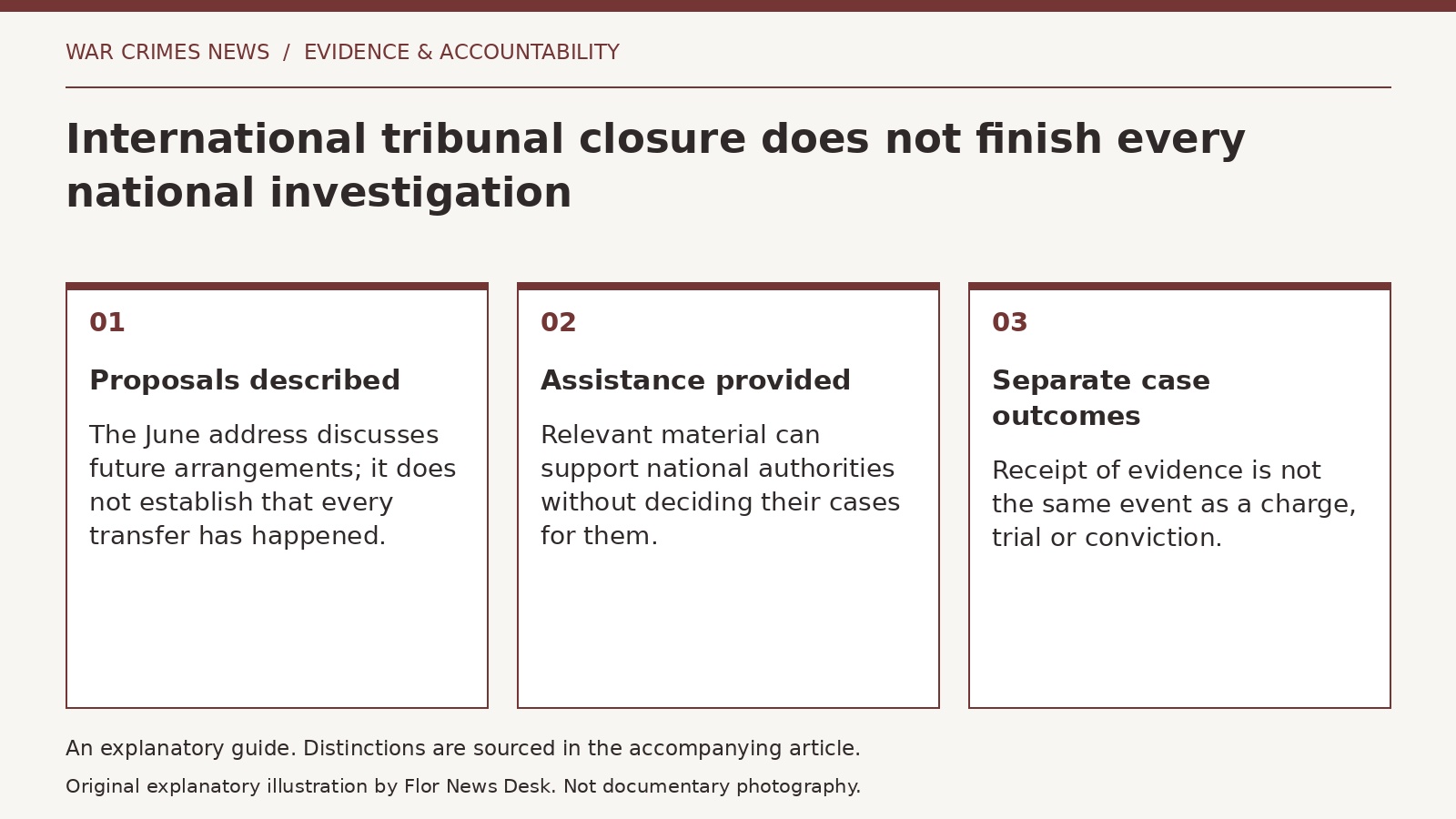
Addressing the UN Security Council in June 2026, the prosecutor of the International Residual Mechanism for Criminal Tribunals discussed how assistance to national authorities could continue as the mechanism’s functions evolve. The official account of the address includes proposals concerning evidence, expertise and future institutional arrangements. A proposal in that account is not evidence that the proposed transfer has already occurred.
Closing one international institution’s trial programme and completing every related domestic investigation are different propositions. An institution can have finished a defined set of cases while national authorities continue other work. The boundary of the case programme is therefore essential to interpreting a claim that judicial work is complete.
Assistance and decision-making
The mechanism’s requests-for-assistance explanation describes support for states and judicial authorities through the prosecutor’s office or registry. Access to relevant material can support a national process; it does not substitute for that process’s own decisions.
Imagine a fictional investigator receiving a certified court record. Receipt establishes that a particular document became available. It does not establish that charges were brought, that a trial occurred or that a defendant was convicted. Those would be later procedural events requiring their own records.
The distinction also applies to the contents of the transferred material. Evidence relevant to one case may need to be examined for its significance in another. The existence of an earlier record does not authorize inventing a later court’s assessment of it.
Preserve the status of a proposal
In the June address, future arrangements are presented as recommendations for sustaining necessary functions. A subsequent decision establishing those arrangements would add something different to the public record. Reporting the recommendation as completed implementation would remove that evidentiary step.
A hypothetical administrative transfer could involve authority, resources and access arrangements being addressed at different times. An announcement about one component would not demonstrate that each remaining component was already operating.
The cited institutional pages explain the prosecutor’s stated direction and the existing assistance function. They are not a register of every current national investigation and do not establish an outcome for an unnamed suspect. The useful distinction is between institutional transition, support supplied and the independent progress of a particular judicial case. None should be treated as a substitute for the others.