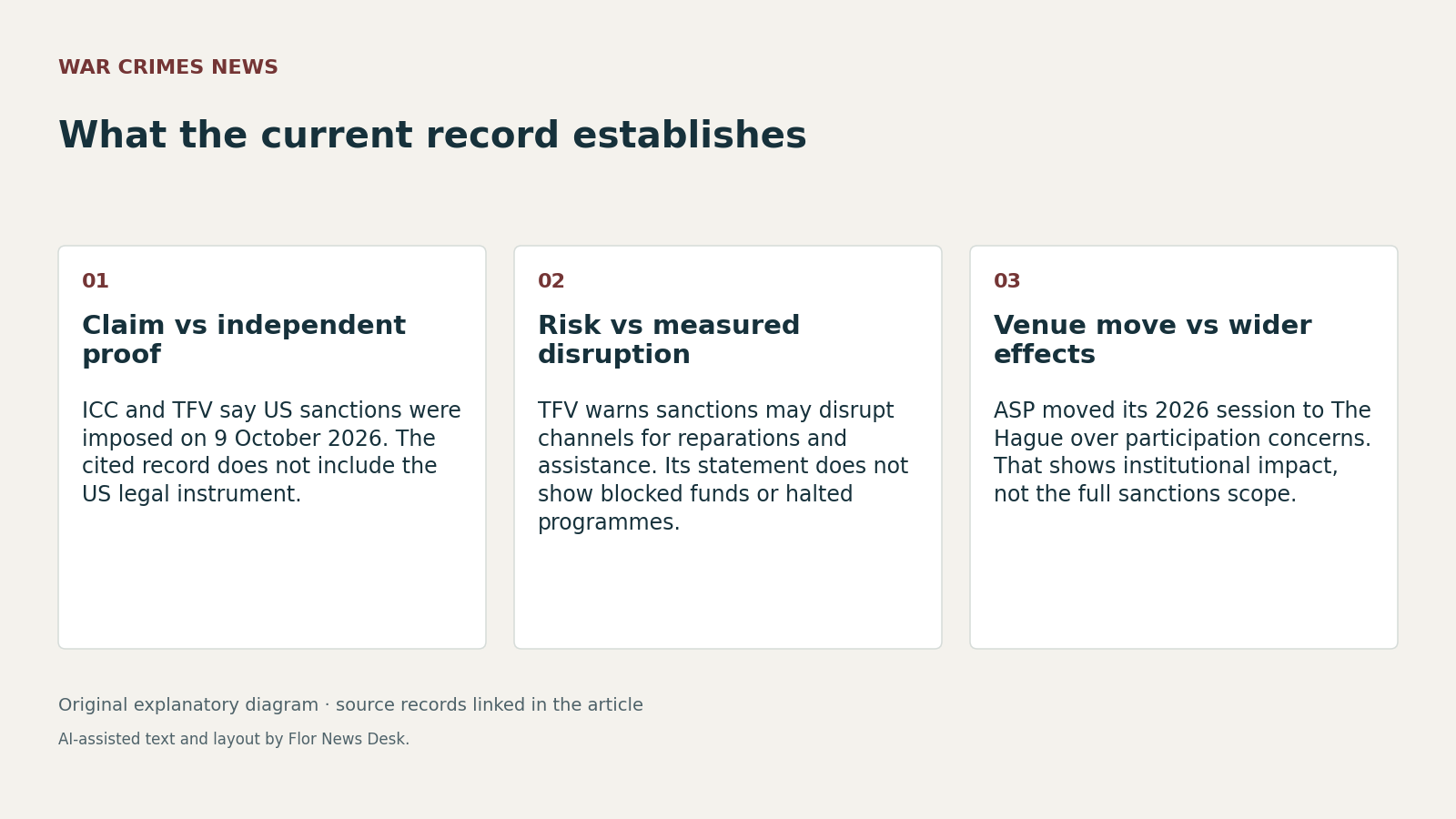

The new development on 9 October 2026 is not that sanctions risk was being discussed in the abstract. It is that the International Criminal Court publicly stated that the United States had imposed sanctions on the Court as an institution on that date, and the Trust Fund for Victims immediately warned that those measures could disrupt the financial and partnership channels used for reparations and assistance programmes (ICC, 9 October 2026; Trust Fund for Victims, 9 October 2026).
Those two pages matter because they move the public record from earlier disputes over individual designations to an institutional claim of action taken on a specific date. The ICC’s 9 October release says the step followed earlier US designations against 13 independent judges and prosecutors and says the Court will continue its mandate. But the available record here remains one-sided: the ICC page does not include the US sanctions instrument, the legal authority used, the enforcing agency, compliance guidance, or evidence that any bank transfer, contract or arrest-related activity was actually blocked on 9 October 2026 (ICC, 9 October 2026).
The Trust Fund for Victims statement is narrower and, for accountability readers, more operationally significant. It says sanctions may disrupt the financial channels, services and partnerships needed to deliver reparations and assistance, including rehabilitation, education, peacebuilding and memorialisation (Trust Fund for Victims, 9 October 2026). That is evidence of a stated institutional risk, not of a proven service interruption. The statement does not identify frozen funds, failed transfers, terminated vendors, affected countries, suspended programmes or the amount of money exposed. The distinction matters: announced pressure on an institution is not the same thing as documented harm to victim-facing delivery.
The Assembly of States Parties had already treated sanctions-related access problems as serious enough to affect its own operations. In a press release published on 29 September 2026, the Assembly said its Bureau had decided on 28 September to move the twenty-fifth session from United Nations Headquarters in New York to The Hague, where it is scheduled for 30 November to 7 December 2026. The stated reason was participation concerns tied to the venue, including elected Court officials subject to US sanctions and visa restrictions affecting some delegations and non-governmental organization representatives (Assembly of States Parties, 29 September 2026). That decision shows a concrete institutional response before the 9 October ICC and Trust Fund statements, but it still does not prove what sanctions legally required or how broadly private actors would comply.
An earlier ICC statement from 19 August 2026 helps explain the trajectory. On that date, the Court said the US administration had announced new designations against Judge Tomoko Akane and Senior Trial Lawyer Abdoulaye Seye, and it gave a time-specific count of sanctioned judges and officials (ICC, 19 August 2026). As of 10 October 2026, that August count should be read only as a historical snapshot, not a complete current roster.
The immediate reporting gap is therefore not whether the ICC objects; that is established. The gap is implementation. The next documents that would materially change the story are the US designation text or sanctions instrument, any Treasury or State Department compliance guidance, evidence from the Trust Fund for Victims or its service providers that transfers or partnerships were actually interrupted, and Assembly participation records showing whether the venue move altered attendance or representation. Until those records appear, the public evidence supports a clear but limited conclusion: ICC-related institutions are publicly describing sanctions as already imposed and as operationally risky, while the mechanism and measurable effects remain unproven in the documents now available.