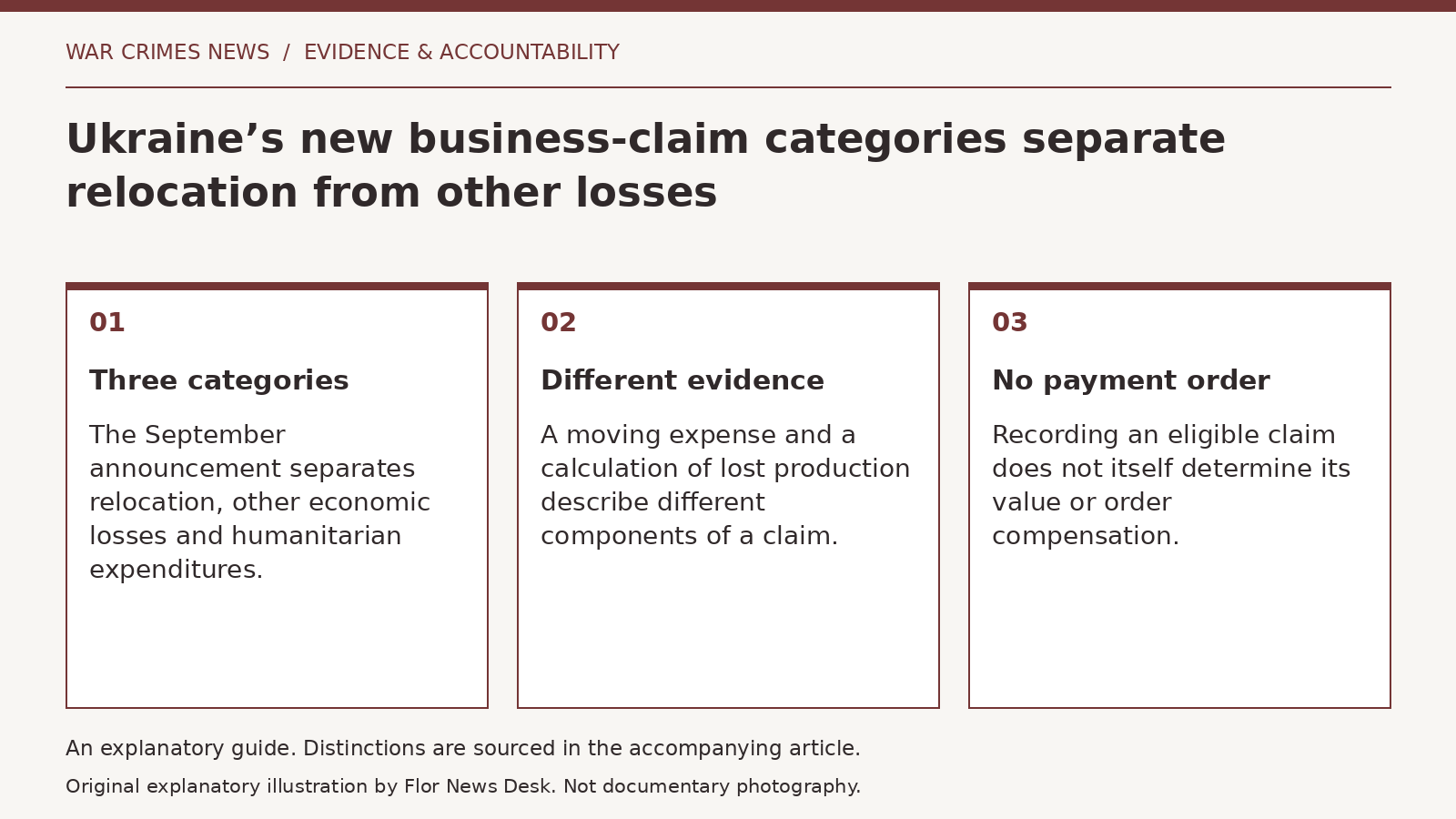
The Register of Damage for Ukraine opened three further claim categories for legal entities on September 10, 2026: business relocation, other economic losses and humanitarian expenditures. Its announcement separates these categories rather than treating every financial consequence of the war as one undifferentiated loss.
The relocation category covers matters such as moving and restarting business activity. The residual economic-loss category excludes losses belonging in other business categories, while humanitarian expenditures concern a different type of spending. The notice also calls for supporting information and an explanation of the amount claimed. These are features of the submission framework, not findings about a particular business.
Identify the event behind an amount
Consider a fictional workshop that moves equipment and loses several weeks of production. A transport invoice could document a moving expense. It would not establish the value of production that did not occur. A calculation of interrupted production would address another proposition, requiring its own assumptions and supporting records.
That example does not decide which category a real claim belongs in. It illustrates why an amount and its description have to remain connected. Combining different components without identifying them could make the total harder to examine, even when the arithmetic is correct.
The register’s mandate explanation draws a further boundary: it receives and processes claims and records those meeting eligibility criteria, but does not decide their merits, determine their value or order payment. Those later functions belong to the compensation mechanism being developed separately.
Registration is one stage
In the fictional workshop’s record, a submission receipt would establish that material was sent. It would not show that every assertion was accepted or that a payment had been ordered. A later decision would need to be read for the specific question it determined.
The September expansion therefore concerns the kinds of claims that can enter the process. It should not be described as money already distributed or as a criminal judgment against an individual. The useful reporting distinction is between the event alleged, the evidence offered, the processing stage reached and any later determination. Each requires a record appropriate to that claim.