
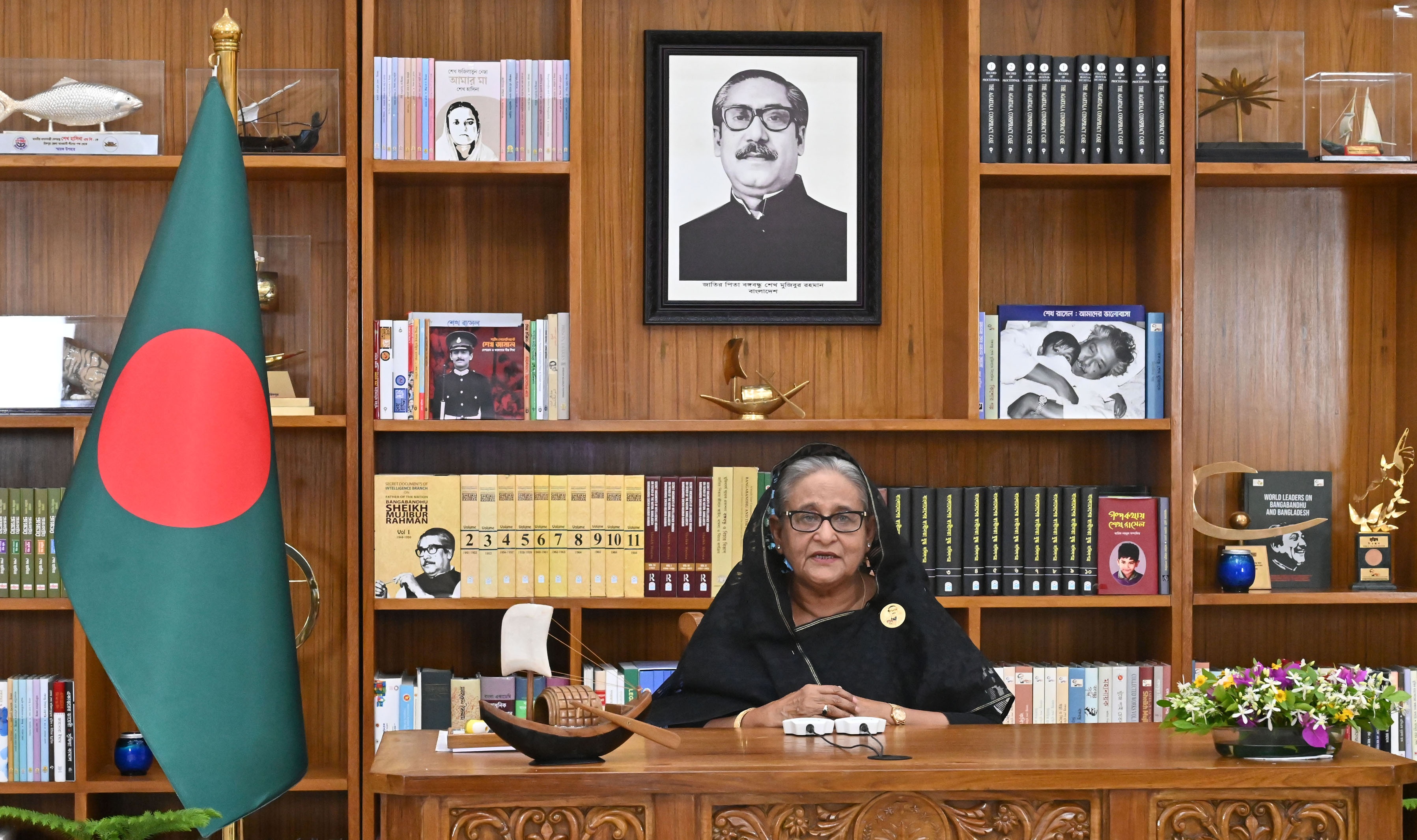
Bangladesh’s prosecution of Sheikh Hasina raises two questions that should not be collapsed into one: whether grave abuses require accountability, and whether the institutions delivering it are independent and fair. A credible answer must protect victims without treating the political identity of an accused person—or an entire party’s supporters—as a substitute for evidence.
On November 17, 2025, Bangladesh’s International Crimes Tribunal convicted Hasina and former home minister Asaduzzaman Khan Kamal of crimes against humanity and sentenced them to death in absentia. Human Rights Watch’s assessment documented serious fair-trial concerns. Neither that criticism nor Hasina’s rejection of the judgment, however, is itself a judicial ruling overturning the convictions.
The most defensible criticism is therefore not that accountability must stop. It is that the proceedings, political restrictions and irreversible punishment require scrutiny strong enough to distinguish justice from political exclusion.
The ICC and Bangladesh’s tribunal are different institutions
The International Criminal Court in The Hague is not the court that sentenced Hasina. Bangladesh’s International Crimes Tribunal is a domestic institution, created in 2010 under national legislation originally directed at atrocities during the 1971 independence struggle. Its name does not make it an ICC chamber, nor does reference to international criminal law amount to endorsement by an international court. The tribunal’s history and the 2025 proceedings should be read with that distinction in mind.
The ICC’s publicly described Bangladesh/Myanmar investigation concerns alleged crimes against the Rohingya linked to violence in Myanmar and their cross-border consequences. Bangladesh’s Rome Statute membership, effective from June 1, 2010, provides a jurisdictional connection. That investigation must not be represented as an ICC trial of Hasina over the 2024 protests.
Under Articles 12–17 of the Rome Statute, jurisdiction and admissibility are separate requirements. The ICC complements national proceedings; it is not a general appeal court empowered to cancel any disputed domestic judgment. A complaint, communication or demand for ICC intervention is not equivalent to an opened case or an arrest warrant.
Similarly, a crime against humanity is not simply another name for a war crime. Article 7 addresses specified acts committed within a widespread or systematic attack on civilians, with the required knowledge. The absence of a conventional war does not by itself defeat such a charge. The issue is whether the relevant legal elements and individual responsibility were properly established.
Victims’ claims cannot be erased by the political argument
The UN human rights office’s February 12, 2025 findings estimated that as many as 1,400 people may have been killed between July 1 and August 15, 2024. The office described evidence of killings, arbitrary detention and torture involving the former government’s security apparatus, and called for further criminal investigation. These were fact-finding conclusions, not a substitute for proving each defendant’s guilt in court.
Hasina’s legal team has challenged aspects of that record. NDTV reported on May 29, 2026 that her counsel sought a retraction of the UN casualty estimate, pointing to a smaller official gazette list. That is a documented challenge by her lawyers, not confirmation that the UN retracted its findings. A named administrative list and an estimate also cannot be equated without examining their periods, definitions and methods.
The proper response to disputed figures is access to evidence and a transparent accounting of the dead—not a presumption that all allegations are fabricated, or that every contested allegation has already been proved.
Fair process is part of accountability, not an obstacle to it
Human Rights Watch reported that Hasina and Khan lacked lawyers of their own choosing. Their state-appointed lawyer could cross-examine prosecution witnesses but presented no defence witnesses. The organisation also identified constitutional restrictions on protections otherwise available to defendants, and recalled similar tribunal failures during Hasina’s own rule. Those points, set out in its November 2025 assessment, are concrete issues for scrutiny, not merely partisan objections.
The UN human rights office’s statement on the verdict recognised its significance for victims while stressing fair-trial standards and opposing the death penalty. Importantly, the office said it had not been privy to the conduct of the trial. Its statement should not be misrepresented as either a comprehensive validation of the proceedings or an international annulment of them.
For this analysis, the decisive questions are practical: Could the defence meaningfully test recordings and witness accounts? Were disclosure and preparation adequate? Were judges insulated from political pressure? Is there an effective route to challenge material errors? A government’s insistence that nobody is above the law is persuasive only when the state itself accepts those constraints.
Judicial change under street pressure
The concern about pressure on the judiciary has a documented starting point. On August 10, 2024, Chief Justice Obaidul Hassan resigned after student protesters threatened consequences if he remained in office. Reuters reported the resignation and the protesters’ threats, as well as law adviser Asif Nazrul’s appeal for protesters to remain peaceful and avoid damaging public property.
A judiciary associated with an ousted administration may require substantial reform. But removing political influence cannot mean replacing it with intimidation by crowds. The relevant test is whether appointments, removals and disciplinary decisions follow transparent procedures that protect judges from retaliation for unpopular rulings.
This episode concerns the Supreme Court, not proof that every member of the International Crimes Tribunal was appointed by a mob or that a particular judgment was dictated outside court. Its significance is institutional: a transition that promises independent justice must explain how judges and lawyers are protected from both government interference and coercive street pressure. Neither the previous administration’s record nor popular anger dispenses with that obligation.
The prosecution-corruption allegations: names, denials and evidence
The question of corruption within the prosecution is not confined to anonymous political accusations. On February 23, 2026, fellow prosecutor BM Sultan Mahmud publicly accused outgoing chief prosecutor Mohammad Tajul Islam and prosecutor Gazi Monawar Hossain Tamim of corruption. Prothom Alo reported that Sultan alleged improper financial arrangements surrounding the conversion of accused people into state witnesses. He specifically questioned the treatment of former police chief Chowdhury Abdullah Al-Mamun and former Ashulia sub-inspector Sheikh Abzalul Haque. Tajul rejected the allegations, attributing them to personal resentment and defending the proceedings as transparent.
Mamun’s role makes the issue directly relevant to scrutiny of Hasina’s trial: he was a co-accused who became a prosecution witness and received a five-year sentence in the November 17 judgment. That does not prove his evidence was purchased. It does make disclosure of any benefits, communications and conditions attached to his cooperation important when assessing his testimony.
There were also specific evidence-preservation concerns. The Daily Star reported on March 31 that a fact-finding committee had been formed on March 10, headed by Chief Prosecutor Aminul Islam. A hard drive expected to contain footage relevant to an alleged visit to Tamim’s office had been replaced. The registrar described equipment replacement as routine maintenance and denied that a particular camera had been targeted. Tajul and Tamim denied wrongdoing. A replaced drive raises questions about preservation and access; it is not, without further evidence, proof of deliberate destruction or of a bribe.
A separate case produced a more concrete, though limited, development. New Age reported on April 21 that Aminul said investigators had authenticated a recording concerning an alleged Tk 1 crore demand by removed prosecutor Saimum Reza Talukder for bail for former lawmaker ABM Fazle Karim Chowdhury. He said no further findings had then been established and the committee had not submitted its final report. This concerned a different defendant and prosecutor; it cannot be presented as a finding that Tajul took money during Hasina’s trial.
The reports reviewed for this update do not establish a final finding that Tajul accepted bribes. They do justify demands for an independent, published accounting of the allegations, preservation of relevant records and disclosure of any evidence affecting witness credibility. Any resulting challenge to a conviction would need to show how proved misconduct affected the evidence or fairness of that particular case. Allegations against prosecutors should neither be buried nor converted into automatic acquittals.
Hasina’s own position: rejecting the trial while demanding legal protection
In an interview transcript supplied to the publisher and identified as a recent NDTV telephone interview, Hasina said: “I categorically reject the trial process and its outcome.” She described the death sentence as politically motivated and unjust.
She also said: “I expect the same fair application of the law in my own case,” and: “I demand full legal protection of my rights as a citizen throughout any judicial process.” In the same supplied account, she expressed willingness to face imprisonment as part of continuing her political work and reiterated an intention to return to Bangladesh by December 2026.
The original recording and broadcast date of that supplied interview have not been independently verified for this article. These quotations are attributed to the supplied transcript, not presented as a new interview conducted by War Crimes News.
Her statements establish her position, not the truth of every allegation she makes about the authorities. Nor does a willingness to face imprisonment amount to accepting a conviction or waiving defence rights. The meaningful distinction is between opposition to accountability itself and opposition to a particular process alleged to be unfair.
The Awami League ban changes the stakes
The treatment of the Awami League makes the question broader than one former leader’s criminal responsibility. Human Rights Watch documented a May 12, 2025 ban under amended anti-terrorism powers, covering meetings, publications and online speech supporting the party. It described the restrictions being used against party members and peaceful activists.
A restriction presented as temporary can still have lasting political consequences. When a party’s ability to organise is tied to the conclusion of lengthy criminal proceedings, the duration of litigation becomes a factor in electoral competition. That connection warrants examination of necessity, proportionality and independent review; it does not, by itself, establish that every judge acted with an improper motive.
Claims that the party has more than 60 million active followers are not independently established in the evidence reviewed for this article. The argument does not need an unsupported membership number. The Awami League is a longstanding major political organisation, and peaceful supporters retain individual rights regardless of allegations against its leadership.
Criminal responsibility should attach to proved conduct. A party affiliation is not a confession, and a conviction against leaders does not automatically demonstrate the guilt of every member or voter. Conversely, the size or history of a party cannot shield officials from prosecution supported by evidence.
The chronology must also be kept current. The 2025 verdict and ban arose under the interim administration; Human Rights Watch’s March 2026 assessment records that Tarique Rahman took office following the February election. Its August 23, 2026 report subsequently raised concerns about prolonged detention of people linked to the former government, including detainees without charges and deaths in custody. Those allegations require investigation on their own merits, not dismissal because the people affected belonged to the previous ruling party.
The U.S. trade deal: agriculture, garments and energy
The commercial relationship extends well beyond aircraft. The February 9, 2026 reciprocal-trade agreement was negotiated under Muhammad Yunus’s interim administration. Its scale gives critics a stronger basis for scrutiny than general assertions about foreign influence.
The joint U.S.–Bangladesh statement identified approximately $3.5 billion in purchases of American agricultural products, including wheat, soy, cotton and corn, and an estimated $15 billion in energy purchases over 15 years. It also described preferential access for American industrial and agricultural goods. These were announced commercial arrangements and commitments, not evidence that the full sums had already been paid or all supplies delivered.
The U.S. Trade Representative’s account presented the agreement as an expansion of opportunities for American exporters. The bilateral statement presented improved access to the U.S. market as Bangladesh’s corresponding gain. Both sides’ descriptions should be tested against the final obligations, implementation and distribution of costs—not treated as independent assessments of who ultimately benefits.
Agriculture: cheaper supplies or pressure on domestic producers?
For agriculture, the policy question is who gains from preferential imports and who bears the adjustment. Lower-cost food or inputs could benefit consumers and manufacturers; direct competition with domestic production could reduce some farmers’ margins. These are potential channels of impact, not measured outcomes established by the agreement itself.
A serious assessment would identify the products and quantities actually imported, compare landed prices with alternative suppliers, and examine effects on farm-gate prices and public procurement. It would also distinguish food imports from industrial inputs such as cotton. Combining them into a single claim that Bangladeshi agriculture has been destroyed conceals more than it explains.
Garments: market access with conditions attached
At signing, the agreement envisaged a 19 percent U.S. reciprocal tariff on originating Bangladeshi goods and a mechanism allowing a to-be-specified volume of textiles and apparel to receive a zero reciprocal rate, linked to exports of U.S.-produced textile inputs. Those are the terms described in the February statement, not an assertion that 19 percent is the applicable customs rate on every shipment today. A zero reciprocal tariff also should not be confused with the elimination of every other import duty.
The proposed mechanism warrants examination of sourcing costs and bargaining power. Does the value of improved American market access outweigh any added cost of procuring qualifying inputs? How are the benefits distributed among exporters, domestic textile suppliers and workers? Those questions require the operating rules and actual orders, not assumptions that all garments qualify or that the arrangement benefits every part of the industry equally.
Energy: long-term purchases need a public value-for-money test
The announced 15-year energy-purchase horizon raises a different set of questions: pricing formulas, delivery reliability, foreign-exchange exposure, flexibility to change suppliers and the relationship to domestic production and renewable investment. Long-term supply can reduce some risks, but inflexible or overpriced commitments can create others. Publishing the relevant procurement terms would allow those possibilities to be evaluated.
Bangladesh’s economic critics have made objections on the record. At a February 28 briefing, the Centre for Policy Dialogue urged the newly elected government to withdraw from the agreement, describing it as discriminatory and warning about restrictions on economic policy choices and trade with third countries. The Business Standard’s report attributed that assessment to the think tank; it is a substantive criticism, not a judicial determination that the agreement is unlawful.
Industrial distress must also be examined without assuming a single cause. Reuters’ September 22 reporting documented gas shortages, unreliable electricity and production disruption in Bangladesh’s garment sector amid the Middle East energy crisis. That evidence of serious strain does not establish that the February trade agreement alone caused it.
The defensible conclusion is that American suppliers obtained valuable announced commercial opportunities while Bangladesh took on commitments deserving independent scrutiny. The evidence cited here does not establish that agriculture, garments and energy were all completely destroyed by one deal, or that the purchases were payment for installing a government. Establishing personal enrichment or foreign direction would require identifiable financial records, contracts, communications or corroborated testimony—not merely a list of commercial beneficiaries.
U.S. interests and Boeing: documented gains, unproved judicial linkage
American commercial gains belong in an examination of the wider political setting, provided they are not turned into proof of an unestablished conspiracy.
On April 30, 2026, Boeing and Biman Bangladesh Airlines announced an order for 14 aircraft: eight 787-10s, two 787-9s and four 737-8s. Reuters reported that the move away from Airbus came amid U.S. trade pressure. The approximately $3.7 billion figure was a list-price estimate, not a disclosed final contract payment.
There is a newer development: on September 23, 2026, Boeing announced 11 additional aircraft, comprising five 787-10s and six 737-8s. The company said the two purchases brought the year’s orders to 25 aircraft. Senior U.S. and Bangladeshi officials attended the signing alongside the UN General Assembly.
These announcements establish commercial engagement and a valuable export relationship. They give a concrete basis for examining how trade leverage, access and diplomatic priorities interact. They do not establish that Washington directed a tribunal, purchased a verdict or caused Hasina’s removal.
The distinction matters because an identifiable beneficiary is not necessarily the author of the events from which it benefits. A claim connecting aircraft purchases to judicial decisions would require additional evidence—such as authenticated communications, financial links or credible testimony identifying an actual agreement. The sources reviewed here do not supply that connection.
What Trump’s $29 million allegation does—and does not—show
Donald Trump’s February 21, 2025 remarks about approximately $29 million for Bangladesh’s political landscape prompted allegations of foreign interference. But the existence of a political-assistance programme must be separated from claims about its recipients, expenditure and purpose.
Democracy International’s own description identifies a USAID-funded Strengthening Political Landscape programme and a multiparty fellowship intended to develop political skills and reduce polarisation. That establishes organised U.S.-funded political engagement; it does not establish covert control over a government change.
Dismislab’s February 25, 2025 examination identified Democracy International as a U.S.-registered implementing organisation, not the obscure two-person outfit portrayed in the allegation. It reported about $29.9 million approved and $16.9 million disbursed by then, distinguishing the award value from money actually paid. Bangladesh’s foreign ministry also disputed the characterisation.
The legitimate questions are who selected participants, how funds were used, whether political access was balanced and whether programme records support the stated aims. Describing the entire sum as proven funding to overthrow Hasina, exploit Bangladesh’s democracy or dictate her sentence would go beyond the evidence. The programme also predated her August 2024 departure, so chronology must be examined rather than treated as proof of causation.
The test: can justice withstand scrutiny without excluding peaceful politics?
The combination of a capital sentence, contested defence safeguards, broad party restrictions and continuing detention concerns justifies close independent examination. It does not permit a responsible analysis to announce that every allegation against Hasina is false or that foreign commercial interests prove a rigged trial.
A credible response would preserve evidence and make judicial reasoning accessible; enable effective defence participation and independent observation; provide meaningful review of party restrictions and individual detentions; investigate custodial deaths; and protect victims and witnesses from intimidation. Suspending irreversible punishment while material fair-trial concerns are addressed would protect the possibility of correcting error.
Any investigation into political interference should follow identifiable acts: who gave instructions, what pressure was applied, which procedures departed from lawful standards, and who can substantiate those claims. Accountability for abuses by the former government and accountability for abuses against its supporters are not competing principles. They are the same principle applied consistently.
The central question is not whether Hasina’s allies or opponents can claim a political victory. It is whether Bangladesh can establish individual responsibility through institutions that remain credible when power changes hands. Justice that relies on silencing peaceful opposition risks becoming another instrument of the cycle it is supposed to end.
The same demand for transparency should extend to the economic agreements and to the prosecution itself. Publish procurement terms and their fiscal implications; disclose relevant conflicts of interest; report the findings and limits of corruption inquiries; and provide a lawful mechanism to revisit evidence shown to have been tainted. A promise of cleaner government is not fulfilled by applying a lower standard to the officials who replaced the previous administration. Nor should a serious allegation be used to substitute collective political blame for proof of individual conduct.