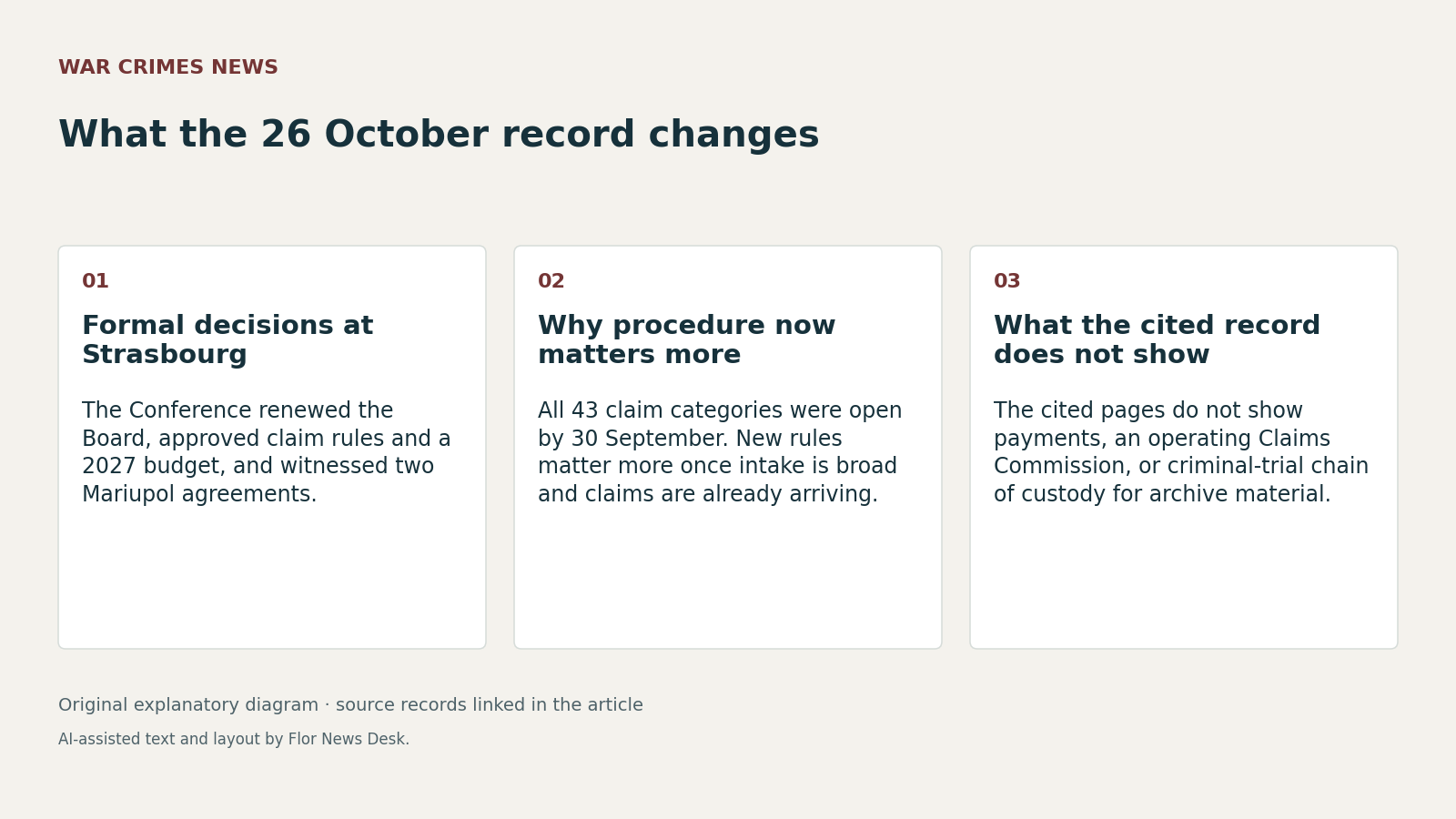

The Register of Damage for Ukraine’s Conference of Participants on 26 October 2026 changed the institutional record in a narrower but important way: it renewed the body’s leadership, approved additional claims rules, and formalised cooperation with Mariupol authorities and a municipal archive. Those moves matter because the Register already says all 43 claim categories are open for submission. They do not, on the cited pages, establish compensation awards, payouts, or a working International Claims Commission. Conference notice All categories notice RD4U homepage
The governance part is concrete. The 26 October notice says the Conference, meeting in Strasbourg at its eighth session, re-appointed all seven Board members for a second, non-renewable three-year term, received an update on implementation of the 2026 budget, and approved an adjusted budget for 2027. That is evidence of continuity and planning, not of outcome. The notice gives no budget figures and no measure of whether staffing, technology or review capacity changed. Without those underlying documents, readers can say the institution has extended its leadership and approved spending plans, but not whether it materially increased its ability to process claims. Conference notice
The new rules are potentially more significant than the reappointments, precisely because the intake system is already broad. On 30 September 2026, the Register said all 43 categories were open and that it had received 195,000 claims, recording more than 65,000 while the rest were still being processed. Against that backdrop, the 26 October approval of Rules Governing the Succession to Claims and revised Rules Governing the Submission, Processing and Recording of Claims suggests the institution is moving from category-by-category launch to procedure-setting at scale. But the cited record does not include the text of either set of rules, so it cannot show who may succeed to a claim, what filing burdens changed, or whether review standards became stricter or looser. All categories notice Conference notice
The Mariupol agreements are also concrete, but their legal and evidentiary significance should be kept in bounds. In the Conference’s presence, Mariupol mayor Vadym Boichenko and Executive Director Markiyan Kliuchkovskyi signed a Memorandum of Cooperation between the Register and the City of Mariupol, plus an Information Transfer Agreement between the Mariupol Municipal War Archive and the Register. Separately, the 30 September page says local authorities and municipal institutions can submit the final three state categories the Register opened. Read together, those records indicate a plausible bridge between municipal documentation and claims submission. They do not show what records, if any, were transferred, on what timetable, with what authentication, or with what custody arrangements for criminal proceedings. Conference notice All categories notice
That limit matters because the Register’s own public framing remains transitional. Its homepage presents the Register as the first step toward a future mechanism for justice and compensation, and the 26 October notice says participants discussed progress toward establishing the International Claims Commission for Ukraine, including national processes and plans for signing and ratifying the convention that would create it. That is best read as architecture under construction, not completion. The cited pages do not provide country-by-country signature or ratification status, and they do not show that the Commission exists or can order compensation. RD4U homepage Conference notice
For accountability reporting, the practical takeaway is specific. As of 31 October 2026, the public record cited here supports saying that the Register has tightened governance, adopted more procedural rules and opened a formal cooperation channel with Mariupol-linked institutions after opening all claim categories. It does not yet support saying how those rules work in practice, whether the archive arrangement has produced usable transfers, whether 2027 funding is adequate, or whether the larger compensation mechanism has crossed from planning into operation. The next decisive records would be the texts of the approved rules, the terms of the Mariupol agreements, budget figures and execution reports, and formal convention-signature or ratification instruments. Conference notice RD4U homepage