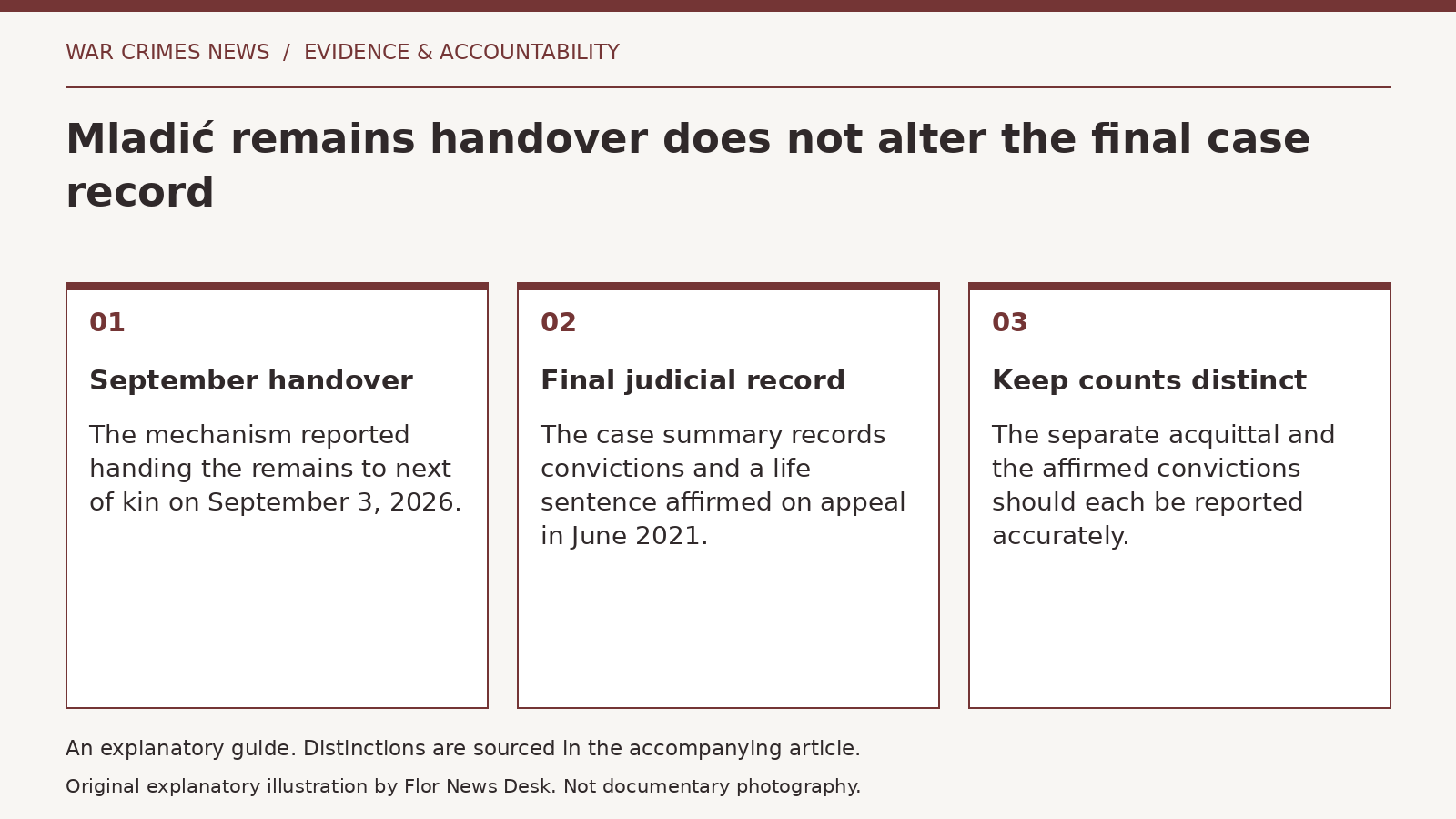
The International Residual Mechanism for Criminal Tribunals reported on September 3, 2026 that Ratko Mladić’s remains had been handed to his next of kin. Its announcement follows his death in a hospital in The Hague on August 27. The mechanism linked the handover to standards governing the treatment of deceased prisoners and rejected glorification of convicted war criminals.
The transfer is an administrative event after death. It is not a new judgment, an acquittal or a revision of the earlier case. The difference matters when a current headline brings a long-completed prosecution back into the news.
Two timelines in one account
The mechanism’s case summary records the trial judgment of November 22, 2017 and the appeal judgment of June 8, 2021. The convictions and life sentence were affirmed on appeal. The summary includes the Srebrenica genocide conviction, while also recording the acquittal on the separate genocide count concerning municipalities elsewhere in Bosnia and Herzegovina.
Preserving the distinction between those counts is part of accurately describing the result. A conviction on one count does not authorize rewriting an acquittal on another, and an acquittal on one count does not erase the convictions that remained in force.
A hypothetical court chronology illustrates the reporting task. One entry records a judgment; another records its appeal; a later entry concerns custody or administration. Sorting the events by date helps a reader follow them, but chronology alone does not make the latest entry a reconsideration of everything before it.
Humane treatment and accountability
There is no logical contradiction between reporting humane administrative treatment and accurately recording a person’s convictions. They concern different responsibilities. Neither a family handover nor its location supplies a new assessment of the underlying evidence.
This account relies on the mechanism’s public announcement and case summary, not an examination of a newly issued judgment or private family records. It does not attribute individual criminal responsibility to a population or ethnic group.
The current development is therefore specific: the remains were handed to family following the reported death. The criminal case must still be described through its judgments and the distinct outcomes of its counts, rather than through assumptions attached to that later administrative event.