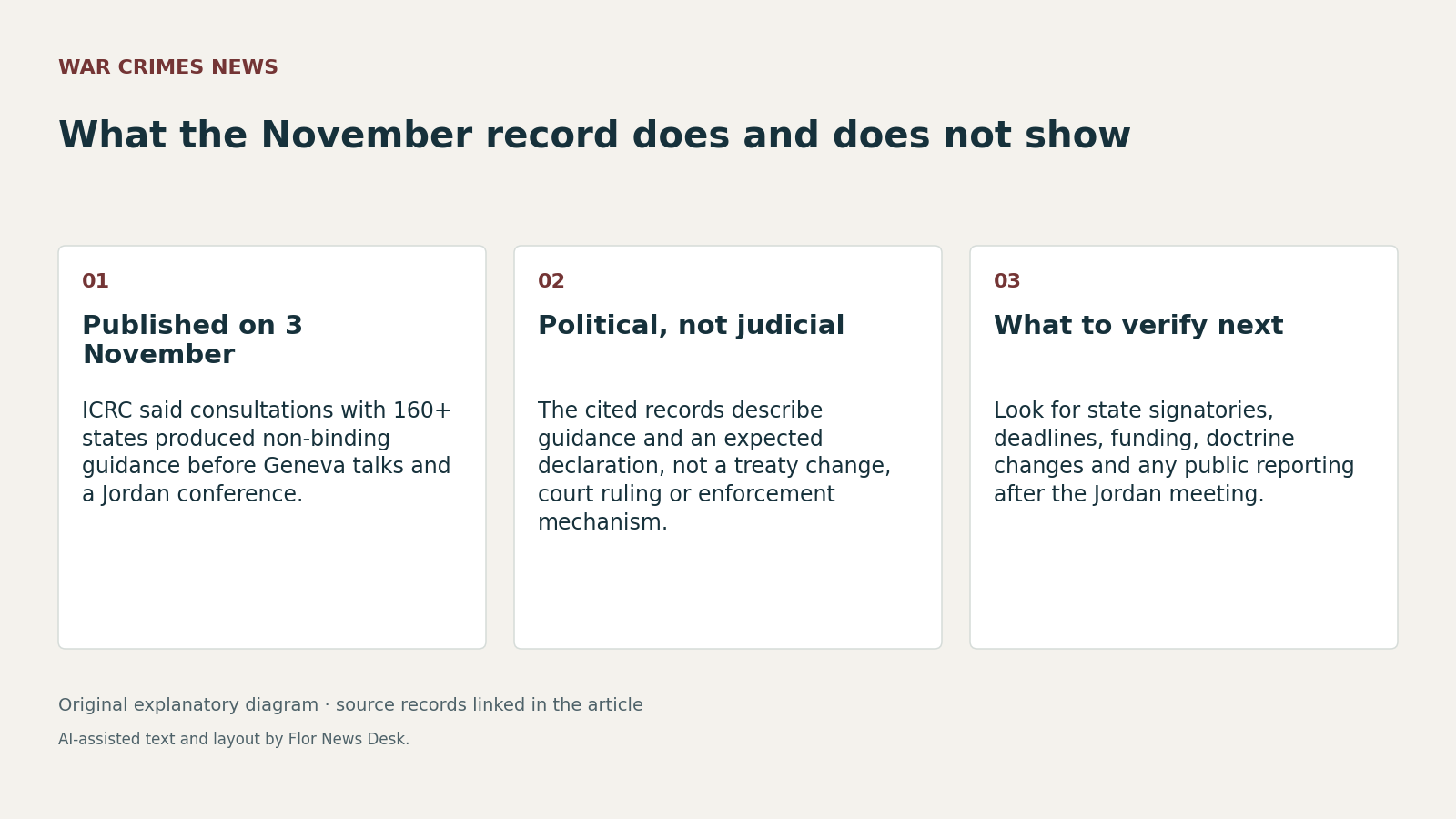

The most important fact established by the 3 November public record is narrow but significant: the International Committee of the Red Cross said two years of state-led consultations involving more than 160 states had produced practical, non-binding guidance on better application of international humanitarian law, timed before the Global IHL Dialogue in Geneva on 3 and 4 November 2026 and before a high-level conference in Jordan on 7 December 2026. That is a political and operational development, not a judicial one. The cited record does not amount to a treaty amendment, a court ruling or proof that any state has implemented a listed measure. ICRC statement, 3 November 2026
What makes the 3 November statement newsworthy is that it points to specific practices rather than abstract support for the law of war. The ICRC said the guidance covers how armed forces refer to adversaries and civilians, monitoring social media use by armed forces and public authorities, protected zones around essential infrastructure, medical facilities on no-strike lists, civil-military coordination and safe maritime corridors for essential goods. Those examples are concrete enough to test later against military manuals, public directives or national plans. But the same source record also limits the claim: it is an ICRC statement describing guidance, not the full legal text of a new instrument, and it does not identify which states accepted which step. ICRC statement, 3 November 2026
The broader initiative was already framed in political terms on 23 September 2026, when Brazil, China, France, Jordan, Kazakhstan and South Africa, together with the ICRC president, said Jordan would host the High-Level Conference to Uphold Humanity in War on 7 December 2026 and that states would issue a concise political declaration after consultations. That statement also said 27 states had co-led seven thematic workstreams. As of 6 November 2026, however, that September language remains an expectation recorded before the event. It does not establish that a declaration was later adopted or what it contained. Joint statement, 23 September 2026
The state counts in the public record also require care. The 3 November ICRC note to editors said 127 states had officially joined the Global IHL Initiative, while the 23 September joint statement gave 118 as of that date, and the 3 November statement separately referred to consultations involving more than 160 states. Those are not necessarily the same category. A fourth figure appears in a United Nations transcript page for the Sixth Committee’s 19 October meeting, where Jordan was transcribed as saying 125 states had joined. But that page warns it is generated by automatic speech recognition, says the audio no longer matches in places, and gives 7 November for the Jordan conference, which conflicts with the ICRC’s 7 December date. It is useful evidence of what speakers were recorded as saying, not a reliable scheduling record on its own. ICRC statement, 3 November 2026 Joint statement, 23 September 2026 UN Sixth Committee transcript page
For accountability reporting, the limit is as important as the substance. Non-binding guidance can shape expectations, internal doctrine or later public promises, but the cited records do not create criminal liability, reparations rights, investigatory powers or any verification mechanism. That is analysis drawn from the sources’ own descriptions of the process as guidance and a planned political declaration. Any later accountability significance would depend on additional records showing state adoption, funding, orders, reporting duties or operational use. ICRC statement, 3 November 2026 Joint statement, 23 September 2026
The practical checks for the 7 December Jordan meeting therefore are documentary, not rhetorical: whether a final declaration is published; which states are named as endorsers; whether any annexes set deadlines, funding lines or reporting obligations; and whether governments release national doctrine updates tied to the listed measures. Reporters should also seek an official post-event record of the 3 and 4 November Geneva dialogue, because by 6 November those dates had already passed, yet the sources retrieved here do not establish what was agreed there. ICRC statement, 3 November 2026