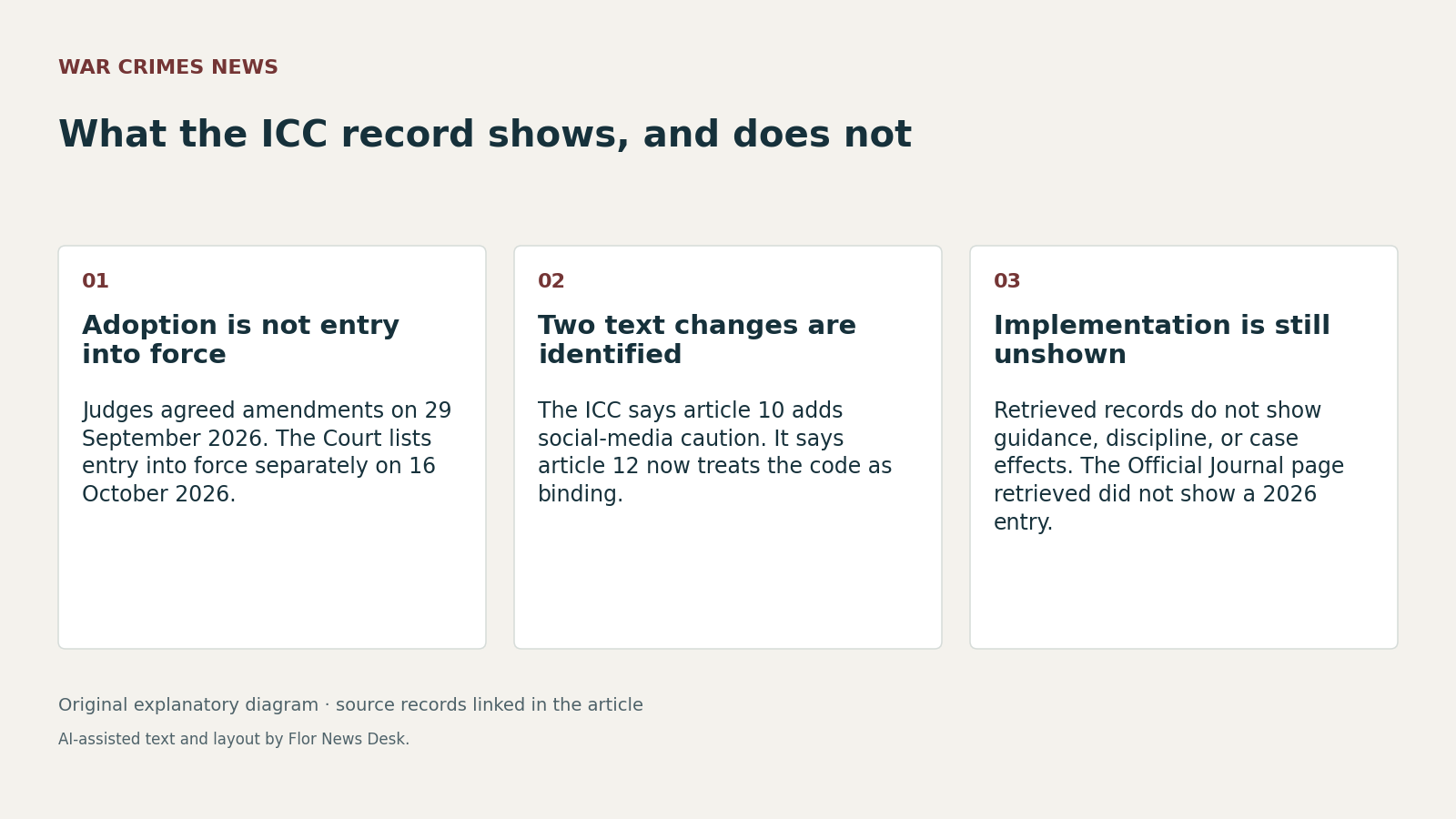

On 16 October 2026, the International Criminal Court said a revised Code of Judicial Ethics entered into force, after judges had agreed the amendments on 29 September 2026 during their annual retreat. The clearest point established by the retrieved record is institutional and narrow: the Court says two ethics provisions changed and are now in force. The same record does not yet show how those changes will be applied in disciplinary practice, case management or public reporting of alleged breaches (ICC amendment release, core legal texts listing).
According to the ICC’s 16 October release, judges added a new sub-paragraph 3 to article 10 stating that judges shall exercise caution when using social media and other information technologies. The Court also says article 12 now states that the ethical standards in the code are binding and that non-compliance may amount to misconduct. The Court attributes those amendments to regulation 126 of the Regulations of the Court (ICC amendment release).
The distinction between agreement and legal effect matters here because the earlier retreat announcement described a different procedural moment. On 30 September 2026, the ICC said judges had agreed to amend Chapter 8 of the Regulations of the Court, that those proposed amendments would be submitted to the Advisory Committee on Legal Texts, that article 12 would be revised to recognise binding standards, and that language had been finalised for an added paragraph to article 10 on social media. That release also said the revised code would be published shortly. By 19 October 2026, that phrasing was already a past expectation, not proof by itself of entry into force or implementation (retreat release).
What moves the story from proposal to adopted court text is the later record. The ICC’s core legal texts page lists a 2026 Code of Judicial Ethics entry, identified as ICC-BD/02-04-26, with an adoption date of 29 September 2026 and an entry-into-force date of 16 October 2026. That page is useful because it separates the retreat decision from the later effective date, and because it shows the Court treating the 2026 code as a distinct edition alongside 2022, 2021 and 2005 versions (core legal texts listing).
But one part of the publication trail remains incomplete in the retrieved material. As retrieved on 19 October 2026, the ICC’s Official Journal page for the Code of Judicial Ethics displayed editions from 2022, 2021 and 2005, not a 2026 entry. That means the available Official Journal page does not directly verify a 2026 posting there, even though the Court’s 16 October release says the amendments entered into force upon publication of the amended code on the ICC website (Official Journal page, ICC amendment release).
The accountability question now is not whether the Court announced an ethics change, but whether the Court will make its operation visible. That is analysis, based on the record’s limits: the retrieved sources do not include disciplinary filings, Presidency or Registry guidance, advisory decisions, or case-level rulings showing how article 12’s new binding language will be used. They also do not establish whether the separate Chapter 8 disciplinary-regime amendments mentioned on 30 September 2026 have since completed their own route through the Court’s legal framework. Until those records appear, the public file supports a precise conclusion and not more: the ICC says the code changed on 16 October 2026, while enforcement and institutional consequences remain unshown in the material reviewed here (retreat release, ICC amendment release, core legal texts listing, Official Journal page).