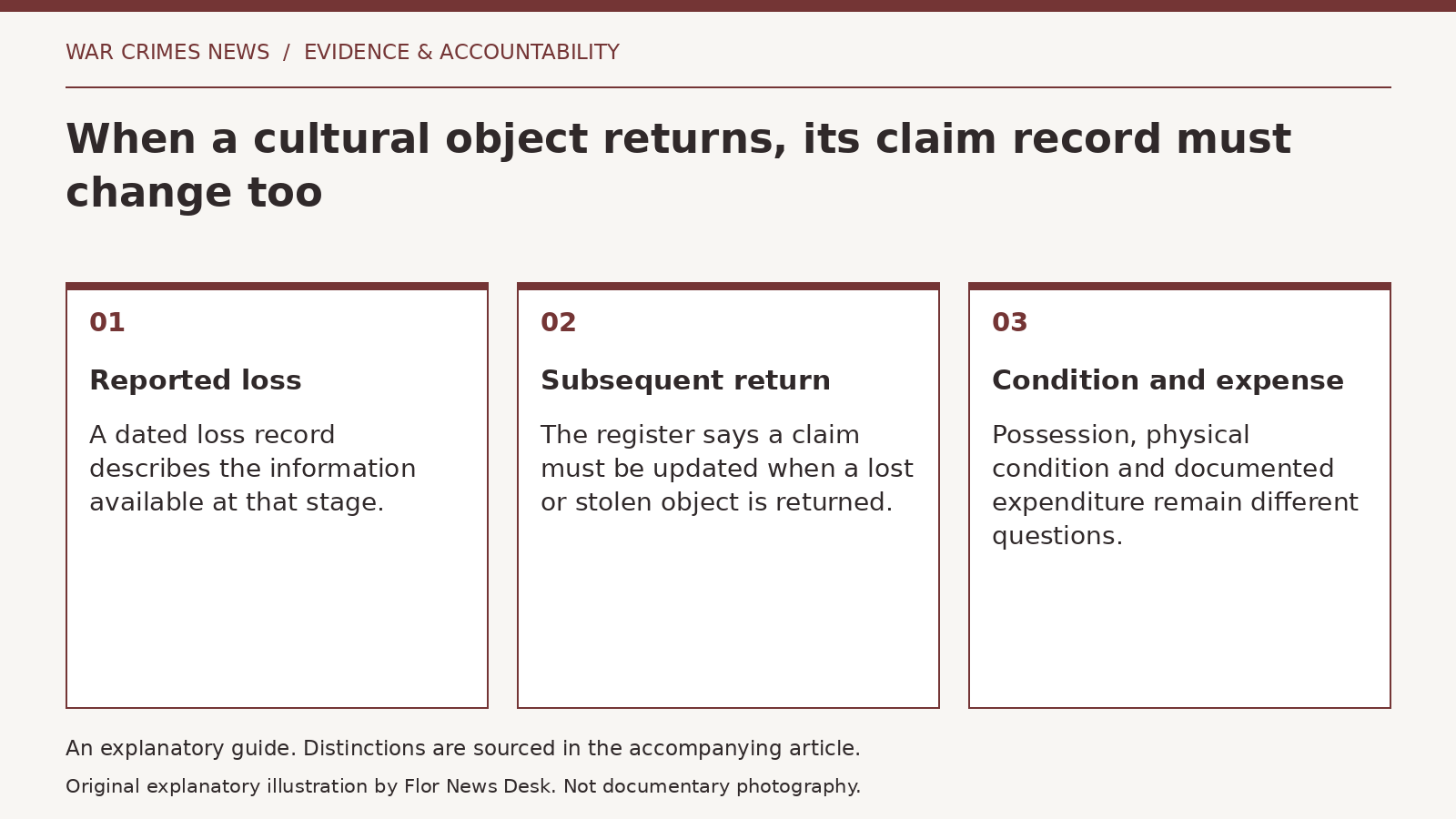
The Register of Damage for Ukraine opened cultural-property claim categories on September 3, 2026. Its announcement concerns damage, destruction or loss of culturally valuable objects and buildings, with categories for public bodies and legal entities. It also identifies a continuing responsibility: a claim must be updated if a lost or stolen object is subsequently returned.
The notice describes potential components including the value of lost property, restoration or conservation work, and expenditure connected with evacuation, protection, searches or return. Listing these components does not establish an award or a criminal conviction. It describes information that can form part of the claim process.
A changing object, a dated record
Imagine a fictional collection reporting an object missing in March and recovering it in August. A March inventory and an August return record can both be accurate. Presenting only the earlier record as the object’s current status would nevertheless give an incomplete account.
Recovery would raise a separate question about condition. The return of an object would not logically demonstrate that it arrived undamaged, just as damage would not demonstrate that it remained missing. Evidence about possession, condition and expenditure answers different questions.
The ICRC’s cultural-property overview explains that cultural property benefits from civilian-object protection and an additional treaty framework. It describes obligations concerning safeguarding and respect for such property. That general legal context does not determine responsibility for an individual object’s loss or establish that a particular event meets the elements of a crime.
Preserve the sequence
In the fictional collection, a search invoice could remain a record of expenditure after an object returned. Whether and how that expense affects a real compensation decision would require the applicable rules and evidence. The example establishes no entitlement; it separates a past expense from a changing possession status.
A useful account would therefore retain the sequence rather than replacing one simple label with another. When was the loss reported? What later information became available? Which component of the claim does that information affect? The September announcement makes the update requirement explicit. Reporting a claim accurately means following that evolving record, not freezing the story at its first submission.