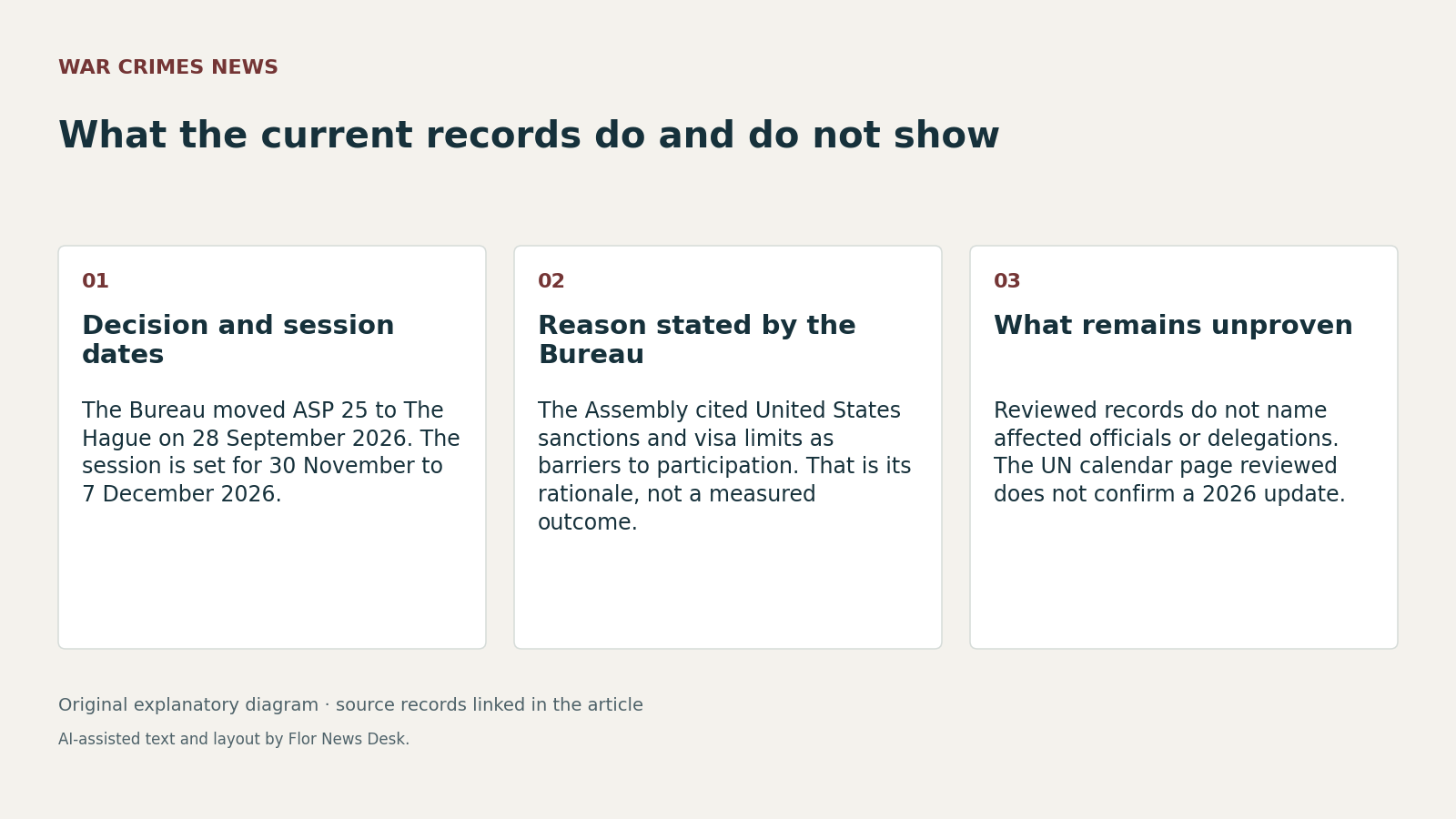

The clearest fact in the current record is administrative. On 28 September 2026, the Bureau of the Assembly of States Parties to the Rome Statute decided to move the Assembly’s twenty-fifth session from United Nations Headquarters in New York to The Hague, with the announcement published on 29 September 2026. The session is scheduled for 30 November to 7 December 2026, and the official pages say 5 and 6 December will be working days (ASP press release; ICC-hosted page).
The stated reason is important, but it should be read precisely. According to the Assembly’s release, the Bureau cited participation limits connected to the New York venue, including United States sanctions affecting elected Court officials and visa restrictions affecting some delegations and representatives of non-governmental organizations. The same release says the decision followed consultations with all States Parties (ASP press release). That establishes the Bureau’s explanation for the move. It does not independently prove which officials, states or NGOs would have been unable to participate, or on what exact legal basis each restriction would operate.
A second boundary appears in the ICC-hosted version of the announcement. That page attributes to Assembly President Päivi Kaukoranta the position that the relocation reflects circumstances specific to 2026 and is not intended to set a precedent for future session venues (ICC-hosted page). Analytically, that matters because it frames the decision as a one-session response, not a settled redesign of how the Assembly relates to New York or the United Nations. It is, however, still an institutional position rather than evidence of how later bureaus will act.
The main gap is on the United Nations side of the record. The reviewed United Nations Department for General Assembly and Conference Management calendar page filtered by organ does not visibly show a 2026 entry for the twenty-fifth session or any relocation notice in the retrieved text (UN calendar page). That absence does not contradict the Bureau’s decision. It means only that this reviewed UN page cannot yet confirm a revised calendar entry, a formal hosting adjustment or any other UN administrative step.
That limitation is more than clerical. Readers may reasonably want to know whether the move changes accreditation, documentation, remote participation, room access or costs. The reviewed records do not answer those questions. They also do not identify the elected officials affected by sanctions or the delegations affected by visa restrictions (ASP press release; ICC-hosted page). The careful reading is therefore narrower than some political commentary will be: a venue decision is verified, while the full operating model and the exact scope of exclusion remain unestablished in the cited record.
What can be said, and no less, is still consequential. About nine weeks before the session opens, the Assembly Bureau concluded that keeping the meeting in New York would limit participation in 2026, so it relocated the session to The Hague for 30 November to 7 December 2026 (ASP press release; ICC-hosted page). What cannot yet be claimed from the reviewed documents is whether the move resolves every access problem, whether the UN has formally updated its own records, or what attendance outcome the change will produce. For accountability reporting, that distinction is the story.