The ICRC’s June 11, 2026 explanation of military artificial intelligence distinguishes decision-support systems from autonomous weapons and other uses of software. Its questions-and-answers page emphasizes that international humanitarian law continues to apply and that human responsibility does not disappear through reliance on a system.
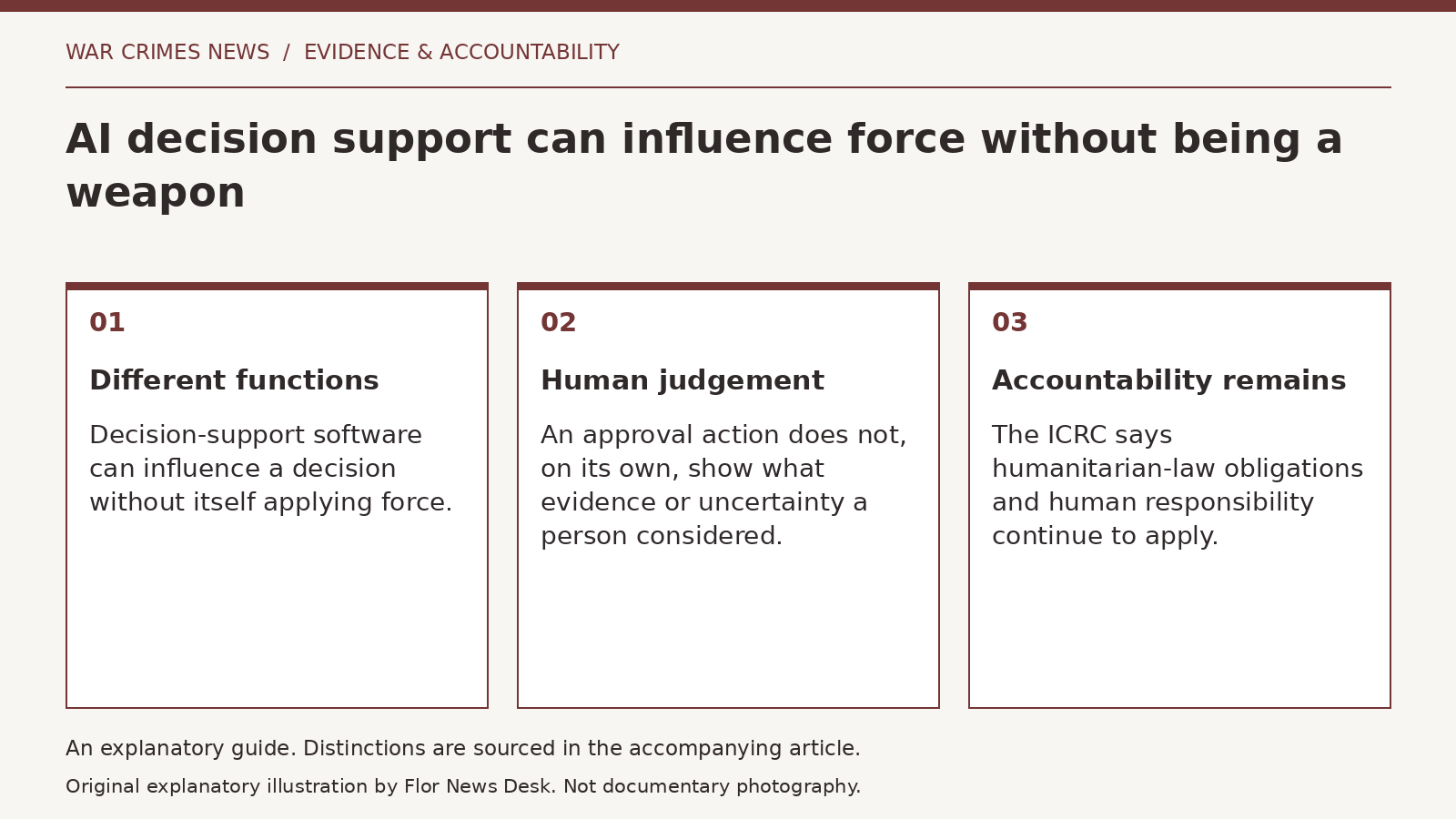
The distinction concerns function, not simply a product label. Software can organize information or present options that influence a decision even when it does not itself apply force. Describing it as advisory does not show how much weight a person actually gives its output.
Examine the judgement, not just the signature
Imagine a fictional review process in which a person receives a machine-generated recommendation. A record showing that the person clicked approval would establish an action. It would not, without more information, establish what evidence they examined, whether they understood uncertainty or whether they considered an alternative.
This example concerns accountability and evaluation, not an instruction for targeting or conducting an operation. A human presence in a process and meaningful human judgement are different claims. Evidence for the first should not automatically be offered as proof of the second.
The ICRC’s 2024 publication overview on military decision support describes systems that display, synthesize or analyse information and proposes examining their influence on decision-making. The public overview was read for this article; no findings from its downloadable report are attributed here without examination.
Uncertainty must remain visible
The June guidance identifies concerns including bias, overreliance and the quality or context of data. These are risks the ICRC describes, not proof that every system produces the same error or that a named incident was caused by software.
In the fictional review, a neatly formatted output could still contain an unresolved uncertainty. Presentation quality would not determine the quality of its supporting information. A useful record would distinguish what was supplied, what remained uncertain and what the human decision-maker concluded.
The legal and institutional question is consequently broader than whether a machine fired a weapon. The cited guidance supports examining how software shapes judgement while preserving responsibility. It does not establish compliance, wrongdoing or causation in a specific operation. Those conclusions would require evidence about that operation rather than an inference from the presence of AI alone.