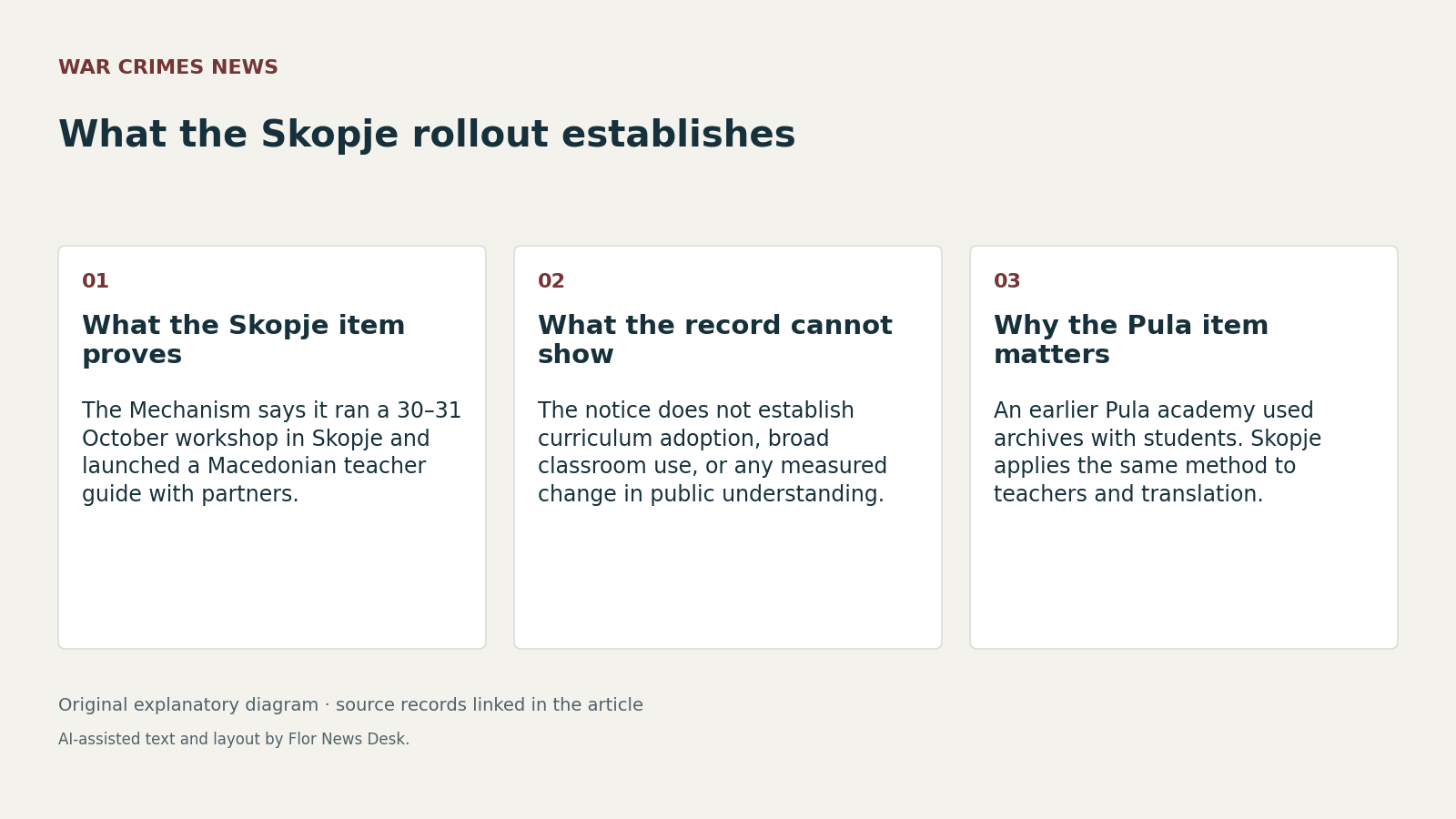
The International Residual Mechanism for Criminal Tribunals has put a specific new fact on the record: its Information Programme for Affected Communities says it held a two-day workshop in Skopje on 30 and 31 October 2026 and launched a Macedonian-language edition of its three-volume Guide for History Teachers, working with the Association of History Teachers of North Macedonia and EuroClio. Skopje workshop item For accountability reporting, that matters less as ceremony than as evidence of a localized education rollout tied to tribunal archives.
The same item describes the workshop as a practical exercise in converting ICTY and Mechanism records into classroom material about the 1990s conflicts in the former Yugoslavia. It says the event took place at the Holocaust Memorial Center for the Jews of Macedonia, and that 25 history teachers from across North Macedonia spent the second day developing lesson plans and teaching materials based on those archives. Skopje workshop item That is a narrower and more concrete activity than simply promoting archival access: the archive is being packaged for teachers' use.
What the record does not do is just as important. The Mechanism's notice does not show that any ministry adopted the guide, that the material entered a national curriculum, or that teachers later used it in classrooms. Skopje workshop item Nor does a translated guide create new legal findings. The judicial record came earlier, through ICTY and Mechanism cases; this workshop concerns how already-adjudicated material may be taught, not what courts have found.
A second Mechanism item from October 2026 helps locate the Skopje event within a broader outreach pattern. In that notice, the institution says MIP joined a Transitional Justice Academy in Pula, Croatia, from 8 to 11 October 2026, where a researcher led sessions on war crimes trials before the ICTY and the Mechanism and on the role of their archives in research, education and legacy work. Participants also used documentary material to examine judicially established facts. Pula academy item The continuity is the archive-based method; the shift in Skopje is the audience and format.
That audience shift is the article's main significance. Pula, as described by the institution, involved students and young professionals from Bosnia and Herzegovina, Croatia and Serbia. Pula academy item Skopje, by contrast, was built around history teachers in North Macedonia and a Macedonian translation. Skopje workshop item On the sourced record, that suggests MIP is moving from general legacy programming toward tools aimed at people who can mediate the tribunal archive for others. That is an inference from the change in participants and materials, not proof of later classroom adoption.
The funding and partnership lines also matter. Both notices say MIP is funded by the European Union. Skopje workshop item Pula academy item The Skopje item further lists local and regional partners and panel participants from Bosnia and Herzegovina, Serbia, Croatia, Montenegro and North Macedonia. Skopje workshop item Those facts do not establish political consensus about the 1990s conflicts, but they do show the Mechanism presenting this initiative as a regional, donor-backed educational project rather than a domestic court process.
Readers should therefore treat the Skopje launch as a documented institutional step, not as evidence of impact already achieved. The strongest supported point is that the Mechanism says it organized a workshop, released a Macedonian-language edition of an existing guide, and had teachers work directly with ICTY and Mechanism archival material. Skopje workshop item The weakest point, because the notices do not establish it, would be any claim about changed curricula, changed public understanding, or implementation beyond the event itself. Both records are institutional media items, not judgments or policy instruments. Skopje workshop item Pula academy item