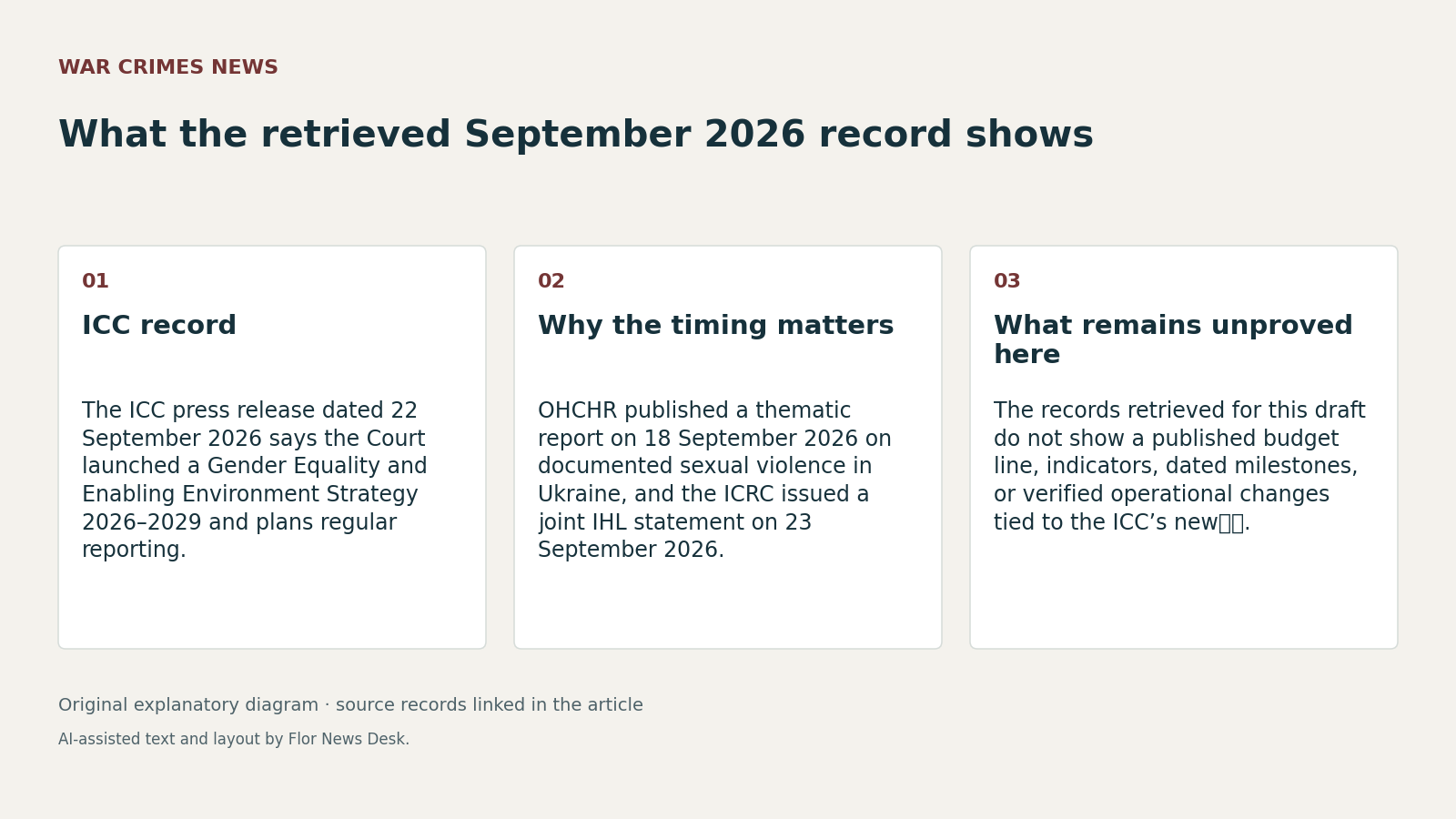

On 22 September 2026, the International Criminal Court published a press release saying it had launched a Gender Equality and Enabling Environment Strategy 2026–2029. The Court’s news index lists that item on the same date. On the record retrieved here, that establishes publication and the Court’s stated aims. It does not, by itself, establish implemented reform.
The ICC press release says the strategy is the next phase of the Court’s work on gender equality and workplace culture. According to the Court, it builds on the “Gender Equality and Workplace Culture Strategy 2023-2025,” expands the focus beyond workplace culture to wider conditions affecting how personnel contribute to the institution’s work, applies across all organs and personnel, and takes an intersectional approach. The Court also says regular reporting on implementation will follow. Those are institutional commitments described by the ICC itself in a press notice, not measured results.
A key limit is that the underlying strategy document was not among the records retrieved for this draft. That matters. Without the full text, this article can assess only what the press release and index say, and what those records omit.
What they omit is notable. As of 30 September 2026, the retrieved public record here does not show a published budget line for the strategy, named indicators, baseline data, a dated implementation timetable inside the 2026–2029 period, or evidence of completed changes to staffing rules or operational practice. It also does not show, on these records, any direct link from the strategy to prosecutorial guidance, case selection, cooperation requests, witness protection or victim-support procedures. That is a limit of the retrieved record, not proof that no such material exists elsewhere.
The timing still makes the announcement relevant. On 18 September 2026, the Office of the United Nations High Commissioner for Human Rights published a thematic report on sexual violence in the context of the Russian Federation’s full-scale armed attack against Ukraine. OHCHR said the report covered 24 February 2022 through 31 July 2026 and documented 1,004 cases. OHCHR also stressed that those findings were representative rather than comprehensive because sexual violence is underreported. OHCHR said the patterns it observed indicated use of sexual violence as a method of torture and other cruel, inhuman or degrading treatment or punishment.
Then, on 23 September 2026, the day after the ICC announcement, the International Committee of the Red Cross published a joint statement on the Global Initiative to galvanize political commitment to international humanitarian law. The statement said 118 states had joined the initiative, 27 states had co-led seven thematic workstreams, and Jordan would host a High-Level Conference to Uphold Humanity in War on 7 December 2026. It also said states bear the primary responsibility for upholding, implementing and applying the Geneva Conventions.
Taken together, those records support a narrow accountability point. In late September 2026, external bodies were publicly documenting conflict-related sexual violence and pressing states on the protection of civilians, while the ICC was publicly announcing an internal equality strategy. That makes the ICC move relevant to institutional credibility. But on the records retrieved here, the strategy’s practical effects remain unproved.
The careful conclusion is limited. The ICC has publicly launched a court-wide internal strategy and described its scope in broad terms. What is not yet established by the retrieved public record is whether the strategy has dedicated resources, measurable benchmarks, or any verified effect on how the Court investigates, prosecutes or supports affected participants.