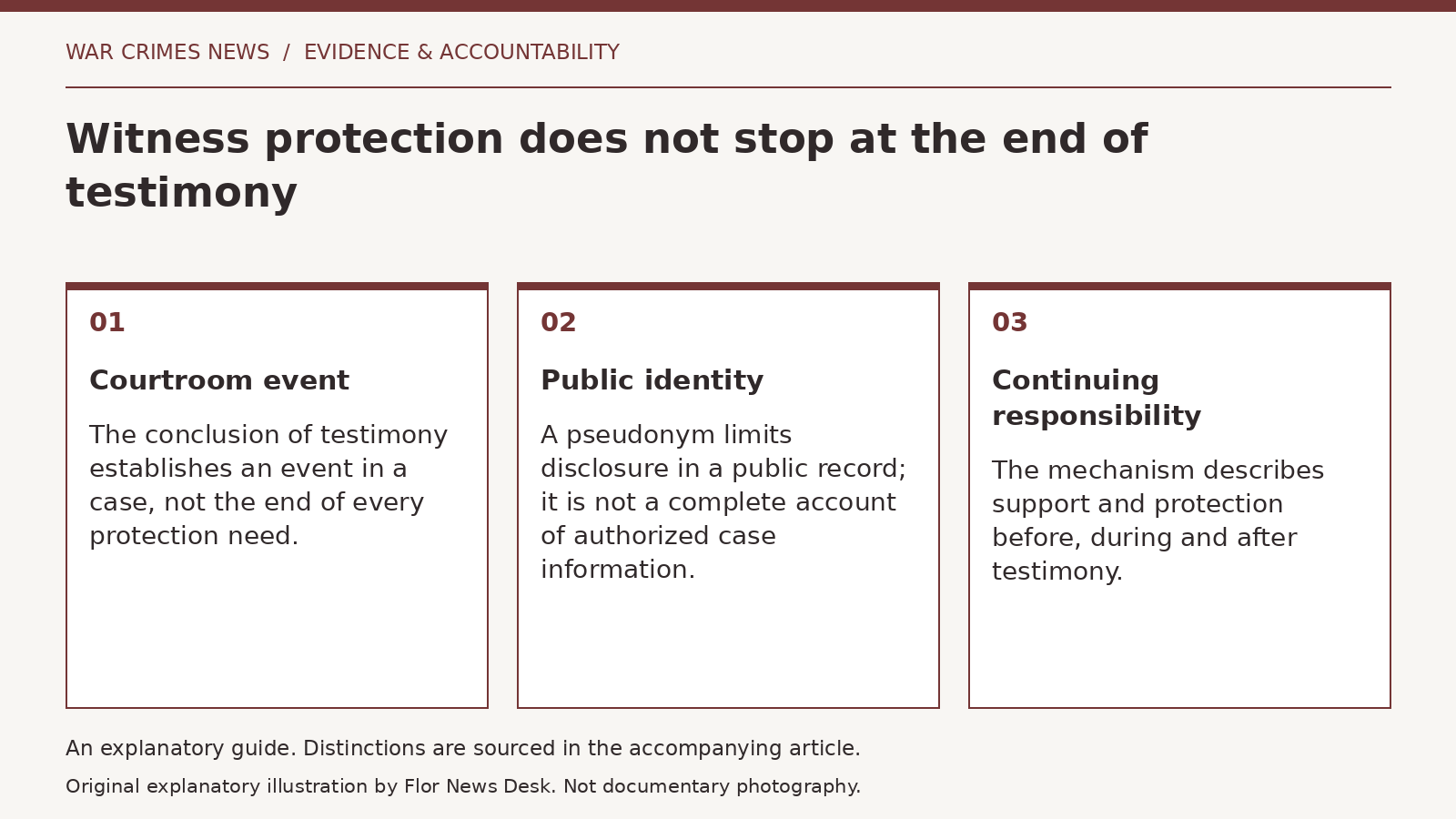
The International Residual Mechanism for Criminal Tribunals describes witness support and protection as responsibilities extending before, during and after testimony. Its explanation of the function includes measures affecting public disclosure and continuing assistance through its witness-support units. A witness finishing an appearance does not, by itself, establish that the need for protection has ended.
The distinction is between an event in a courtroom and an ongoing responsibility concerning a person. A case timeline may record when testimony concluded. It cannot alone describe every subsequent risk or the status of a particular protection measure.
Public visibility is not the complete record
Consider a fictional public transcript using a pseudonym. The pseudonym tells the reader how the witness is identified in that public record. It does not show that nobody within the authorized process knows the person’s identity, or that the person has no continuing relationship with support services.
Trying to infer or expose the identity from surrounding details would defeat the purpose of withholding it. Nothing in this article identifies a protected witness or supplies a method for circumventing a protective measure.
The mechanism’s historical exhibition on witness support traces the development of services associated with the Rwanda and former Yugoslavia tribunals. That history supplies institutional context. It is not a current case file or evidence of the arrangements in place for an individual today.
A completed case and a continuing function
In a hypothetical closed case, the judgment’s finality could be clear while the circumstances affecting a witness continued to change. Those observations would not contradict one another. They concern different subjects and would require different records to assess.
A public account can explain the existence of a support function without disclosing the operational details that could put people at risk. Transparency about responsibility does not require publication of every personal or protective detail.
The two institutional sources describe a function and its history, not a new protection order issued in September 2026. The reporting lesson is to avoid using the end of testimony as an assumed end date for protection. A person’s continuing circumstances cannot be inferred solely from the last public event in the case in which they appeared.