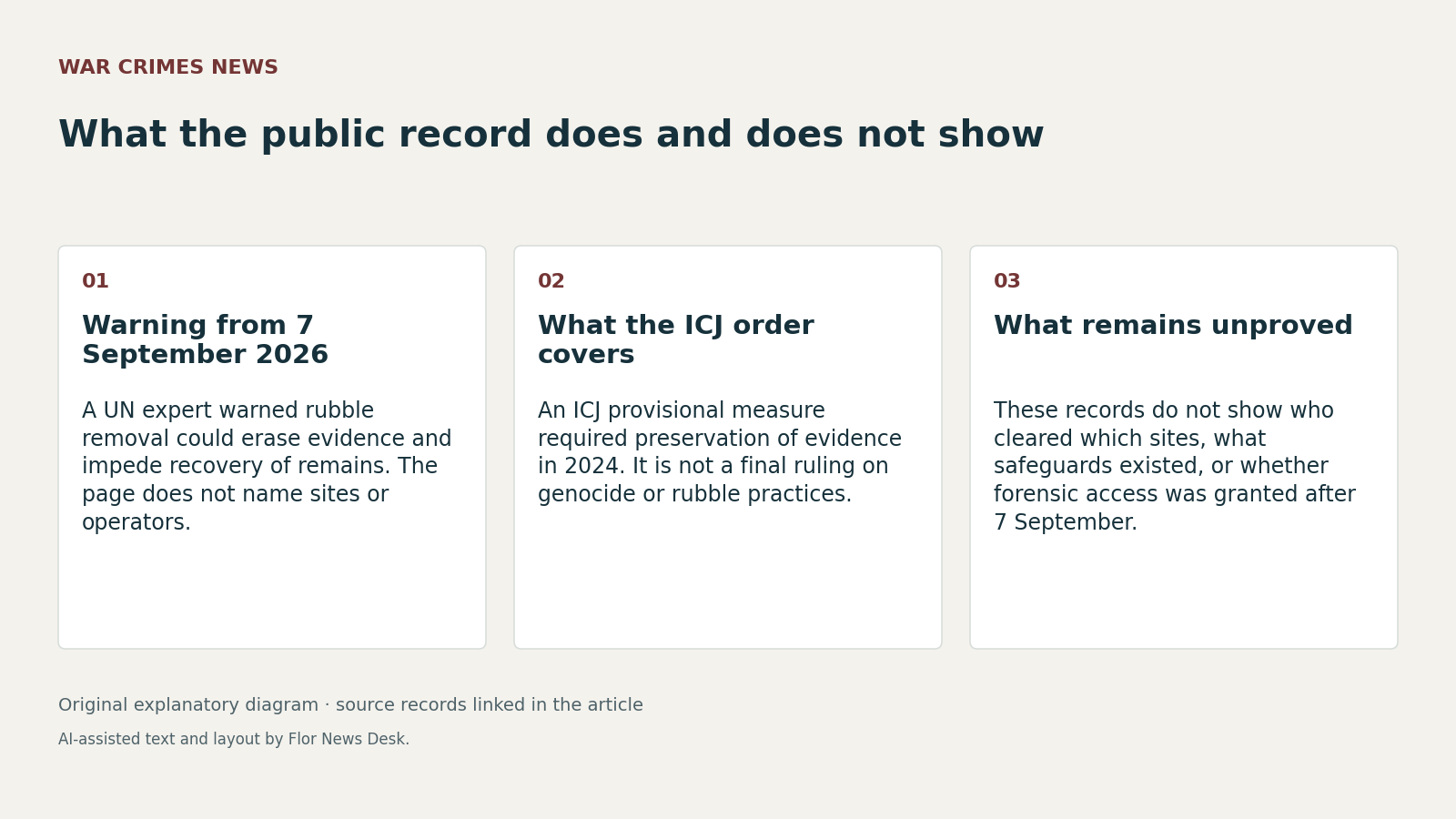
On 7 September 2026, Francesca Albanese, the UN Special Rapporteur on the situation of human rights in the Palestinian territory occupied since 1967, warned that rubble removal, crushing and relocation in Gaza under Israeli military control could destroy evidence relevant to alleged international crimes and obstruct the recovery and identification of human remains. The same release attributed to Palestinian authorities an estimate that more than 10,000 people remained buried under debris, and said nearly 70 percent of Gaza was under access restrictions and varying degrees of Israeli military control at that time (UN/OHCHR release via UNISPAL).
That matters because it shifts the accountability question. Public debate often asks what happened during attacks; this warning asks what may happen after destruction, when debris is moved before independent forensic work can assess a site. According to the 7 September release, Albanese said she had received credible information from multiple sources in August 2026 about deliberate and widespread rubble removal, crushing and transport, and that Israeli sources had confirmed discussions with Israeli companies about demolition, removal and recycling (UN/OHCHR release via UNISPAL). But the same public record does not identify the sources, contractors, locations, volumes removed, or any chain-of-custody safeguards. It also describes operations as ongoing on 7 September 2026, not as a verified status on 19 October 2026.
The legal backdrop is older and narrower than the warning. In its 24 May 2024 order in South Africa v. Israel, the International Court of Justice reproduced the 26 January 2024 provisional measure requiring Israel to take effective steps to prevent destruction and ensure preservation of evidence related to allegations under the Genocide Convention. The same order records that South Africa sought additional access for UN officials, fact-finding missions, investigators and journalists, and that Israel asked the Court to reject that request (ICJ order of 24 May 2024). That is a real legal frame for preservation. It is not, on this record, a court-approved protocol for rubble handling, site access, or forensic custody in Gaza.
A second September 2026 UN record underscores the setting but not the missing operational details. On 24 September 2026, UN High Commissioner for Human Rights Volker Türk said OHCHR had monitored, documented and reported on the human rights situation in the Occupied Palestinian Territory for 30 years, and said Israeli forces were deployed in 70 percent of Gaza (Türk remarks at UNGA ministerial meeting). He also called for support for civil society groups working on accountability, justice and reconciliation. Those remarks reinforce that documentation remains central. They do not establish whether any rubble-clearing operation had forensic safeguards, or whether independent experts were granted access to affected sites.
The strongest inference available from these records is limited but important. First, UN officials and mandate holders had already documented and reported large-scale violations in Gaza by 2026. Second, Albanese's 7 September warning identifies debris management itself as a possible threat to future proof, not merely a humanitarian or engineering issue. Third, the ICJ's preservation language means evidence protection is not a rhetorical add-on; it already sits inside an international legal proceeding (UN/OHCHR release via UNISPAL; ICJ order of 24 May 2024).
What the present record cannot establish is equally important. It does not show who cleared which sites, on what written authority, with what procedures for remains or physical traces, or whether independent forensic teams requested and received access after 7 September 2026. So the September warning is best read as an evidentiary alarm grounded in a UN expert's account, not as proof that evidence was in fact destroyed or that any court has already found responsibility for rubble-clearing practices (UN/OHCHR release via UNISPAL; Türk remarks at UNGA ministerial meeting; ICJ order of 24 May 2024).