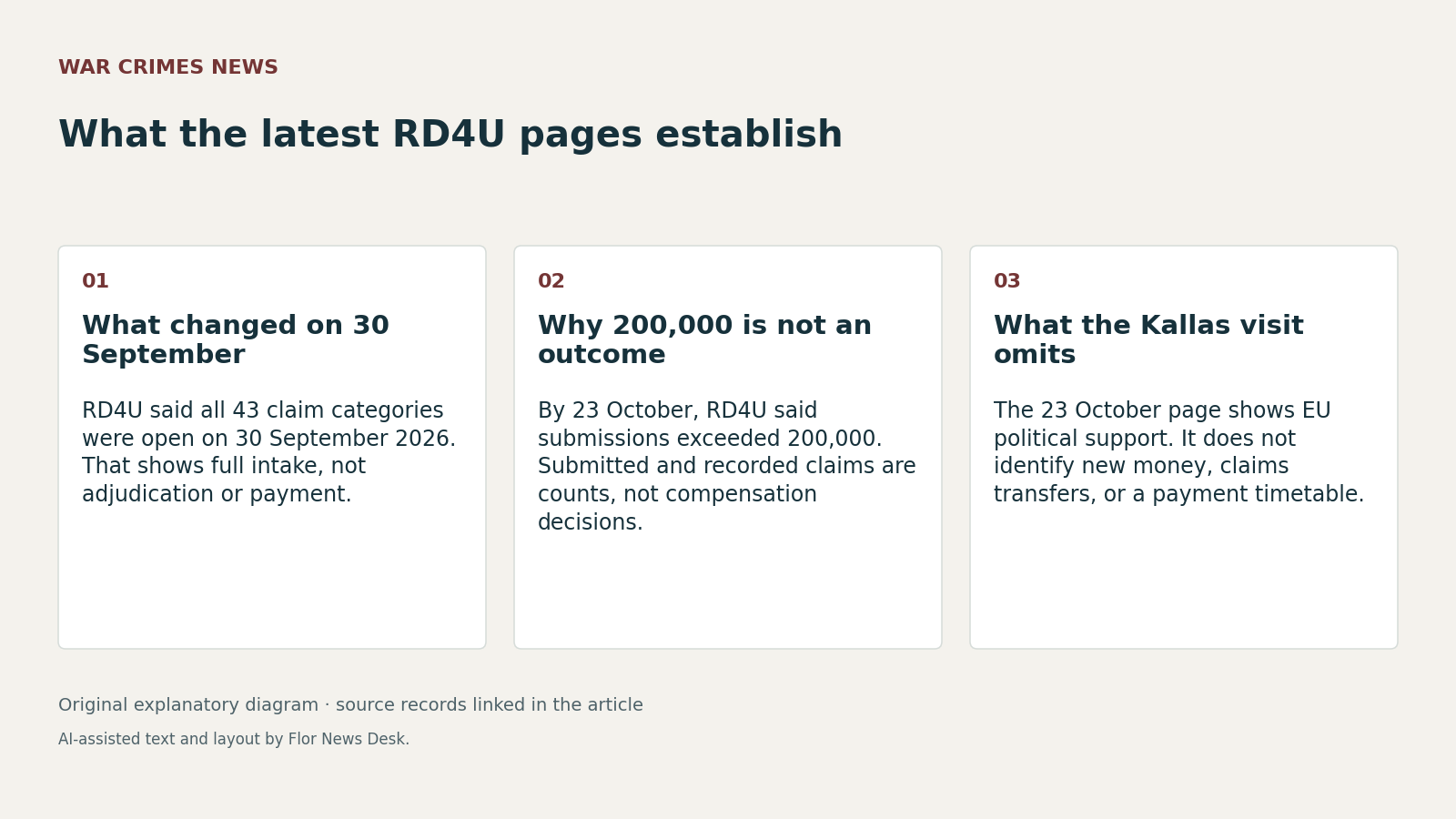

EU High Representative Kaja Kallas’s visit to the Register of Damage for Ukraine in The Hague on 23 October 2026 matters less for any proved institutional breakthrough than for what it clarifies about the register’s current stage. Read with RD4U’s 30 September 2026 announcement that all 43 claim categories are open, the public record now supports a narrower conclusion: the register has moved from phased rollout to full submission intake and has senior EU political visibility. The same pages do not show new funding, a transfer of claims to a functioning International Claims Commission for Ukraine, or any compensation award or payment timetable RD4U visit account RD4U all-categories announcement.
The operational step on 30 September is specific. RD4U said the staged launch of its submission system began on 2 April 2024 and reached full category coverage when the last three categories opened on 30 September 2026: B1.6 Other losses of property, B3.1 Environmental damage, and B3.2 Pillaging and/or appropriation of natural resources. RD4U also said the 43 categories are divided into 21 for individuals, 11 for legal entities, and 11 for the State of Ukraine RD4U all-categories announcement. That establishes scope. It means the question is no longer whether an intake window exists for a listed claimant group.
The same 30 September page reported 195,000 claims received and more than 65,000 recorded, with the remainder still under processing RD4U all-categories announcement. Those numbers show volume and processing stages, but not a success rate. A recorded claim is not, on this record, a finding on liability, an assessment of value, or a payment order. RD4U described the opening of all categories as a prerequisite for later transfer of claims to a future International Claims Commission for Ukraine RD4U all-categories announcement. As of 26 October 2026, that wording remains prospective in the cited page; it does not establish that any transfer has begun or that the commission is already operating.
The 23 October page adds a later tally and a political signal, not a demonstrated legal or financial outcome. RD4U said Kallas visited its headquarters, met Executive Director Markiyan Kliuchkovskyi and secretariat staff, and that more than 200,000 claims had been submitted by that date RD4U visit account. Because that figure is later than the 30 September count, it should be read only as a newer snapshot, not as a same-date revision. The page also says the European Union has supported RD4U since May 2023, including voluntary support for setup and systems and annual operating-budget contributions, and that the EU signed the Convention establishing an International Claims Commission for Ukraine in December 2025 and ratified it in May 2026 RD4U visit account. What the page does not identify is equally important: no new funding amount, no decision taken at the visit, and no schedule for compensation.
RD4U’s news index helps place those records in sequence. It lists the 30 September all-categories item and the 23 October Kallas visit among the newest entries shown, and it also lists earlier category-opening notices dated 8 September 2026 for individuals and 10 September 2026 for legal entities RD4U news index. That chronology supports treating late September as the endpoint of a phased opening process. The index, however, is only a pointer to titles, dates and locations; it does not itself prove totals, funding or legal effect.
For accountability reporting, the present gap is not whether RD4U exists or accepts claims. The gap is what happens after intake. On the public pages cited here, readers still cannot see documents showing how recorded claims would be transferred, how any compensation mechanism would be financed, or when a claimant could expect adjudication or payment. The immediate analytical point is restrained but useful: by 26 October 2026, the register’s front end is publicly much clearer than its back end.