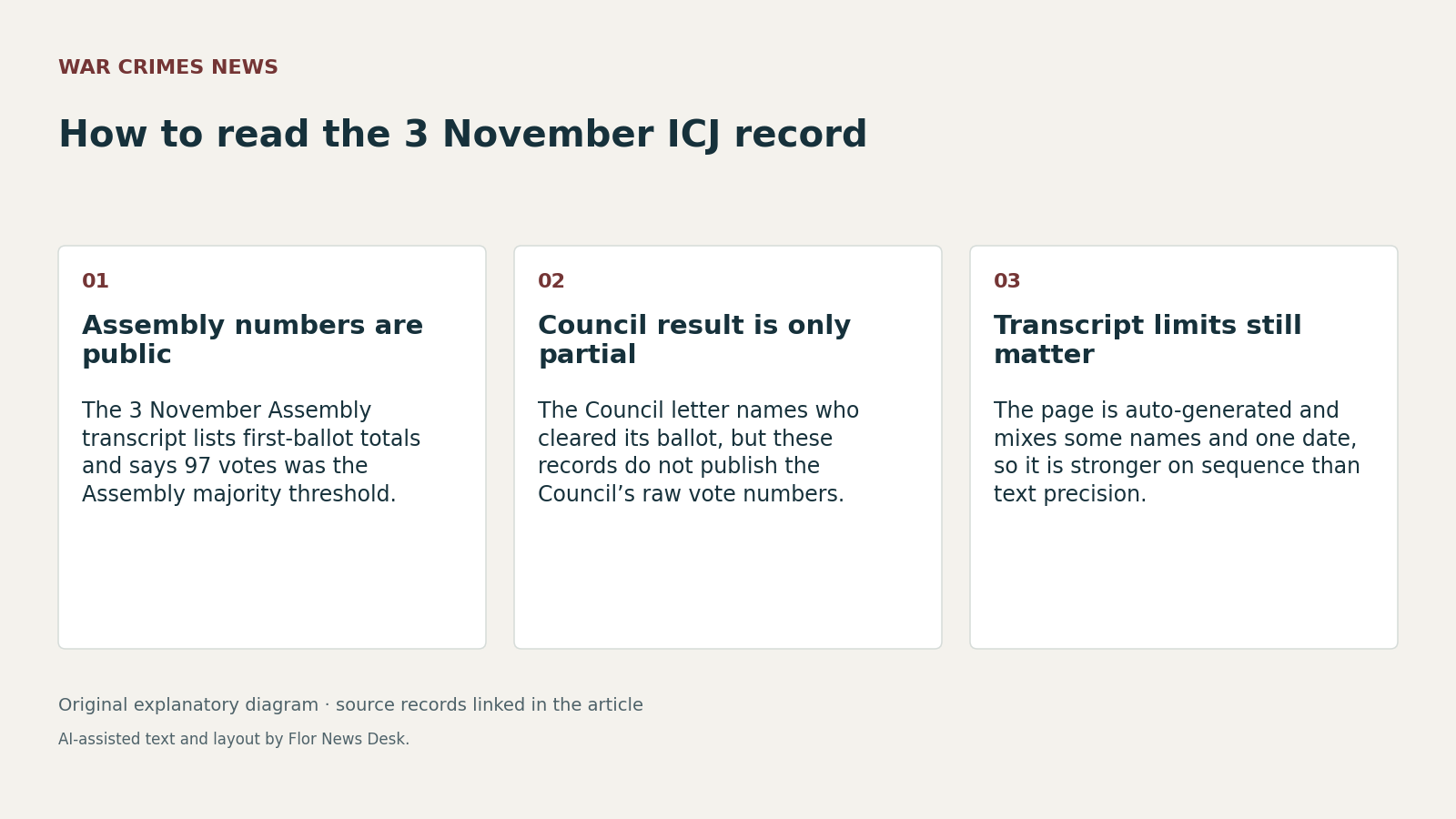
The clearest public record in this source set for the International Court of Justice election held on 3 November 2026 is the General Assembly plenary transcript from that day. It says the Assembly opened voting for five nine-year ICJ terms beginning on 6 February 2027, and that an absolute majority in the Assembly was 97 because all 193 Member States counted as electors. In the first Assembly ballot, with 191 valid ballots cast, the transcript lists 151 votes for Reina Lee of Singapore, 146 for François Alabrun of France, 129 for Dapo Akande of the United Kingdom, 117 for Phoebe N. Okoa of Kenya and 106 for Mahmoud Daifallah Hamoud of Jordan. General Assembly 35th and 36th plenary meeting
The same meeting record then adds the Security Council’s side of the process, but only partially. According to a letter read out by the Assembly President and attributed to the President of the Security Council, the Council had recorded absolute majorities for Akande Dapo, François Alabrun, Mohammed Daifallah Ahmad, Rena Lee and Marcelo Vázquez Bermúdez at its 10261st meeting on 3 November 2026. After comparing the two organs’ results, the Assembly announced four candidates as elected in both bodies: Dapo Akande, François Alabrun, Mahmoud Daifullah Ahmad and Rina Lee. That comparison matters more than the spelling differences, because the Assembly itself treated those names as the same successful candidacies across the two ballots. General Assembly 35th and 36th plenary meeting
The fifth seat was filled later in the same meeting. The transcript says Sierra Leone, Ecuador and the Republic of Korea withdrew candidates before a final Assembly ballot in which Phoebe N. Okoa received 183 votes out of 191 valid ballots. A second Security Council letter was then read into the Assembly record saying she had obtained an absolute majority in the Council, and the Assembly declared her elected. But that same readout reportedly referred to “3 September 2026” even though the surrounding meeting record is for 3 November 2026, leaving the source record unable on its own to resolve whether that was a speaking mistake or a transcription problem. General Assembly 35th and 36th plenary meeting
What do these records show about the election method? A historical General Assembly elections archive, from a 2010 ICJ election, says the Assembly vote was run independently of, but concurrently with, the Security Council. The 3 November 2026 transcript shows that sequence in practice: the Assembly did not declare candidates elected on the strength of its own totals alone, but after receiving Council letters and identifying overlaps. That is enough to explain the dual-track mechanics in this article. It is not enough to supply the current governing text, and the source set does not publish the Council’s raw vote counts for 3 November 2026. UN General Assembly - Elections & Appointments General Assembly 35th and 36th plenary meeting
The date itself is also documented elsewhere in the UN record. At the Sixth Committee’s opening meeting on 5 October 2026, the chair said the programme of work had been changed because the ICJ election had been moved to Tuesday, 3 November 2026, and that meetings scheduled for that date were rescheduled. That procedural record does not give results, but it supports the election’s timing and shows the ballot was significant enough to alter the legal committee’s calendar. Sixth Committee, 1st plenary meeting
What these documents do not show is just as important. The 29 October 2026 plenary discussion on the ICJ report described a court with 24 contentious cases as of 31 July 2026, one new case filed on 26 June 2026 and rules amendments due to enter into force on 1 February 2027. That gives context for why bench composition matters. It does not establish how newly elected judges will be assigned in future proceedings or how they will vote in any interstate or advisory case. And because the 3 November page is an automatically generated transcript rather than an official record, with inconsistent renderings such as Reina, Rena and Rina Lee, it is strongest as evidence of sequence and Assembly tallies, not as a final text cleanup of every name. General Assembly: 29th plenary meeting General Assembly 35th and 36th plenary meeting