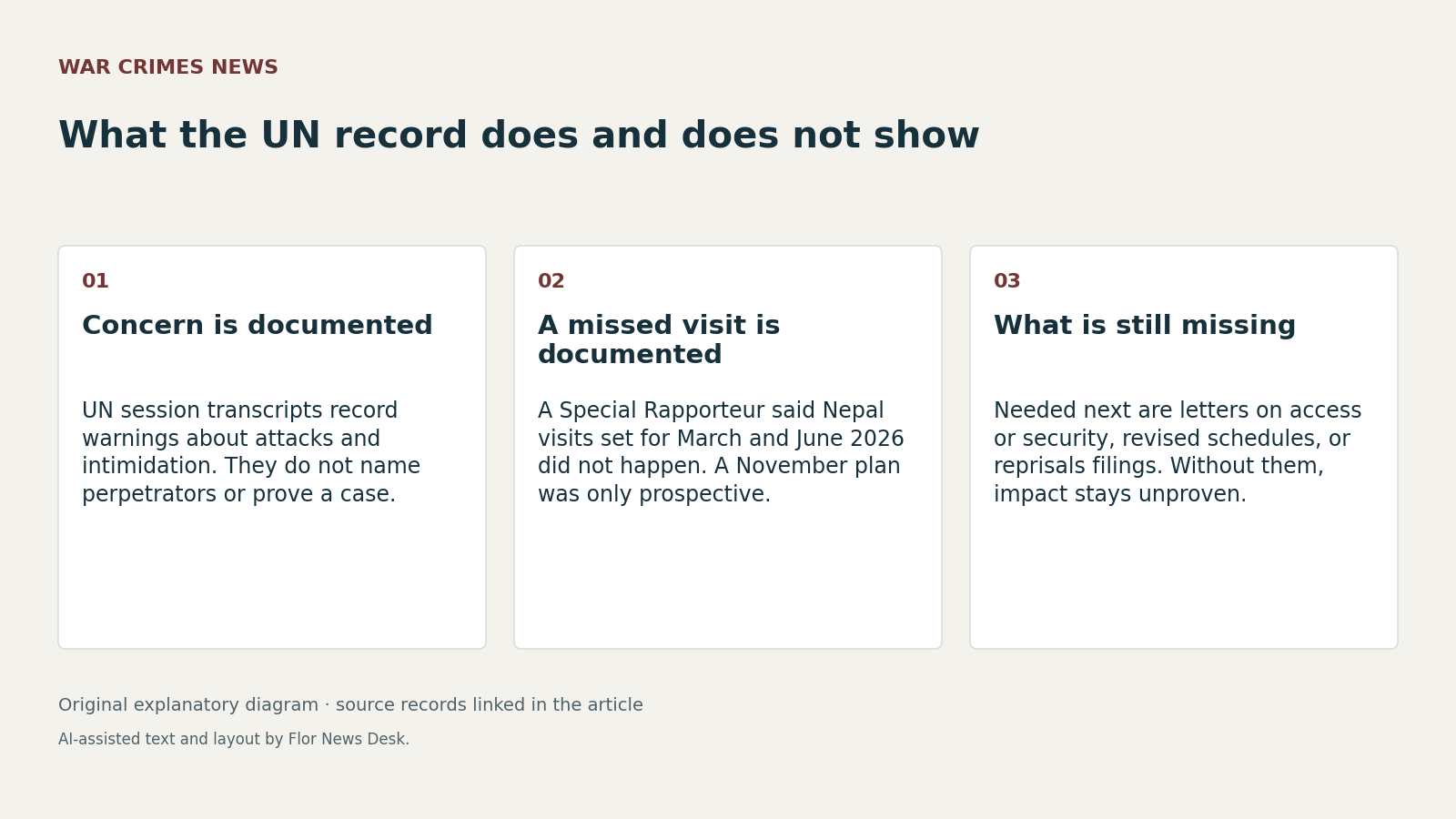
Public UN records reviewed for this analysis show real institutional alarm about pressure on Special Procedures mandate holders, but not a proven retaliation case. At the Human Rights Council’s 63rd session, the Council president and several state groupings warned about personal attacks, intimidation and reprisals directed at mandate holders in the Council’s Special Procedures system, while some states later stressed compliance with the code of conduct in resolution 5/2 (1st meeting transcript, 26th meeting transcript). What the retrieved record does not supply is the part accountability readers usually need first: named incidents, attributed perpetrators, and documented enforcement steps in response to those warnings.
In opening remarks, the Council president said disagreement with mandate holders was permissible, but insults, personal attacks, threats and efforts to undermine their independence were not. He also referred to protection against intimidation or reprisals involving cooperation with UN human rights bodies, including during Council sessions, Universal Periodic Review processes, Special Procedures visits and the sending of information to mandate holders (1st meeting transcript). That matters because it places the concern at the point where experts receive material and conduct field activity, not only at the level of public rhetoric.
The concern was repeated later in debate. Uruguay, speaking for 15 countries in the Group of Friends of Special Procedures, said mandate holders faced personal attacks, intimidation, threats, disinformation and other pressure, and warned that these could affect their security and sometimes their families. Iraq, for the Arab Group, rejected intimidation and reprisal, and the European Union stressed the need to respect mandate independence (26th meeting transcript). Those are politically important statements. They are not findings of fact about any particular episode.
The limitation is built into the documents themselves. The transcript pages say they were produced by automatic speech recognition and are not official UN records (1st meeting transcript, 13th meeting transcript, 26th meeting transcript). None of the retrieved passages identifies which mandate holders were attacked, where an incident occurred, whether a state or private actor was blamed, or whether any complaint led to an investigation, sanction or criminal case. So the public record here establishes institutional concern, not adjudicated responsibility.
The clearest operational consequence in the retrieved material is scheduling failure. Bernard Duhaime, the Special Rapporteur on the promotion of truth, justice, reparation and guarantees of non-repetition, told the Council that he had been unable to carry out a planned Nepal visit on dates in March and June 2026, and said he remained committed to going in November 2026. Nepal told the Council the visit had not materialized because of unforeseen circumstances and said it hoped to receive him soon (13th meeting transcript). As of 2026-11-09, that passage remains only a forward-looking plan; it does not show whether a November visit happened.
That does not prove intimidation caused the Nepal delay. The sources do not say that. But read together, the transcripts support a narrower analytical point: the UN system itself is warning that pressure can arise during Special Procedures visits and during the submission of information to mandate holders, while separately recording that at least one country visit did not occur on its scheduled dates (1st meeting transcript, 13th meeting transcript). For accountability work, that is enough to justify scrutiny of access, timing and documentation, even if causation remains unproven.
To move beyond that limited inference, later reporting would need records this public set does not contain: formal correspondence about access or security, revised visit schedules, or complaints pursued through the Special Procedures system. Without those materials, readers can say the Council heard warnings and at least one visit slipped. They cannot yet say who was responsible, whether reprisals were formally established, or what concrete evidence-gathering was lost.