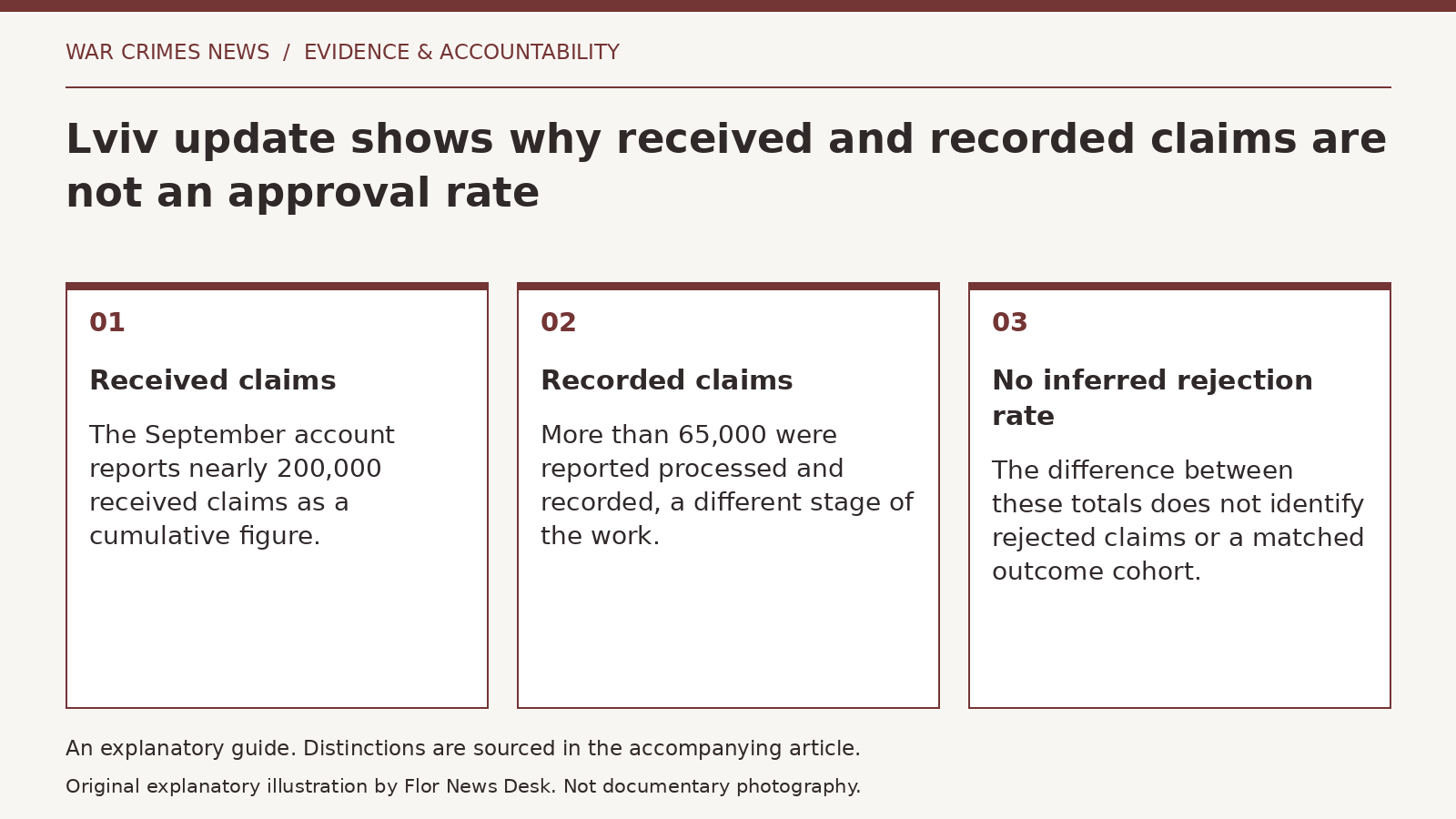
The Register of Damage for Ukraine reported close to 200,000 received claims and more than 65,000 processed and recorded claims in its September account of a visit to Lviv. The visit report, covering September 12–15, also describes ten board decisions recording 7,672 claims. These figures describe different stages and reporting scopes.
Subtracting the recorded total from the received total would not establish the number rejected. The report does not identify the remainder as rejected, and a processing pipeline can contain claims at stages other than a final outcome. Nor do the two rounded cumulative totals identify a common cohort with identical observation periods.
The denominator changes the question
Consider a fictional office that receives applications throughout a month while deciding older submissions. Dividing that month’s decisions by that month’s incoming applications would combine different groups. The resulting ratio could be calculated correctly while answering none of the questions a reader intended to ask about individual outcomes.
To describe a cohort’s outcome rate, the record would need to identify the cohort, its relevant decisions and the observation date. To describe workload, incoming and completed activity might both be useful, but would need to retain those labels.
The register’s submission page provides category-specific routes to forms, rules and information, with digital submission through Diia. A category being open establishes availability of a submission route. It does not show that every submitted claim in that category has reached the same stage.
Outreach is another kind of activity
The Lviv account also describes meetings intended to strengthen local awareness and assistance. Attendance at an information event, receipt of a claim and a board decision are not interchangeable measures. Each documents a different interaction with the process.
In the fictional office, helping someone understand a form could be useful even before they submit it. Counting that assistance as a decided application would nevertheless overstate what occurred.
The September numbers are informative when their processing labels remain attached. They should not become an invented rejection total, an individualized prediction or a payment figure. The record supports an account of submissions, recorded claims and outreach; it does not collapse those activities into one measure of success.