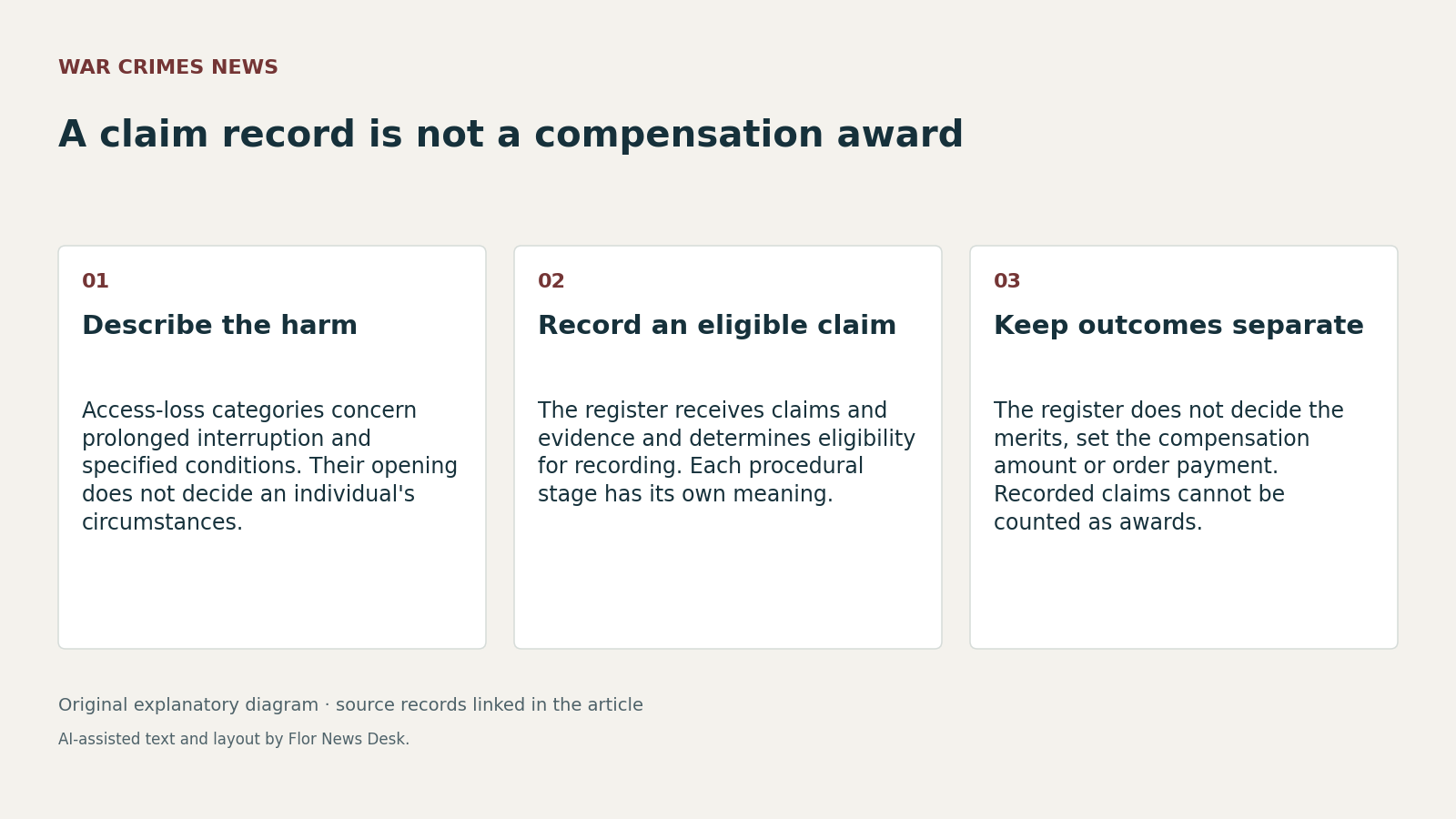
The Register of Damage for Ukraine opened four further categories for individual claims on September 8, including prolonged loss of access to healthcare and education. Its announcement said this completed the launch of its categories for individuals. The development broadens the kinds of harm that the register can receive in a claim. It does not, by itself, show that a particular claim has been accepted or that compensation has been awarded.
The two access categories have specific boundaries. The healthcare category addresses sustained loss of necessary care where deterioration is serious, rapid or irreversible and leads to intense suffering or markedly reduced life expectancy. Education claims concern being unable to study for a sustained period. Those descriptions should not be reduced to any missed appointment or interrupted lesson. The category announcement is a description of the register’s scope, rather than a finding about an individual’s circumstances.
An important analytical distinction follows: the condition of a building and a person’s access to a service answer different questions. A photograph of damage might show something about the building. It does not, on its own, identify every person affected, the duration of an interruption or the consequences for each person. Equally, an image showing an intact building would not establish that everyone could reach it or use the service. These are limits on what can be inferred from that kind of evidence, not findings about an actual hospital, school or claimant.
The register’s mandate description gives a separate boundary for its institutional role. It receives claims and supporting material, organises them and determines whether claims qualify for recording. The register does not determine a claim’s merits, set its monetary value or instruct a payment. Recording and deciding compensation are therefore distinct functions.
That distinction changes how progress figures should be read. A hypothetical report stating that a number of claims had been recorded would establish a different fact from a report identifying compensation decisions. The first figure could not be relabelled as money paid, successful cases or judicial findings. This example illustrates the difference between institutional stages; it supplies no actual claim total or prediction about the speed or outcome of an individual case.
There is also a difference between an expanded route for documenting harm and evidence of how that route works in practice. A category’s opening establishes availability within the announced framework. Assessing its use would require further records: what was submitted, what was recorded and what reasons accompanied the relevant decisions. Neither of the two institutional pages provides a case-by-case account of that process.
The significance of the September announcement is consequently precise. It makes access to essential services an explicit subject of these individual claim categories, alongside other forms of harm. Reading that change accurately means keeping the person’s alleged loss, the evidence offered and the register’s procedural action separate. None of those can stand in automatically for a compensation award.