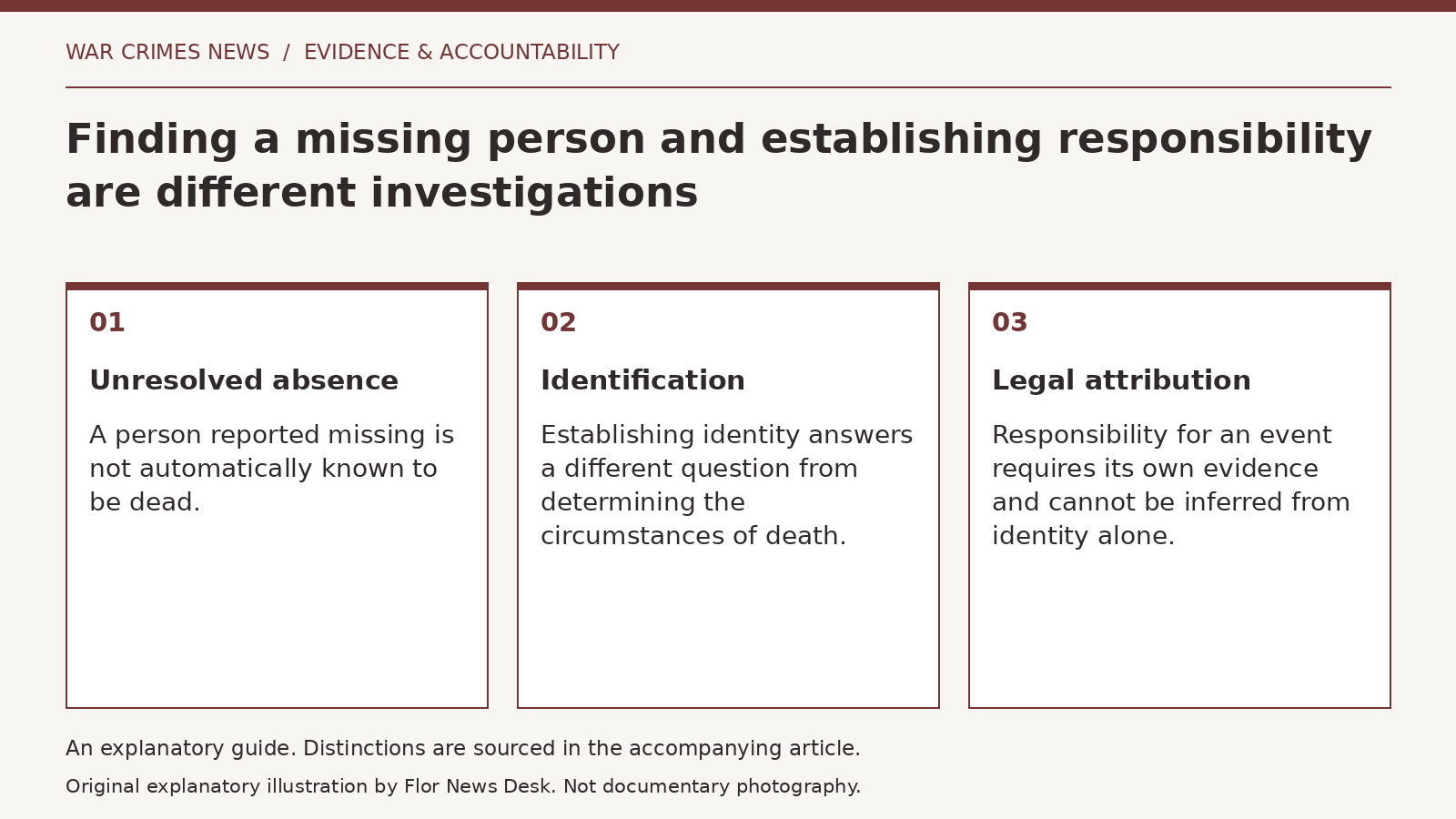
Families seeking a missing relative need information about what happened to that person. The ICRC’s missing-persons explanation describes obligations to clarify fate and whereabouts and the importance of providing answers to families. Missing is not a synonym for dead, and an unresolved absence does not by itself establish one particular cause.
That starting distinction affects how information should be reported. A person could be separated from family while their circumstances remain unknown. Describing the absence as a confirmed death or assigning criminal responsibility without evidence would go beyond what the unresolved record establishes.
Identity and cause answer different questions
Consider a fictional investigation that establishes the identity of human remains. That conclusion would answer who the deceased person was. It would not automatically answer when or how the person died, or who, if anyone, was criminally responsible. Those propositions need evidence appropriate to each question.
The ICRC’s humanitarian-forensics overview describes work concerning dignified treatment and identification of the deceased, cooperation with authorities and support for families. It explains a humanitarian function; it does not turn every identification into a criminal judgment.
Conversely, a judicial finding concerning an event might leave some families without an individual identification. The existence of a court decision and the completeness of a person-specific answer would then be separate matters. This is an analytical possibility, not a description of a particular case.
Keep uncertainty specific
In the fictional record, uncertainty about one element should not be allowed to erase information reliably established about another. Nor should certainty about identity be extended to unsupported claims about responsibility. Stating what is known and what remains unresolved is more precise than calling the entire case either solved or unknown.
Privacy is also distinct from evidentiary value. A public news account does not need to reproduce a family’s contact information or sensitive personal records to explain the institutional work. This article includes no such material and provides no instructions for handling remains or conducting an identification.
The two ICRC pages describe related humanitarian responsibilities, not findings about an individual disappearance. The reporting task is to retain the boundaries between locating a person, identifying the deceased, explaining circumstances and establishing legal responsibility. Families’ need for answers should not be met with conclusions the available evidence cannot support.